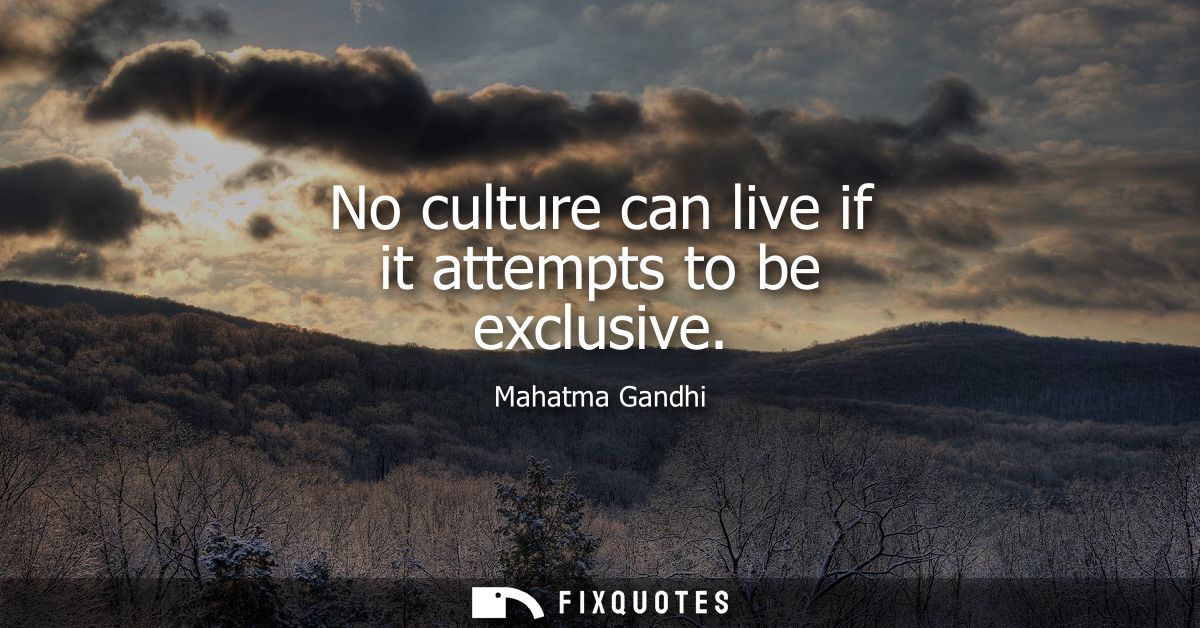
"No culture can live if it attempts to be exclusive"
About this Quote
A culture that walls itself off doesn’t just keep others out; it slowly starves itself of oxygen. Gandhi’s line carries the moral gravity of a leader who watched an empire weaponize difference and then saw a nation-in-waiting risk mirroring that same logic. “Exclusive” here isn’t a gentle critique of snobbery. It’s an indictment of any identity project built on purity: caste hierarchy, communal nationalism, colonial segregation, even the respectable idea that a people can be “protected” by sealing borders around language, religion, or custom.
The intent is strategic as much as ethical. Gandhi is arguing that cultural survival depends on exchange, friction, and hospitality - not as charity, but as self-preservation. His word choice matters: “live” implies a biological test. A culture isn’t a museum artifact to be preserved under glass; it’s a living system that needs contact with what it is not. Exclusivity produces brittleness: fewer ideas, fewer alliances, fewer ways to adapt when history changes the weather.
The subtext lands as a warning to his own side. Anti-colonial pride can curdle into defensive chauvinism; reform can be rejected as betrayal. Gandhi counters that reflex by redefining strength: not the ability to exclude, but the confidence to remain porous without disappearing. Read in context of Partition-era tensions and entrenched caste divisions, the sentence becomes a quiet rebuke: a nation can win independence and still lose its soul if it narrows who counts as “us.”
The intent is strategic as much as ethical. Gandhi is arguing that cultural survival depends on exchange, friction, and hospitality - not as charity, but as self-preservation. His word choice matters: “live” implies a biological test. A culture isn’t a museum artifact to be preserved under glass; it’s a living system that needs contact with what it is not. Exclusivity produces brittleness: fewer ideas, fewer alliances, fewer ways to adapt when history changes the weather.
The subtext lands as a warning to his own side. Anti-colonial pride can curdle into defensive chauvinism; reform can be rejected as betrayal. Gandhi counters that reflex by redefining strength: not the ability to exclude, but the confidence to remain porous without disappearing. Read in context of Partition-era tensions and entrenched caste divisions, the sentence becomes a quiet rebuke: a nation can win independence and still lose its soul if it narrows who counts as “us.”
Quote Details
| Topic | Equality |
|---|---|
| Source | Help us find the source |
| Cite | Cite this Quote |
Citation Formats
APA Style (7th ed.)
Gandhi, Mahatma. (n.d.). No culture can live if it attempts to be exclusive. FixQuotes. https://fixquotes.com/quotes/no-culture-can-live-if-it-attempts-to-be-exclusive-41633/
Chicago Style
Gandhi, Mahatma. "No culture can live if it attempts to be exclusive." FixQuotes. Accessed February 3, 2026. https://fixquotes.com/quotes/no-culture-can-live-if-it-attempts-to-be-exclusive-41633/.
MLA Style (9th ed.)
"No culture can live if it attempts to be exclusive." FixQuotes, https://fixquotes.com/quotes/no-culture-can-live-if-it-attempts-to-be-exclusive-41633/. Accessed 3 Feb. 2026.
More Quotes by Mahatma
Add to List