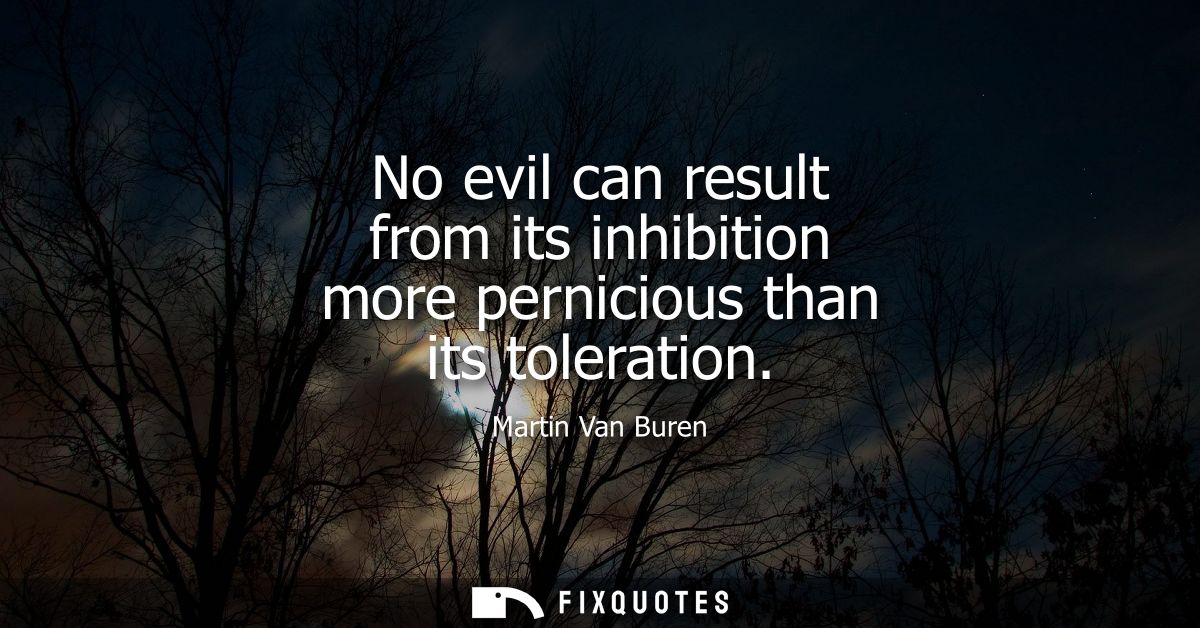
"No evil can result from its inhibition more pernicious than its toleration"
About this Quote
The intent is defensive and preemptive. By claiming “no evil can result” from inhibition that’s worse than toleration, he isn’t weighing evidence so much as foreclosing debate. The sentence is engineered to make coercion feel like the moderate option. “Inhibition” reads almost clinical, a mild technical fix, while “toleration” is framed as a moral failure that metastasizes. The subtext is political triage: if you’re worried about backlash, civil unrest, or sectional fracture, accept suppression now because the alternative will be catastrophic later.
Context matters because Van Buren governed at the edge of national rupture. In the era’s most combustible disputes - especially slavery and abolitionist agitation - leaders routinely treated speech and organizing as accelerants. This kind of phrasing fits a governing style that prized stability and party discipline over moral confrontation. It’s also a prototype of a recurring American argument: liberties are negotiable when the state decides permissiveness is the greater threat. The elegance of the line is that it makes that bargain sound not just necessary, but hygienic.
Quote Details
| Topic | Ethics & Morality |
|---|---|
| Source | Help us find the source |
| Cite |
Citation Formats
APA Style (7th ed.)
Buren, Martin Van. (2026, January 14). No evil can result from its inhibition more pernicious than its toleration. FixQuotes. https://fixquotes.com/quotes/no-evil-can-result-from-its-inhibition-more-93399/
Chicago Style
Buren, Martin Van. "No evil can result from its inhibition more pernicious than its toleration." FixQuotes. January 14, 2026. https://fixquotes.com/quotes/no-evil-can-result-from-its-inhibition-more-93399/.
MLA Style (9th ed.)
"No evil can result from its inhibition more pernicious than its toleration." FixQuotes, 14 Jan. 2026, https://fixquotes.com/quotes/no-evil-can-result-from-its-inhibition-more-93399/. Accessed 12 Feb. 2026.