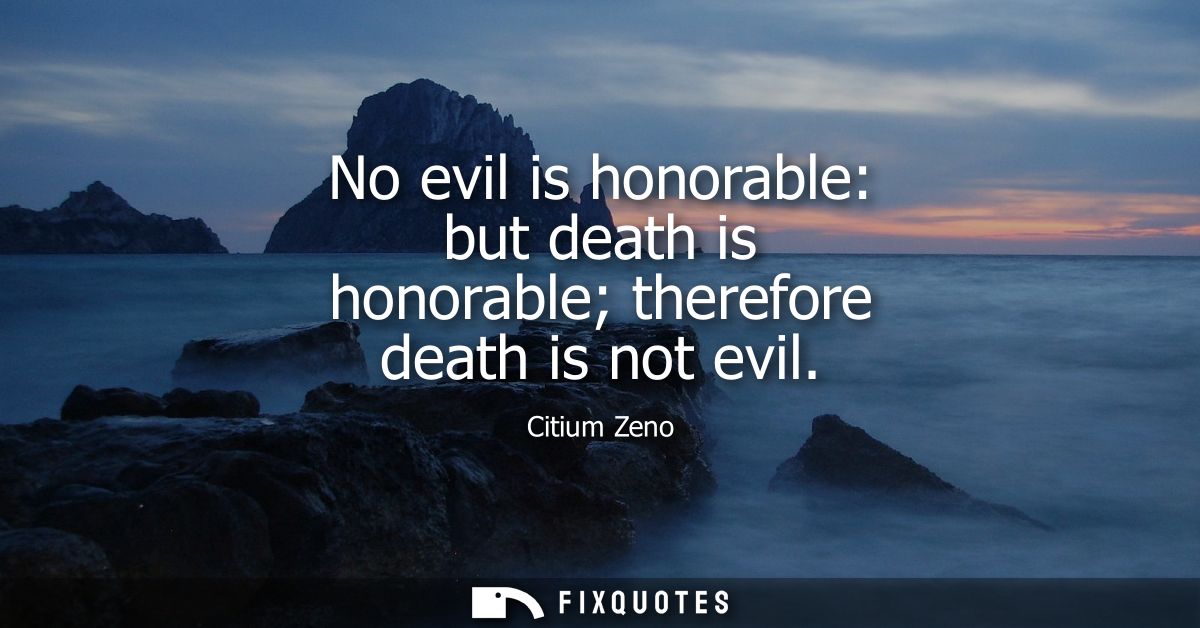
"No evil is honorable: but death is honorable; therefore death is not evil"
About this Quote
The subtext is a quiet assault on the culture of dread. In Athens and across the Hellenistic world, death was the ultimate lever: tyrants threatened it, crowds demanded it, families feared it, and gods were invoked around it. Zeno’s move strips that lever of power. If death is not evil, it cannot be used to blackmail you into betrayal, cowardice, or self-erasure. It becomes an “indifferent” - not nothing, not trivial, but not the thing that determines your worth.
Context matters: early Stoicism was forged amid political volatility and personal precariousness. For Zeno, philosophy isn’t a parlor sport; it’s a discipline for staying free when everything external can be taken. The line is meant to harden the spine: fear of death is often fear of losing control, status, narrative. Stoicism answers by relocating value to the only territory that can’t be conquered: character.
Quote Details
| Topic | Ethics & Morality |
|---|---|
| Source | Help us find the source |
| Cite |
Citation Formats
APA Style (7th ed.)
Zeno, Citium. (2026, January 15). No evil is honorable: but death is honorable; therefore death is not evil. FixQuotes. https://fixquotes.com/quotes/no-evil-is-honorable-but-death-is-honorable-161149/
Chicago Style
Zeno, Citium. "No evil is honorable: but death is honorable; therefore death is not evil." FixQuotes. January 15, 2026. https://fixquotes.com/quotes/no-evil-is-honorable-but-death-is-honorable-161149/.
MLA Style (9th ed.)
"No evil is honorable: but death is honorable; therefore death is not evil." FixQuotes, 15 Jan. 2026, https://fixquotes.com/quotes/no-evil-is-honorable-but-death-is-honorable-161149/. Accessed 11 Mar. 2026.