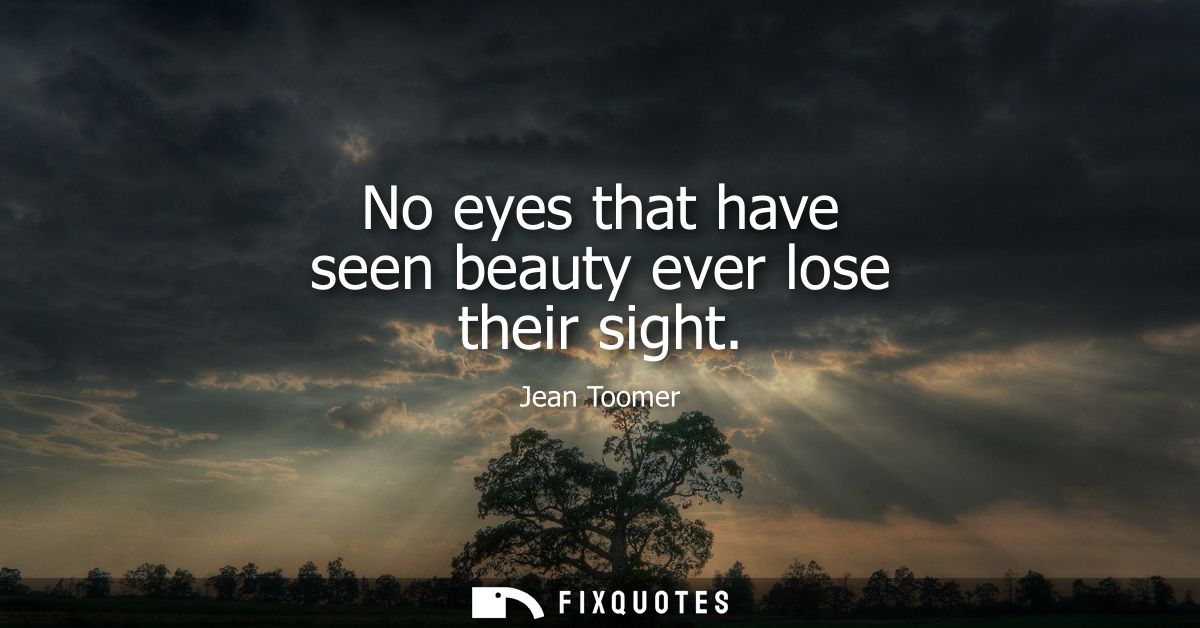
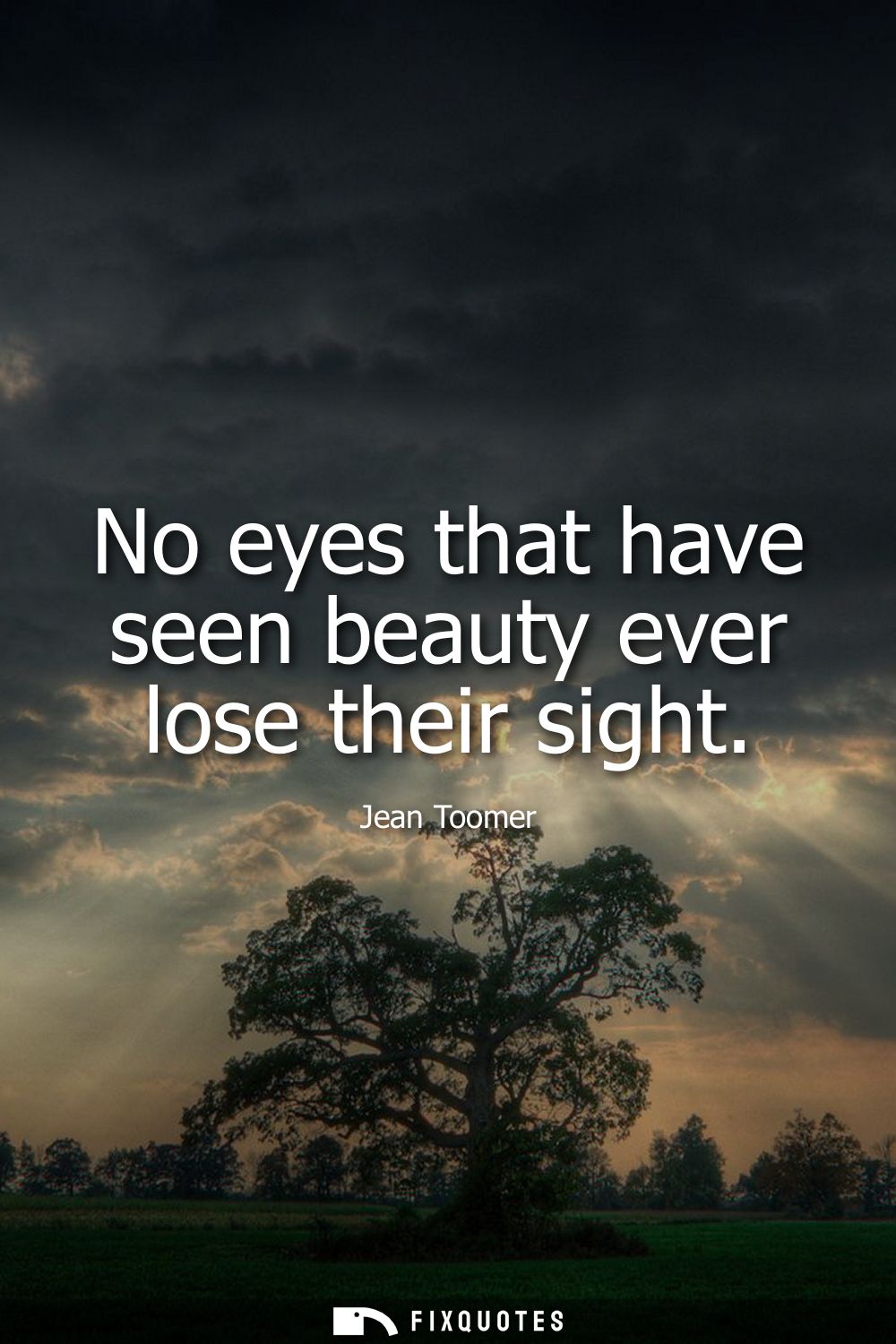
"No eyes that have seen beauty ever lose their sight"
About this Quote
Beauty, for Toomer, is not decoration; it is an irreversible event. "No eyes that have seen beauty ever lose their sight" turns vision into a kind of moral and psychological threshold. Once you have genuinely perceived something luminous - a face, a landscape, a line of music, a human dignity you hadn't been trained to notice - you can't return to the earlier innocence of not-knowing. Even if the world later goes dark, the mind keeps its afterimage.
The phrasing is doing quiet work. "No eyes" universalizes the claim, but the real force sits in "have seen": not glanced, not consumed, not approved by consensus, but seen with attention. Then Toomer flips "lose their sight" from a literal fear (blindness) into a spiritual one (numbness, cynicism, the deadening that comes from routine). The sentence insists that aesthetic experience can function like immunity. You may be wounded by history, but you're harder to fully extinguish.
Placed against Toomer's era and his own career - a Black modernist writing in the wake of the Great Migration and in the teeth of American racial mythology - the line reads as both consolation and provocation. It suggests that beauty is a form of knowledge that outlasts the regimes built to deny it. The subtext is defiant: if you have once apprehended the full humanity and radiance of life, you're less available to the nation's preferred blindness. Beauty becomes memory, memory becomes resistance.
The phrasing is doing quiet work. "No eyes" universalizes the claim, but the real force sits in "have seen": not glanced, not consumed, not approved by consensus, but seen with attention. Then Toomer flips "lose their sight" from a literal fear (blindness) into a spiritual one (numbness, cynicism, the deadening that comes from routine). The sentence insists that aesthetic experience can function like immunity. You may be wounded by history, but you're harder to fully extinguish.
Placed against Toomer's era and his own career - a Black modernist writing in the wake of the Great Migration and in the teeth of American racial mythology - the line reads as both consolation and provocation. It suggests that beauty is a form of knowledge that outlasts the regimes built to deny it. The subtext is defiant: if you have once apprehended the full humanity and radiance of life, you're less available to the nation's preferred blindness. Beauty becomes memory, memory becomes resistance.
Quote Details
| Topic | Wisdom |
|---|---|
| Source | Help us find the source |
| Cite | Cite this Quote |
Citation Formats
APA Style (7th ed.)
Toomer, Jean. (n.d.). No eyes that have seen beauty ever lose their sight. FixQuotes. https://fixquotes.com/quotes/no-eyes-that-have-seen-beauty-ever-lose-their-60633/
Chicago Style
Toomer, Jean. "No eyes that have seen beauty ever lose their sight." FixQuotes. Accessed February 2, 2026. https://fixquotes.com/quotes/no-eyes-that-have-seen-beauty-ever-lose-their-60633/.
MLA Style (9th ed.)
"No eyes that have seen beauty ever lose their sight." FixQuotes, https://fixquotes.com/quotes/no-eyes-that-have-seen-beauty-ever-lose-their-60633/. Accessed 2 Feb. 2026.
More Quotes by Jean
Add to List