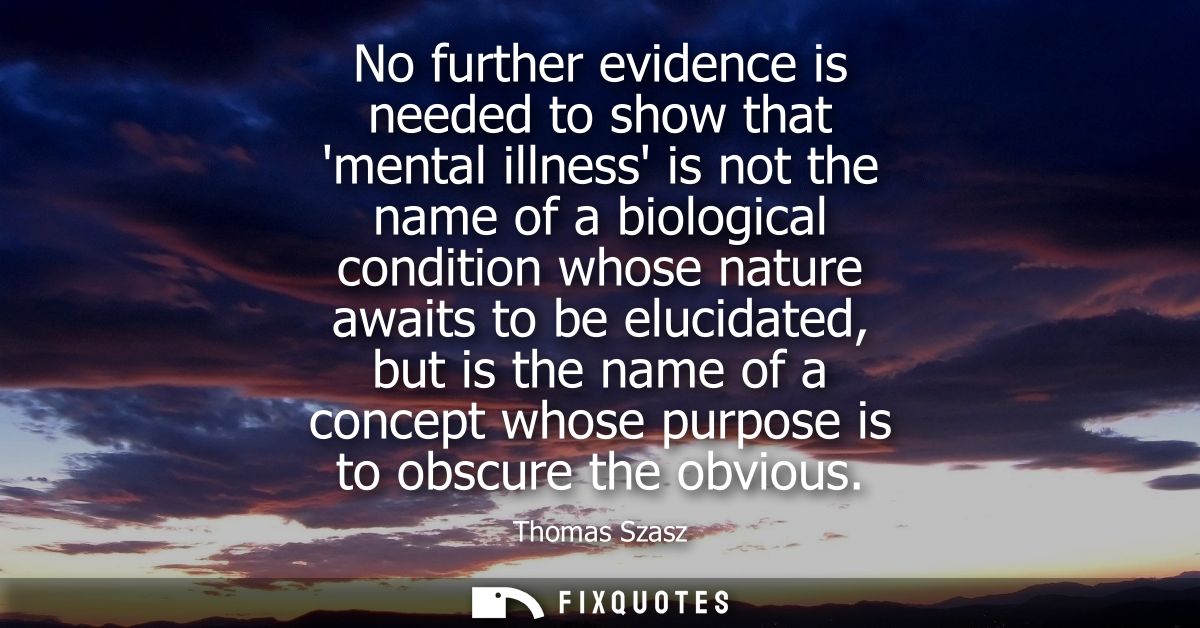
"No further evidence is needed to show that 'mental illness' is not the name of a biological condition whose nature awaits to be elucidated, but is the name of a concept whose purpose is to obscure the obvious"
About this Quote
The subtext is a moral and political critique disguised as an epistemological one. By calling “mental illness” a “concept,” Szasz yanks it out of the clinic and drops it into the realm of social control: labels that do work in institutions, courts, families. “Purpose is to obscure the obvious” is the knife twist. He implies the “obvious” is not a hidden brain lesion but conflicts in living: distress, deviance, trauma, bad circumstances, unbearable choices. In his frame, turning those into illnesses doesn’t merely misdescribe them; it conveniently absolves society and authorities of responsibility while legitimizing coercion in the name of treatment.
Context sharpens the edge. Writing in the mid-to-late 20th century, Szasz was reacting to an era of involuntary hospitalization, diagnostic expansion, and psychiatry’s growing legal power. He’s also preemptively mocking biological reductionism before “chemical imbalance” marketing became cultural common sense. The quote works because it’s absolute, almost recklessly so: a deliberately overstated certainty meant to shock readers into seeing how quickly medical language becomes moral verdict.
Quote Details
| Topic | Mental Health |
|---|---|
| Source | Help us find the source |
| Cite |
Citation Formats
APA Style (7th ed.)
Szasz, Thomas. (2026, January 16). No further evidence is needed to show that 'mental illness' is not the name of a biological condition whose nature awaits to be elucidated, but is the name of a concept whose purpose is to obscure the obvious. FixQuotes. https://fixquotes.com/quotes/no-further-evidence-is-needed-to-show-that-mental-102689/
Chicago Style
Szasz, Thomas. "No further evidence is needed to show that 'mental illness' is not the name of a biological condition whose nature awaits to be elucidated, but is the name of a concept whose purpose is to obscure the obvious." FixQuotes. January 16, 2026. https://fixquotes.com/quotes/no-further-evidence-is-needed-to-show-that-mental-102689/.
MLA Style (9th ed.)
"No further evidence is needed to show that 'mental illness' is not the name of a biological condition whose nature awaits to be elucidated, but is the name of a concept whose purpose is to obscure the obvious." FixQuotes, 16 Jan. 2026, https://fixquotes.com/quotes/no-further-evidence-is-needed-to-show-that-mental-102689/. Accessed 28 Mar. 2026.