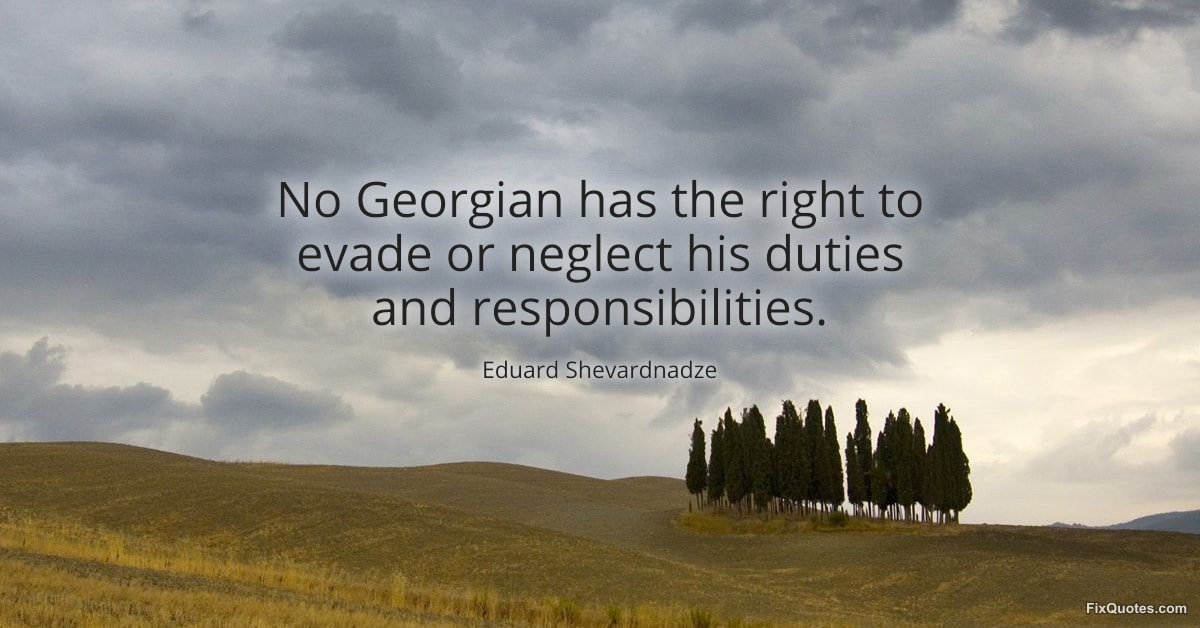
"No Georgian has the right to evade or neglect his duties and responsibilities"
About this Quote
The subtext is national triage. In post-Soviet Georgia, “responsibility” was never just about paying taxes or obeying laws; it was code for holding together a fragile state under stress: civil conflict, economic collapse, corruption, separatist wars in Abkhazia and South Ossetia, and the constant pressure of aligning with or resisting Russian influence. When a government can’t reliably deliver security or prosperity, it often reaches for rhetoric that asks citizens to supply what institutions can’t. The message doubles as a warning: if the country is failing, the blame won’t be pinned solely on leaders; it will be distributed downward, onto ordinary people accused of “evading” their share.
There’s also a self-justifying edge. Shevardnadze, a veteran of Soviet power and later a symbol of Georgia’s uneasy transition, is implicitly casting himself as the custodian of order. The sentence invites unity while narrowing dissent: disagreement can be recoded as irresponsibility. That’s why it works rhetorically. It turns patriotism into a test you either pass through compliance or fail through refusal.
Quote Details
| Topic | Honesty & Integrity |
|---|---|
| Source | Help us find the source |
| Cite |
Citation Formats
APA Style (7th ed.)
Shevardnadze, Eduard. (2026, January 17). No Georgian has the right to evade or neglect his duties and responsibilities. FixQuotes. https://fixquotes.com/quotes/no-georgian-has-the-right-to-evade-or-neglect-his-59658/
Chicago Style
Shevardnadze, Eduard. "No Georgian has the right to evade or neglect his duties and responsibilities." FixQuotes. January 17, 2026. https://fixquotes.com/quotes/no-georgian-has-the-right-to-evade-or-neglect-his-59658/.
MLA Style (9th ed.)
"No Georgian has the right to evade or neglect his duties and responsibilities." FixQuotes, 17 Jan. 2026, https://fixquotes.com/quotes/no-georgian-has-the-right-to-evade-or-neglect-his-59658/. Accessed 18 Feb. 2026.