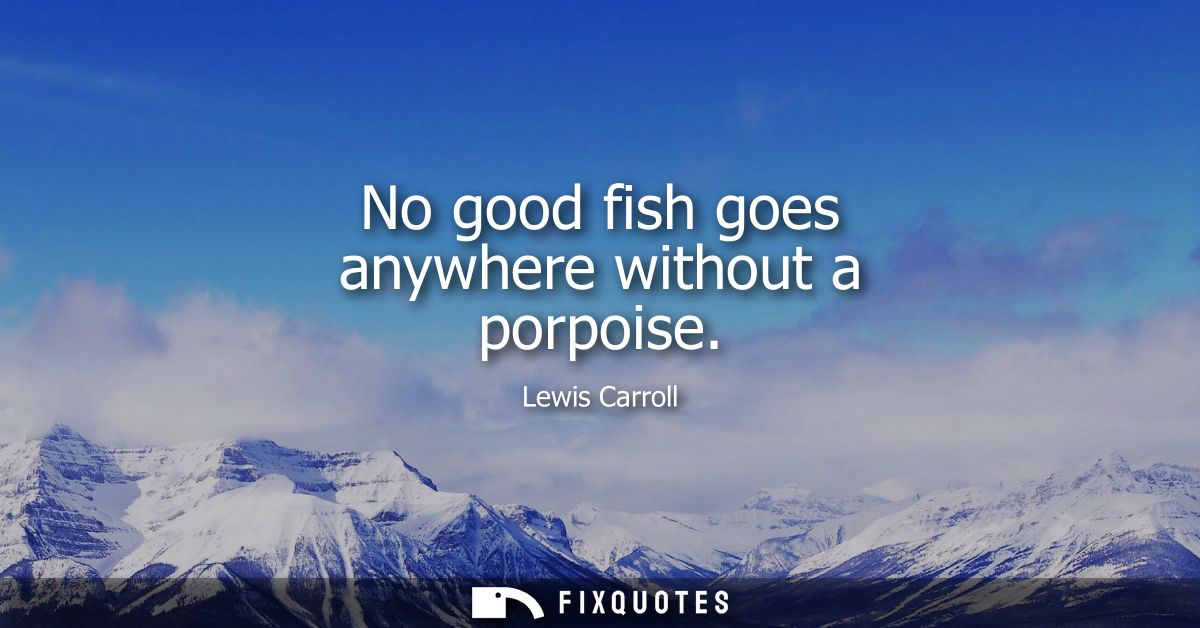
"No good fish goes anywhere without a porpoise"
About this Quote
Nonsense, in Carrolls hands, is never just noise; its job is to smuggle critique past the guardrails of common sense. "No good fish goes anywhere without a porpoise" lands like a proverb that has been put through a funhouse mirror. It borrows the authoritative cadence of Victorian moral instruction ("No good X...") and then swaps in a punch line built on a near-homophone: porpoise/purpose. The joke is linguistic, but the effect is social. Carroll turns the era's obsession with earnestness into a kind of verbal self-parody: even a fish, apparently, must have a mission statement.
The intent is to expose how easily meaning gets manufactured by form. Because it sounds like advice, we start searching for wisdom, and that reflex is the target. Carroll is teasing the human compulsion to impose teleology on everything, to treat motion as morally legible and direction as proof of virtue. The "good fish" is especially sly: goodness becomes not an ethical category but a compliance test - you are good if you can be narrated as having a purpose.
Context matters. Carroll wrote for children, but his nonsense is calibrated for adults overhearing it: a mathematician and logician laughing at the brittle certainty of didactic language. Under the whimsy is a quiet rebuke to a culture that policed seriousness. By letting a pun do the heavy lifting, he suggests that many of our grand, guiding principles are only a syllable away from absurdity - and maybe always were.
The intent is to expose how easily meaning gets manufactured by form. Because it sounds like advice, we start searching for wisdom, and that reflex is the target. Carroll is teasing the human compulsion to impose teleology on everything, to treat motion as morally legible and direction as proof of virtue. The "good fish" is especially sly: goodness becomes not an ethical category but a compliance test - you are good if you can be narrated as having a purpose.
Context matters. Carroll wrote for children, but his nonsense is calibrated for adults overhearing it: a mathematician and logician laughing at the brittle certainty of didactic language. Under the whimsy is a quiet rebuke to a culture that policed seriousness. By letting a pun do the heavy lifting, he suggests that many of our grand, guiding principles are only a syllable away from absurdity - and maybe always were.
Quote Details
| Topic | Puns & Wordplay |
|---|---|
| Source | Help us find the source |
| Cite |
Citation Formats
APA Style (7th ed.)
Carroll, Lewis. (2026, January 18). No good fish goes anywhere without a porpoise. FixQuotes. https://fixquotes.com/quotes/no-good-fish-goes-anywhere-without-a-porpoise-22406/
Chicago Style
Carroll, Lewis. "No good fish goes anywhere without a porpoise." FixQuotes. January 18, 2026. https://fixquotes.com/quotes/no-good-fish-goes-anywhere-without-a-porpoise-22406/.
MLA Style (9th ed.)
"No good fish goes anywhere without a porpoise." FixQuotes, 18 Jan. 2026, https://fixquotes.com/quotes/no-good-fish-goes-anywhere-without-a-porpoise-22406/. Accessed 29 Mar. 2026.
More Quotes by Lewis
Add to List