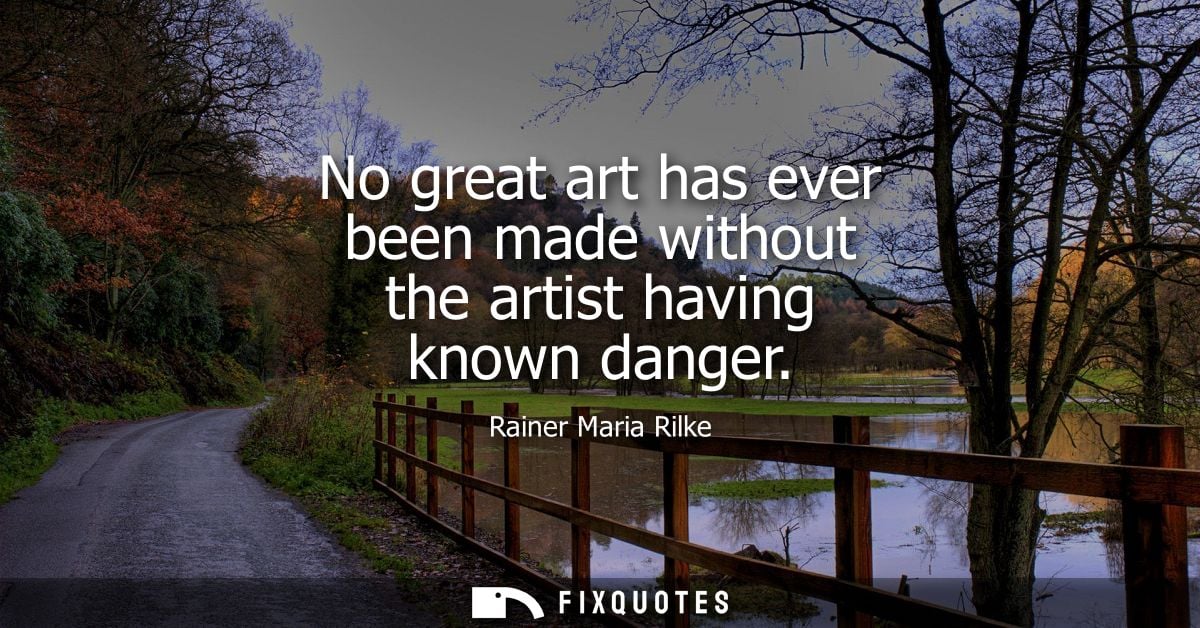
"No great art has ever been made without the artist having known danger"
About this Quote
Rilke’s line smuggles a dare into what looks like aesthetic advice: if you want greatness, risk has to enter the room. Not the glamorous, war-story version of danger, but the quieter kind he knew intimately as a poet of spiritual vertigo and psychic exposure. “Danger” here is the cost of looking too closely at life without the usual protections - irony, distraction, the social mask. Great art, in Rilke’s view, comes from stepping past the safety rail and staying there long enough to report back.
The intent is partly corrective. It pushes against the comforting myth of art as tasteful self-expression, or craft perfected in a sealed studio. Rilke argues for art as an ordeal: you hazard reputation, belonging, sanity, faith. The subtext is that technique alone can’t produce the necessary voltage. Danger is what burns off the decorative layer and forces the artist into contact with the essential material: grief, desire, dread, awe.
Context matters. Rilke wrote in a Europe rattling toward catastrophe, but his “danger” isn’t just historical; it’s existential. His poems keep circling thresholds - angels, death, the unsayable - where language strains and the self feels flimsy. The line works because it reverses the usual hierarchy: danger isn’t a threat to art; it’s the condition that makes art matter. It also flatters and warns at once. If you’re not scared, Rilke implies, you might be making something competent - but you’re probably not making something alive.
The intent is partly corrective. It pushes against the comforting myth of art as tasteful self-expression, or craft perfected in a sealed studio. Rilke argues for art as an ordeal: you hazard reputation, belonging, sanity, faith. The subtext is that technique alone can’t produce the necessary voltage. Danger is what burns off the decorative layer and forces the artist into contact with the essential material: grief, desire, dread, awe.
Context matters. Rilke wrote in a Europe rattling toward catastrophe, but his “danger” isn’t just historical; it’s existential. His poems keep circling thresholds - angels, death, the unsayable - where language strains and the self feels flimsy. The line works because it reverses the usual hierarchy: danger isn’t a threat to art; it’s the condition that makes art matter. It also flatters and warns at once. If you’re not scared, Rilke implies, you might be making something competent - but you’re probably not making something alive.
Quote Details
| Topic | Art |
|---|
More Quotes by Rainer
Add to List