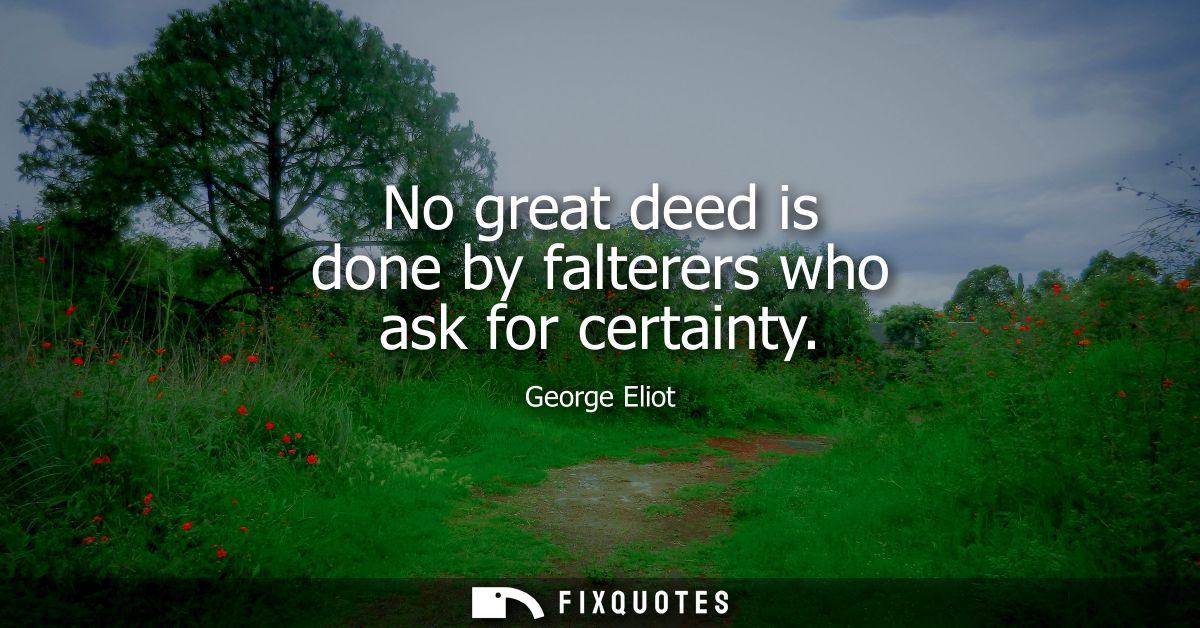
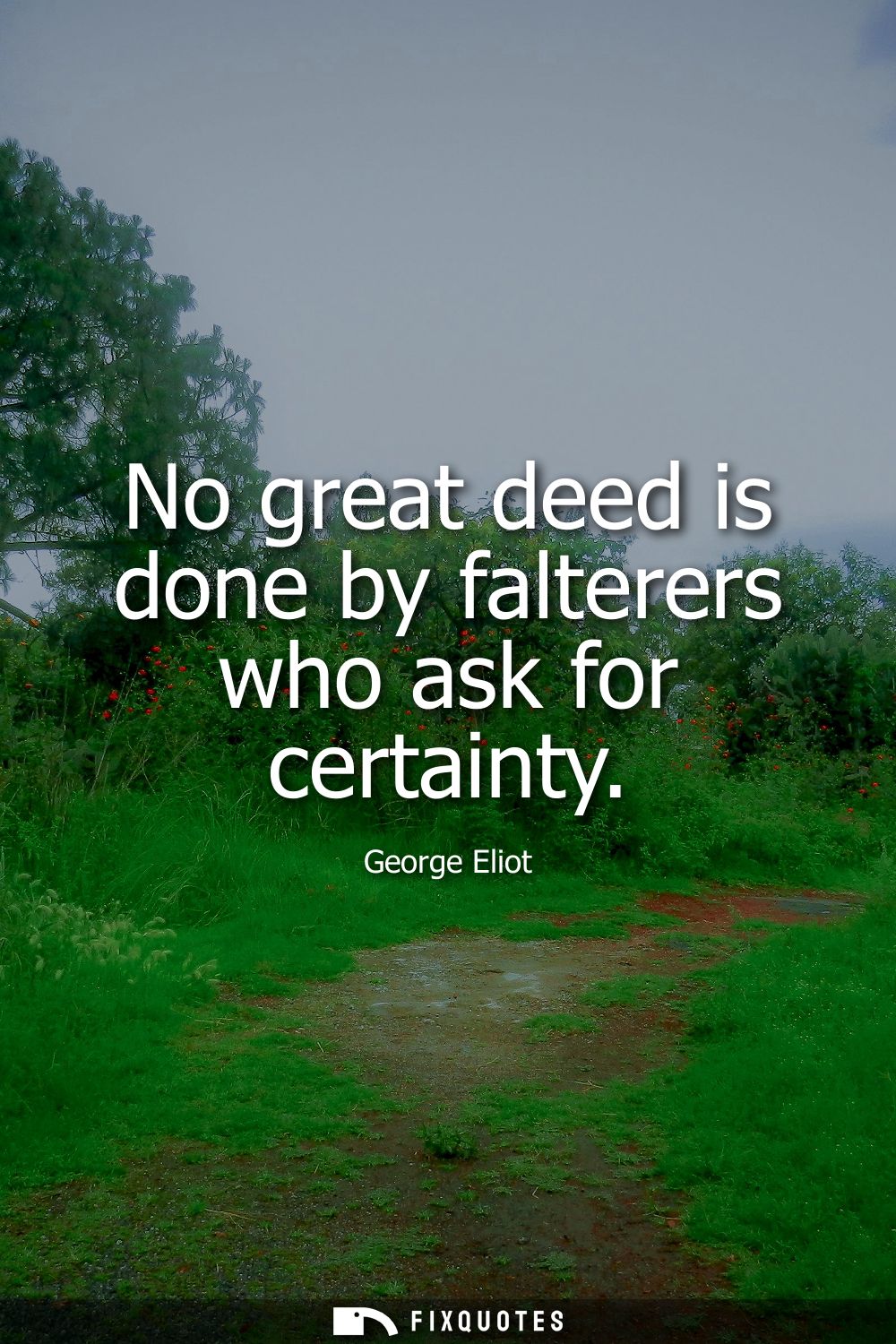
"No great deed is done by falterers who ask for certainty"
About this Quote
Eliot’s line is a quiet rebuke to the Victorian addiction to moral accounting: the idea that you should only act once the universe has stamped your paperwork. “Falterers” is the tell. It’s not just people who hesitate; it’s people who build a whole identity around hesitation, turning caution into character and doubt into a shield against responsibility. The phrase “ask for certainty” skewers a particularly modern form of procrastination: outsourcing courage to proof, insisting that life provide guarantees before you’ll risk being wrong, ridiculed, or harmed.
The sentence works because it frames uncertainty not as a barrier to virtue but as the medium virtue has to move through. “Great deed” is deliberately broad, suggesting moral action rather than heroic spectacle: the unglamorous choice to commit, to protect someone, to speak when silence is safer. Eliot’s fiction is full of characters caught between conscience and consequence, and she understood how often “waiting for certainty” is just fear dressed up as prudence.
In context, this is a novelist’s ethics, not a general’s: the pressure point is interior. Eliot is writing in a culture newly intoxicated by scientific authority and shaken by religious doubt; certainty was becoming a commodity people demanded from theology, politics, even romance. She answers with a bracing claim: certainty isn’t the prerequisite for goodness. It’s frequently the excuse for avoiding it.
The sentence works because it frames uncertainty not as a barrier to virtue but as the medium virtue has to move through. “Great deed” is deliberately broad, suggesting moral action rather than heroic spectacle: the unglamorous choice to commit, to protect someone, to speak when silence is safer. Eliot’s fiction is full of characters caught between conscience and consequence, and she understood how often “waiting for certainty” is just fear dressed up as prudence.
In context, this is a novelist’s ethics, not a general’s: the pressure point is interior. Eliot is writing in a culture newly intoxicated by scientific authority and shaken by religious doubt; certainty was becoming a commodity people demanded from theology, politics, even romance. She answers with a bracing claim: certainty isn’t the prerequisite for goodness. It’s frequently the excuse for avoiding it.
Quote Details
| Topic | Motivational |
|---|---|
| Source | Help us find the source |
| Cite |
Citation Formats
APA Style (7th ed.)
Eliot, George. (2026, January 15). No great deed is done by falterers who ask for certainty. FixQuotes. https://fixquotes.com/quotes/no-great-deed-is-done-by-falterers-who-ask-for-28246/
Chicago Style
Eliot, George. "No great deed is done by falterers who ask for certainty." FixQuotes. January 15, 2026. https://fixquotes.com/quotes/no-great-deed-is-done-by-falterers-who-ask-for-28246/.
MLA Style (9th ed.)
"No great deed is done by falterers who ask for certainty." FixQuotes, 15 Jan. 2026, https://fixquotes.com/quotes/no-great-deed-is-done-by-falterers-who-ask-for-28246/. Accessed 5 Apr. 2026.
More Quotes by George
Add to List