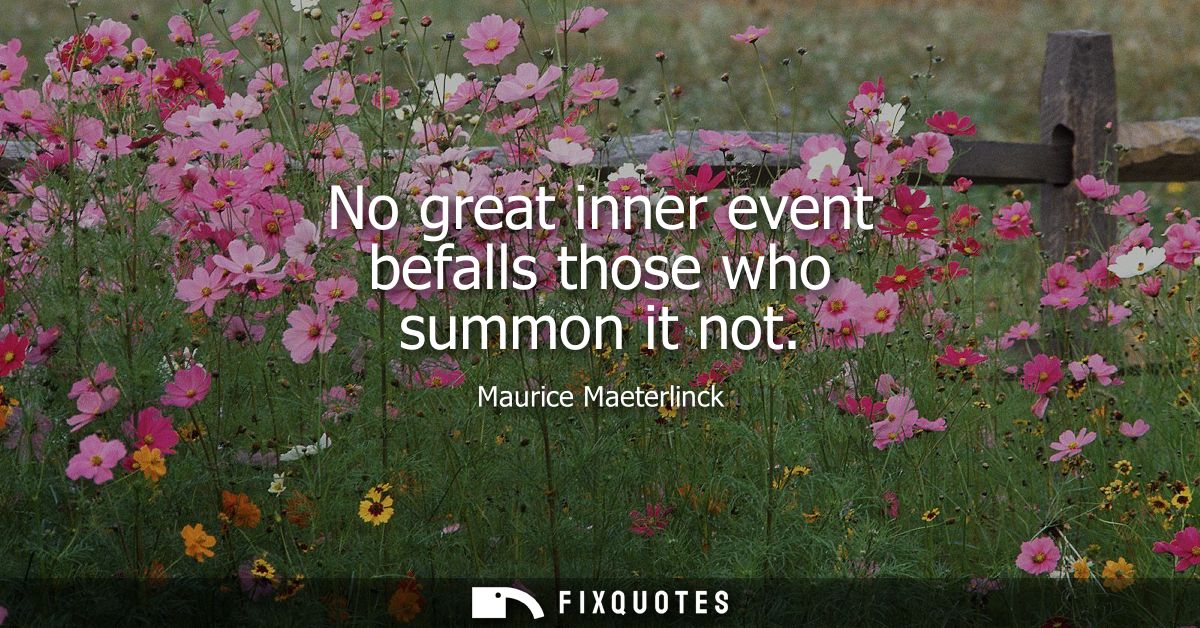
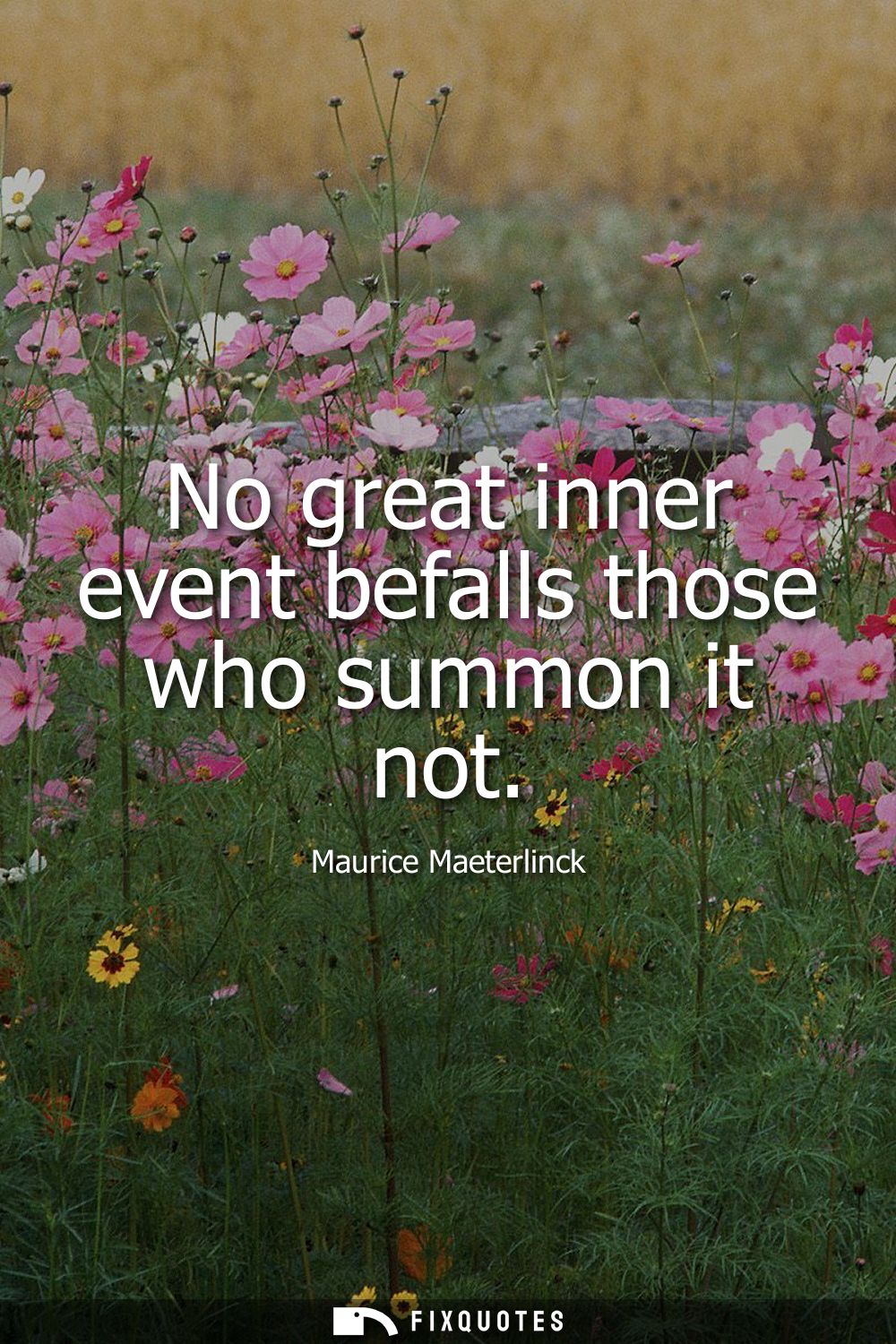
"No great inner event befalls those who summon it not"
About this Quote
Maeterlinck’s line has the quiet tyranny of a proverb: transcendence doesn’t “happen” to you; it’s a rendezvous you have to schedule. Coming from a Symbolist dramatist, that matters. His theater is famously low on plot and high on atmosphere, where the real action is interior - dread, revelation, longing - staged as mood rather than incident. So “inner event” isn’t self-help shorthand for feeling better; it’s closer to a metaphysical shift, the kind that makes ordinary life feel newly haunted or newly lucid.
The sentence works because it flips the romantic fantasy of inspiration as a lightning strike. Maeterlinck implies that the self is not a passive landscape awaiting weather but an instrument that must be tuned. “Summon” is the loaded verb: it evokes prayer, ritual, even séance. Inner transformation, he suggests, requires a deliberate invitation, an ethical readiness, maybe even a willingness to be unsettled. There’s also an austere edge to “not”: no alibis, no accidental awakenings. If nothing changes inside you, the fault isn’t the world’s stinginess; it’s your refusal to call.
Historically, this sits in a fin-de-siecle mood suspicious of blunt realism and hungry for unseen forces - psychology, mysticism, the unconscious - before those ideas became mass-market vocabulary. In our era of endless stimulation and curated “moments,” Maeterlinck’s warning lands like a rebuke: the deepest experiences can’t be scrolled into existence. They have to be asked for, then endured.
The sentence works because it flips the romantic fantasy of inspiration as a lightning strike. Maeterlinck implies that the self is not a passive landscape awaiting weather but an instrument that must be tuned. “Summon” is the loaded verb: it evokes prayer, ritual, even séance. Inner transformation, he suggests, requires a deliberate invitation, an ethical readiness, maybe even a willingness to be unsettled. There’s also an austere edge to “not”: no alibis, no accidental awakenings. If nothing changes inside you, the fault isn’t the world’s stinginess; it’s your refusal to call.
Historically, this sits in a fin-de-siecle mood suspicious of blunt realism and hungry for unseen forces - psychology, mysticism, the unconscious - before those ideas became mass-market vocabulary. In our era of endless stimulation and curated “moments,” Maeterlinck’s warning lands like a rebuke: the deepest experiences can’t be scrolled into existence. They have to be asked for, then endured.
Quote Details
| Topic | Change |
|---|---|
| Source | Help us find the source |
| Cite |
Citation Formats
APA Style (7th ed.)
Maeterlinck, Maurice. (2026, January 16). No great inner event befalls those who summon it not. FixQuotes. https://fixquotes.com/quotes/no-great-inner-event-befalls-those-who-summon-it-97142/
Chicago Style
Maeterlinck, Maurice. "No great inner event befalls those who summon it not." FixQuotes. January 16, 2026. https://fixquotes.com/quotes/no-great-inner-event-befalls-those-who-summon-it-97142/.
MLA Style (9th ed.)
"No great inner event befalls those who summon it not." FixQuotes, 16 Jan. 2026, https://fixquotes.com/quotes/no-great-inner-event-befalls-those-who-summon-it-97142/. Accessed 6 Apr. 2026.
More Quotes by Maurice
Add to List