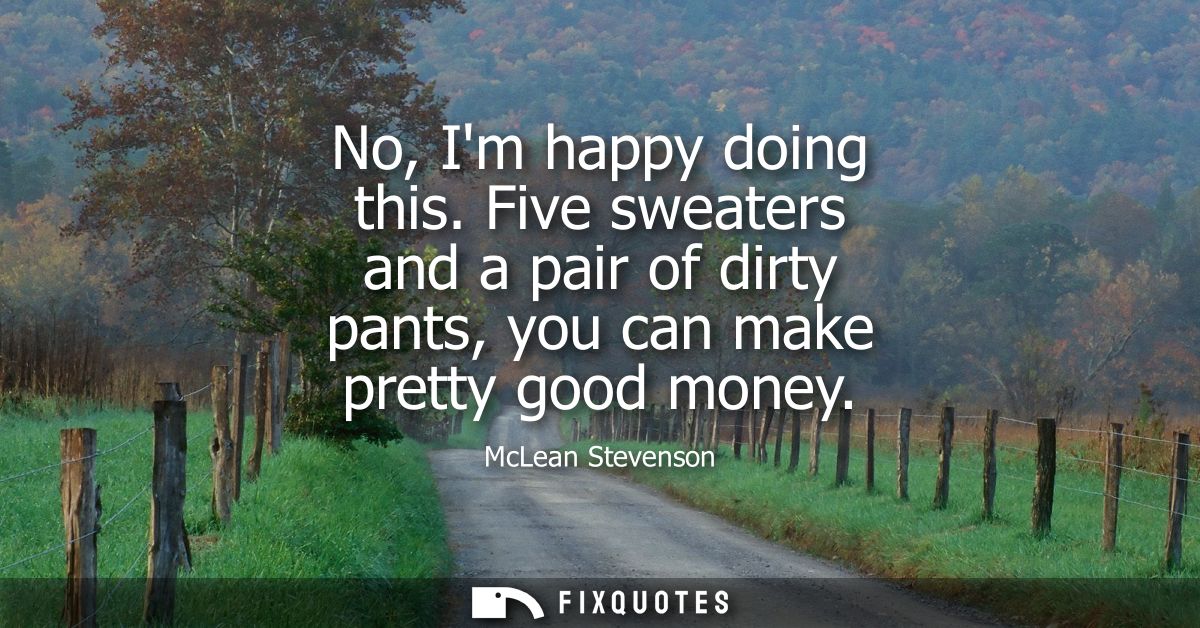
"No, I'm happy doing this. Five sweaters and a pair of dirty pants, you can make pretty good money"
About this Quote
That turn is the real intent. Stevenson is puncturing the myth that entertainment success arrives dressed in tuxedos and taste. The subtext is: the industry sells polish, but it often rewards the opposite - a performance of authenticity, of not trying too hard, of being “one of us.” It’s also a sly admission that show business money can feel unserious, even absurd, compared to the supposed dignity of “real work.” He’s laughing at himself for benefiting from a system where looking disheveled can be part of the brand.
Context matters: postwar American TV loved the scruffy wisecracker who survives chaos with a shrug. Stevenson’s line plays like a backstage riff on that cultural appetite - the comforting fantasy that you don’t have to become someone else to get paid, even if “not becoming someone else” is, in the end, its own carefully sold persona.
Quote Details
| Topic | Witty One-Liners |
|---|---|
| Source | Help us find the source |
| Cite |
Citation Formats
APA Style (7th ed.)
Stevenson, McLean. (2026, January 16). No, I'm happy doing this. Five sweaters and a pair of dirty pants, you can make pretty good money. FixQuotes. https://fixquotes.com/quotes/no-im-happy-doing-this-five-sweaters-and-a-pair-133080/
Chicago Style
Stevenson, McLean. "No, I'm happy doing this. Five sweaters and a pair of dirty pants, you can make pretty good money." FixQuotes. January 16, 2026. https://fixquotes.com/quotes/no-im-happy-doing-this-five-sweaters-and-a-pair-133080/.
MLA Style (9th ed.)
"No, I'm happy doing this. Five sweaters and a pair of dirty pants, you can make pretty good money." FixQuotes, 16 Jan. 2026, https://fixquotes.com/quotes/no-im-happy-doing-this-five-sweaters-and-a-pair-133080/. Accessed 12 Feb. 2026.