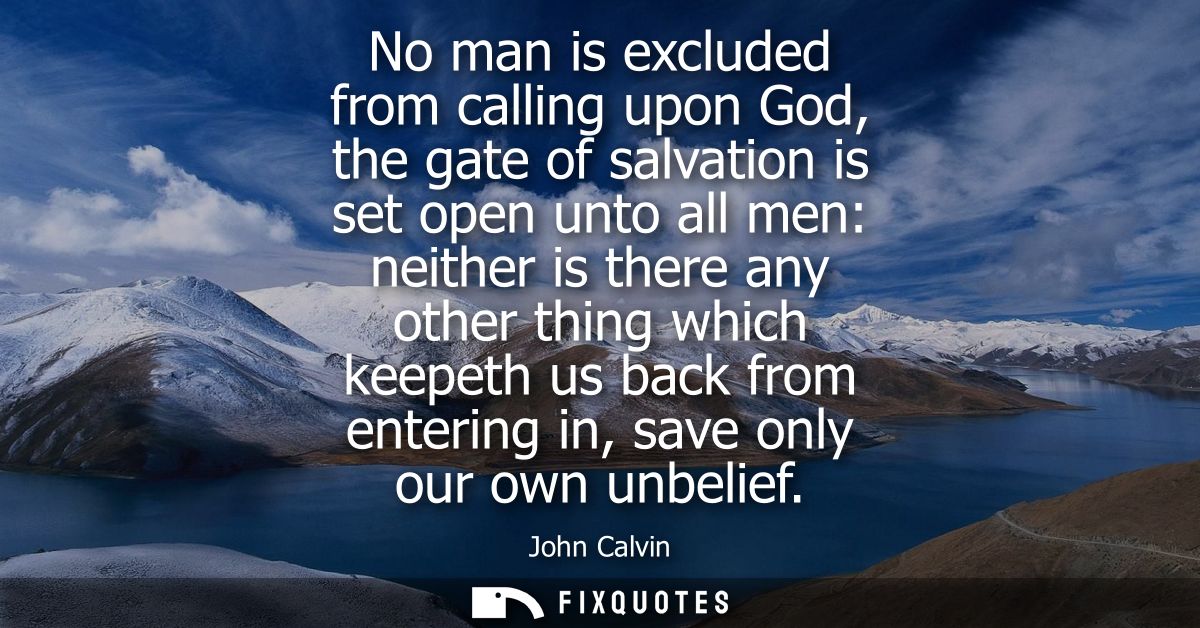
"No man is excluded from calling upon God, the gate of salvation is set open unto all men: neither is there any other thing which keepeth us back from entering in, save only our own unbelief"
About this Quote
The subtext is where the pressure lives. By naming "unbelief" as the sole barrier, Calvin relocates the drama inward. The obstacle is not God’s stinginess or the church’s bureaucracy; it’s the self’s refusal to trust. That rhetorical move does two things at once: it comforts the anxious hearer (you are not disqualified by your biography) and indicts the resistant one (your exclusion is self-authored). It also reframes faith less as a heroic achievement than as a relinquishing of suspicion, a consent to be helped.
Context matters: Calvin is writing in the Reformation’s long argument over who controls access to God. Against late medieval systems of mediation, merit, and penitential economy, he insists on a direct appeal: "calling upon God" as the simplest, most human gesture. The language of "gate" and "entering in" borrows the Gospel’s spatial metaphors to make theology feel like movement rather than abstraction. Salvation becomes not a prize for the competent, but a threshold. The only lock, Calvin implies, is the hand that refuses to turn the handle.
Quote Details
| Topic | Faith |
|---|---|
| Source | Help us find the source |
| Cite |
Citation Formats
APA Style (7th ed.)
Calvin, John. (2026, January 18). No man is excluded from calling upon God, the gate of salvation is set open unto all men: neither is there any other thing which keepeth us back from entering in, save only our own unbelief. FixQuotes. https://fixquotes.com/quotes/no-man-is-excluded-from-calling-upon-god-the-gate-9455/
Chicago Style
Calvin, John. "No man is excluded from calling upon God, the gate of salvation is set open unto all men: neither is there any other thing which keepeth us back from entering in, save only our own unbelief." FixQuotes. January 18, 2026. https://fixquotes.com/quotes/no-man-is-excluded-from-calling-upon-god-the-gate-9455/.
MLA Style (9th ed.)
"No man is excluded from calling upon God, the gate of salvation is set open unto all men: neither is there any other thing which keepeth us back from entering in, save only our own unbelief." FixQuotes, 18 Jan. 2026, https://fixquotes.com/quotes/no-man-is-excluded-from-calling-upon-god-the-gate-9455/. Accessed 4 Apr. 2026.