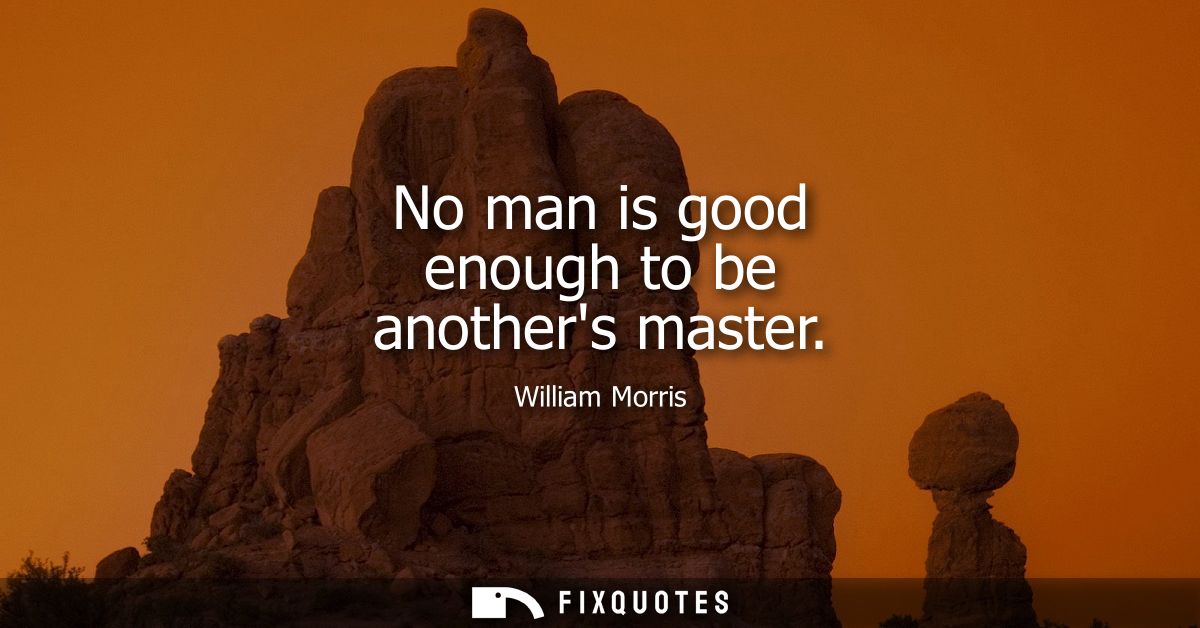
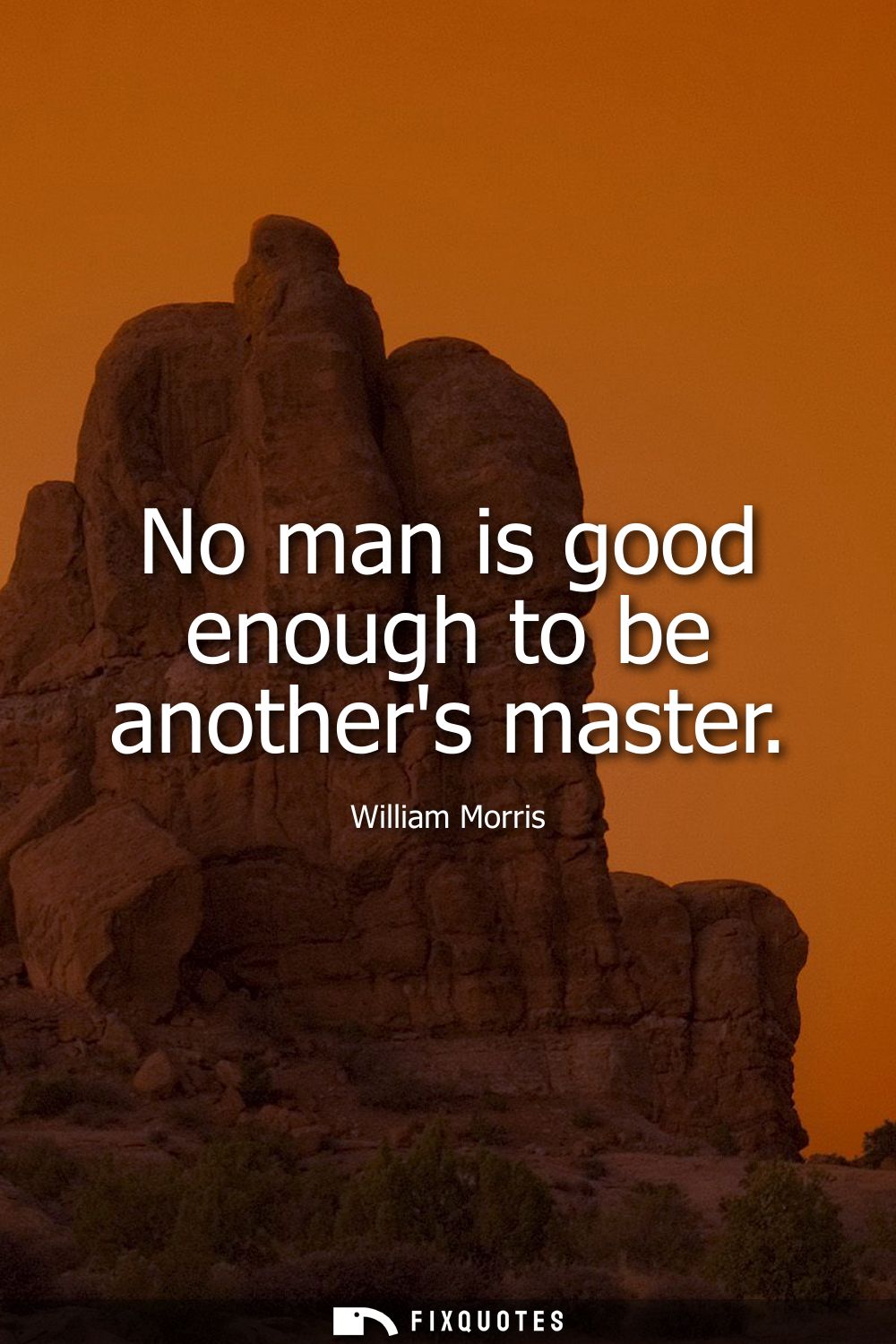
"No man is good enough to be another's master"
About this Quote
A designer’s slogan that reads like a moral grenade: “No man is good enough to be another’s master.” Morris isn’t offering a gentle reminder about kindness; he’s attacking the basic alibi of hierarchy. The line turns on an elegant reversal. Instead of arguing that the enslaved deserve freedom (true, but endlessly bargained down), he questions the supposed fitness of the ruler. Mastery fails not because the subject is unworthy, but because the master is.
The phrasing is deceptively plain, almost workshop talk. “Good enough” is the genius hinge: it frames domination as a competence claim, the way Victorians justified empire, factories, and class rule as management by superior people. Morris denies that any human being can meet the moral standard required to own another person’s time, labor, and choices. It’s a preemptive strike against paternalism, including the “benevolent” boss, the enlightened imperialist, the reformer who still wants to supervise your life for your own good.
Context matters. Morris was a leading figure in the Arts and Crafts movement and a socialist who watched industrial capitalism turn craft into drudgery and workers into replaceable parts. For him, design wasn’t decoration; it was politics made visible in everyday objects and workplaces. If beauty is tied to meaningful labor, then mastery is not just cruel, it’s ugly - a distortion of human making. The sentence reads like a rule for both society and the studio: nobody’s taste, authority, or virtue entitles them to command another’s life.
The phrasing is deceptively plain, almost workshop talk. “Good enough” is the genius hinge: it frames domination as a competence claim, the way Victorians justified empire, factories, and class rule as management by superior people. Morris denies that any human being can meet the moral standard required to own another person’s time, labor, and choices. It’s a preemptive strike against paternalism, including the “benevolent” boss, the enlightened imperialist, the reformer who still wants to supervise your life for your own good.
Context matters. Morris was a leading figure in the Arts and Crafts movement and a socialist who watched industrial capitalism turn craft into drudgery and workers into replaceable parts. For him, design wasn’t decoration; it was politics made visible in everyday objects and workplaces. If beauty is tied to meaningful labor, then mastery is not just cruel, it’s ugly - a distortion of human making. The sentence reads like a rule for both society and the studio: nobody’s taste, authority, or virtue entitles them to command another’s life.
Quote Details
| Topic | Freedom |
|---|---|
| Source | Help us find the source |
| Cite |
Citation Formats
APA Style (7th ed.)
Morris, William. (2026, January 18). No man is good enough to be another's master. FixQuotes. https://fixquotes.com/quotes/no-man-is-good-enough-to-be-anothers-master-2519/
Chicago Style
Morris, William. "No man is good enough to be another's master." FixQuotes. January 18, 2026. https://fixquotes.com/quotes/no-man-is-good-enough-to-be-anothers-master-2519/.
MLA Style (9th ed.)
"No man is good enough to be another's master." FixQuotes, 18 Jan. 2026, https://fixquotes.com/quotes/no-man-is-good-enough-to-be-anothers-master-2519/. Accessed 5 Mar. 2026.
More Quotes by William
Add to List