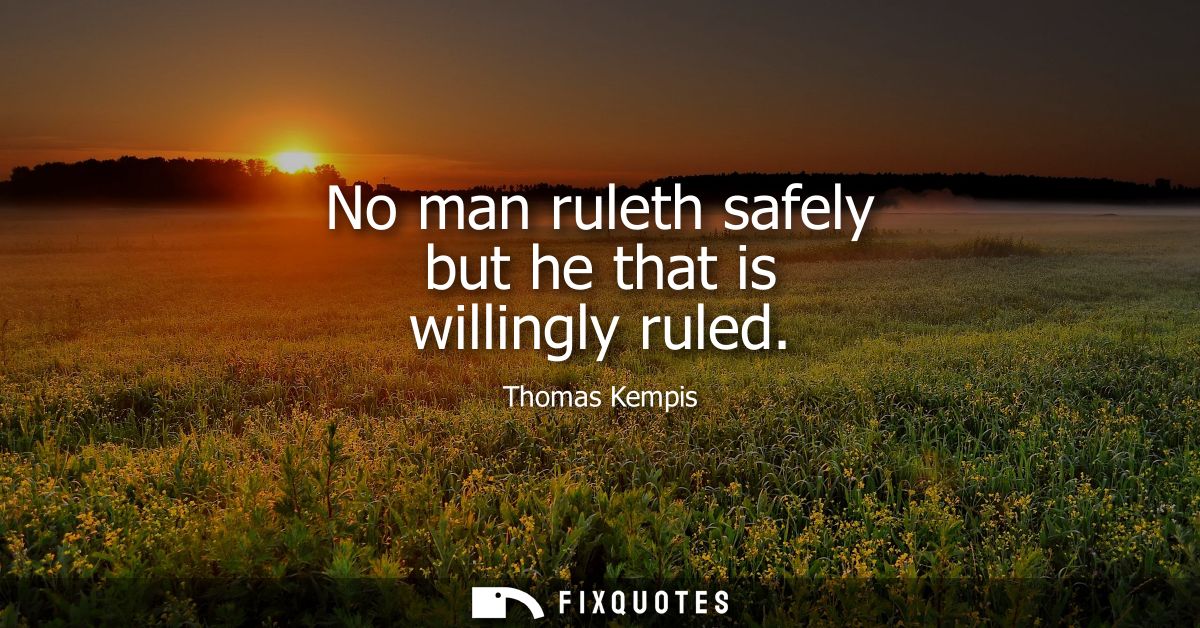
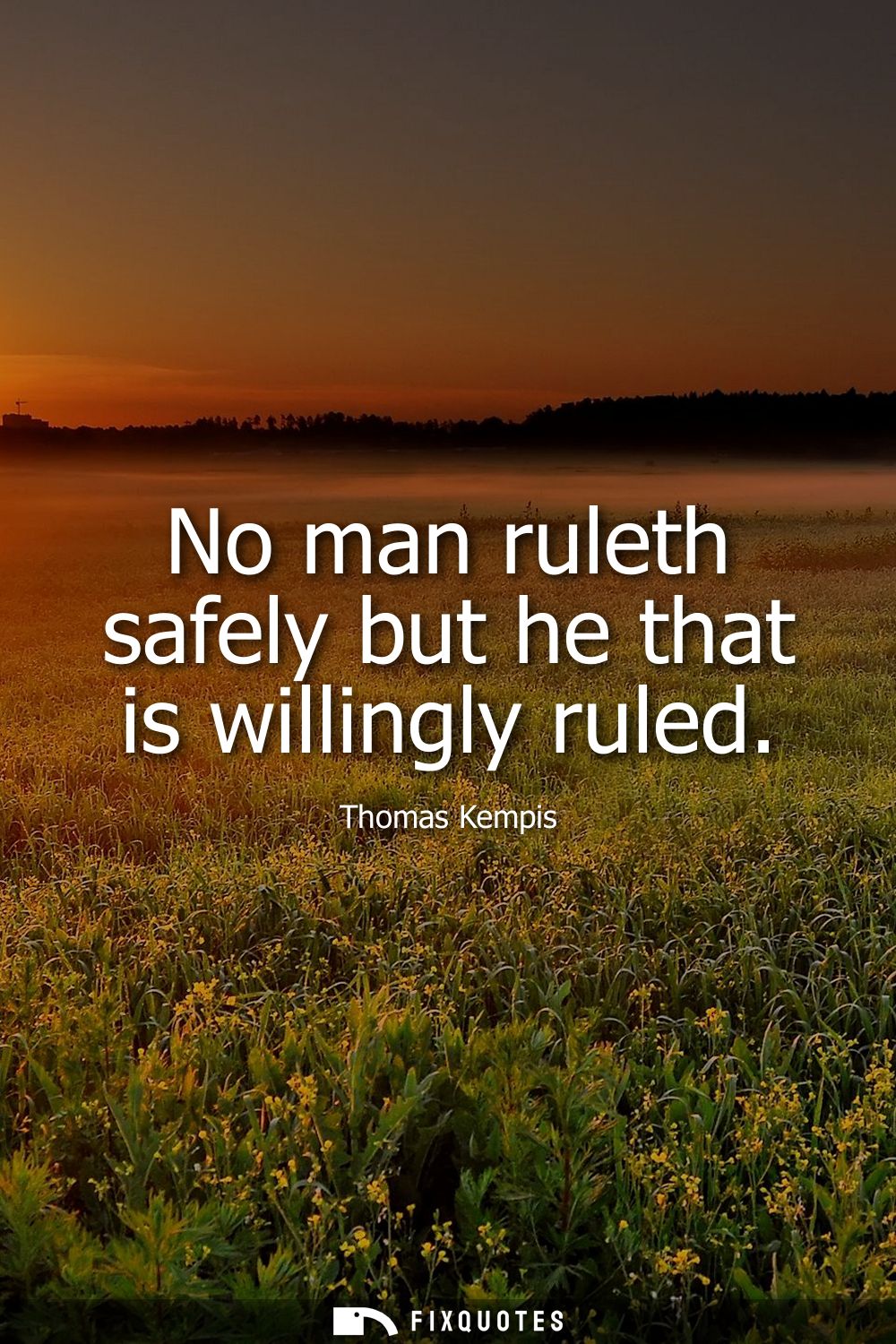
"No man ruleth safely, but he that is willingly ruled"
About this Quote
Power without humility is a short-term loan with brutal interest. Thomas a Kempis, the devotional writer behind The Imitation of Christ, is offering a paradox that’s less clever than cutting: the only ruler who can govern safely is the one who has already learned obedience - not as submission to a bully, but as a disciplined consent to something higher than ego.
The line works because it flips the usual hierarchy. We expect rule to be the proof of superiority; Kempis treats it as the final exam of self-control. “Willingly ruled” is the key phrase. He’s not praising coerced compliance or saintly passivity. He’s arguing that legitimacy begins in the inner life: a person who can accept limits, correction, and accountability is less likely to confuse authority with entitlement. The unsafe ruler, in this moral psychology, isn’t merely tyrannical; he’s untrained. He hasn’t practiced restraint, so power amplifies his worst instincts.
Context matters: Kempis writes in a late medieval Christian world suspicious of worldly status, shaped by monastic models where leadership is service and obedience is formative. His audience would hear echoes of Christ’s inversion of power - the last shall be first - and of the monastery’s daily apprenticeship in being governed.
The subtext is a warning to both leaders and followers. For leaders: if you cannot be ruled, you will rule like a man defending a fragile self. For followers: demand governors who’ve passed through submission, because that’s where empathy, patience, and steadiness are forged. It’s a spiritual sentence that doubles as political realism.
The line works because it flips the usual hierarchy. We expect rule to be the proof of superiority; Kempis treats it as the final exam of self-control. “Willingly ruled” is the key phrase. He’s not praising coerced compliance or saintly passivity. He’s arguing that legitimacy begins in the inner life: a person who can accept limits, correction, and accountability is less likely to confuse authority with entitlement. The unsafe ruler, in this moral psychology, isn’t merely tyrannical; he’s untrained. He hasn’t practiced restraint, so power amplifies his worst instincts.
Context matters: Kempis writes in a late medieval Christian world suspicious of worldly status, shaped by monastic models where leadership is service and obedience is formative. His audience would hear echoes of Christ’s inversion of power - the last shall be first - and of the monastery’s daily apprenticeship in being governed.
The subtext is a warning to both leaders and followers. For leaders: if you cannot be ruled, you will rule like a man defending a fragile self. For followers: demand governors who’ve passed through submission, because that’s where empathy, patience, and steadiness are forged. It’s a spiritual sentence that doubles as political realism.
Quote Details
| Topic | Leadership |
|---|---|
| Source | Help us find the source |
| Cite |
Citation Formats
APA Style (7th ed.)
Kempis, Thomas. (2026, February 20). No man ruleth safely, but he that is willingly ruled. FixQuotes. https://fixquotes.com/quotes/no-man-ruleth-safely-but-he-that-is-willingly-11630/
Chicago Style
Kempis, Thomas. "No man ruleth safely, but he that is willingly ruled." FixQuotes. February 20, 2026. https://fixquotes.com/quotes/no-man-ruleth-safely-but-he-that-is-willingly-11630/.
MLA Style (9th ed.)
"No man ruleth safely, but he that is willingly ruled." FixQuotes, 20 Feb. 2026, https://fixquotes.com/quotes/no-man-ruleth-safely-but-he-that-is-willingly-11630/. Accessed 7 Mar. 2026.
More Quotes by Thomas
Add to List