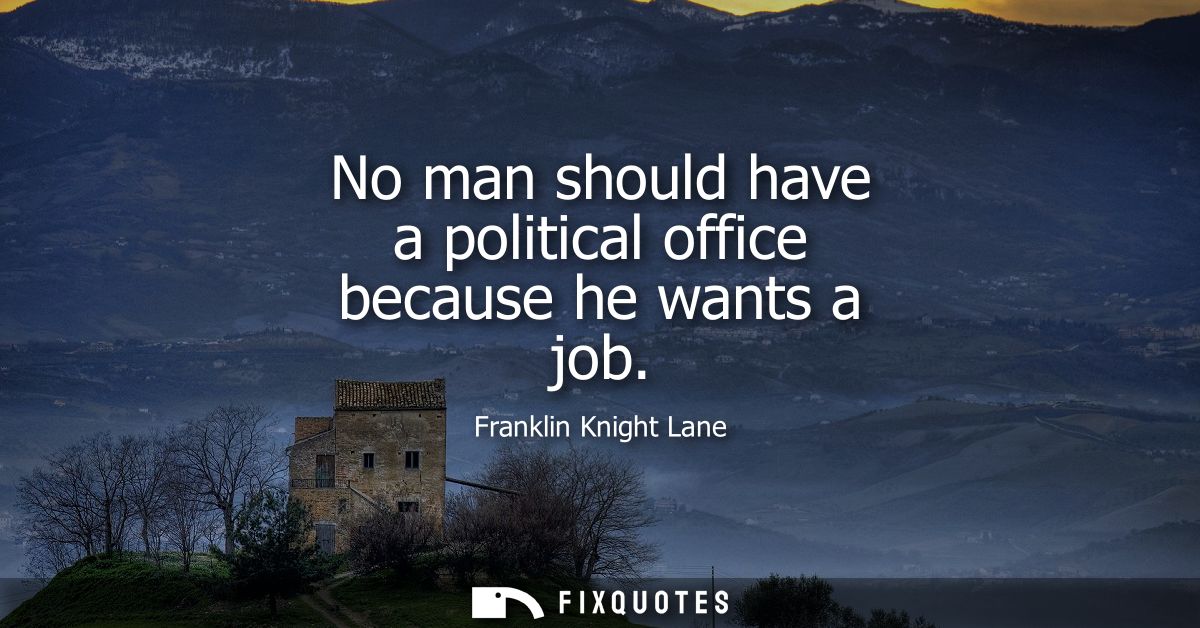
"No man should have a political office because he wants a job"
About this Quote
Ambition is the wrong credential, Lane suggests, and he delivers it with a bluntness that feels almost un-American in a culture that loves the hustle story. “Because he wants a job” sounds small on purpose: not “because he seeks to serve,” not “because he has a vision,” but because he wants employment. The line shrinks public office down to its most transactional core and then condemns that motive as disqualifying.
The intent is a warning about incentives. If office is treated as a paycheck or a rung on a personal ladder, the public becomes a customer to be managed, not a constituency to be represented. Lane is drawing a bright line between vocation and vocation-as-vanity. The subtext is even sharper: wanting the job is how you end up captured by the job. Patronage networks, party machines, and donors thrive on officials who need to keep their position the way a worker needs to keep wages. A person who “wants a job” is easy to bargain with; a person who feels called to responsibility is harder to purchase.
Context matters. Lane lived through the Progressive Era’s fight against corruption and spoils systems, when reformers tried to professionalize government without turning it into a careerist guild. His sentence lands in that tension: government must be competent, but it can’t become just another industry for the ambitious. It’s also a critique of the campaign marketplace. Candidates sell themselves as products; Lane counters with a moral test: if the desire is primarily personal, the office will be, too.
The intent is a warning about incentives. If office is treated as a paycheck or a rung on a personal ladder, the public becomes a customer to be managed, not a constituency to be represented. Lane is drawing a bright line between vocation and vocation-as-vanity. The subtext is even sharper: wanting the job is how you end up captured by the job. Patronage networks, party machines, and donors thrive on officials who need to keep their position the way a worker needs to keep wages. A person who “wants a job” is easy to bargain with; a person who feels called to responsibility is harder to purchase.
Context matters. Lane lived through the Progressive Era’s fight against corruption and spoils systems, when reformers tried to professionalize government without turning it into a careerist guild. His sentence lands in that tension: government must be competent, but it can’t become just another industry for the ambitious. It’s also a critique of the campaign marketplace. Candidates sell themselves as products; Lane counters with a moral test: if the desire is primarily personal, the office will be, too.
Quote Details
| Topic | Honesty & Integrity |
|---|---|
| Source | Help us find the source |
| Cite |
Citation Formats
APA Style (7th ed.)
Lane, Franklin Knight. (2026, January 15). No man should have a political office because he wants a job. FixQuotes. https://fixquotes.com/quotes/no-man-should-have-a-political-office-because-he-141211/
Chicago Style
Lane, Franklin Knight. "No man should have a political office because he wants a job." FixQuotes. January 15, 2026. https://fixquotes.com/quotes/no-man-should-have-a-political-office-because-he-141211/.
MLA Style (9th ed.)
"No man should have a political office because he wants a job." FixQuotes, 15 Jan. 2026, https://fixquotes.com/quotes/no-man-should-have-a-political-office-because-he-141211/. Accessed 23 Mar. 2026.
More Quotes by Franklin
Add to List