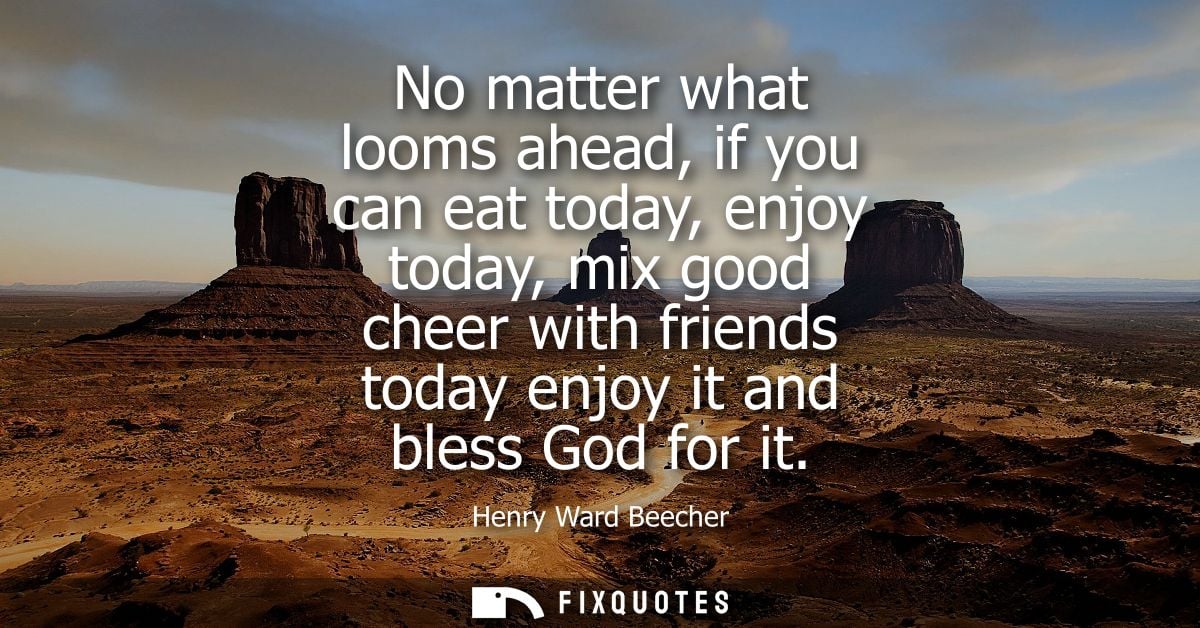
"No matter what looms ahead, if you can eat today, enjoy today, mix good cheer with friends today, enjoy it, and bless God for it"
About this Quote
The shrewdness is in the pairing of the bodily (“eat”) with the social (“good cheer with friends”). Beecher doesn’t float gratitude as an abstract virtue. He grounds it in dinner, laughter, and company, implying that joy isn’t a frivolous detour from faith but one of its everyday proofs. For a 19th-century American minister preaching amid economic volatility, illness, and a national moral crisis that included the lead-up to and aftermath of the Civil War, this is consolation with an edge: you may not control history, but you can control whether you turn bread into blessing.
There’s subtext, too, about sufficiency. Beecher’s “if” quietly admits scarcity; it’s a conditional beat that separates those who can eat from those who can’t, and turns the former into moral agents obligated to acknowledge their luck as divine gift. “Bless God for it” caps the sentence like a receipt: enjoyment is permitted, even encouraged, but it must be translated into reverence. Pleasure becomes a disciplined act, tethered to gratitude so it doesn’t curdle into entitlement.
Quote Details
| Topic | Live in the Moment |
|---|---|
| Source | Help us find the source |
| Cite |
Citation Formats
APA Style (7th ed.)
Beecher, Henry Ward. (2026, February 19). No matter what looms ahead, if you can eat today, enjoy today, mix good cheer with friends today, enjoy it, and bless God for it. FixQuotes. https://fixquotes.com/quotes/no-matter-what-looms-ahead-if-you-can-eat-today-33592/
Chicago Style
Beecher, Henry Ward. "No matter what looms ahead, if you can eat today, enjoy today, mix good cheer with friends today, enjoy it, and bless God for it." FixQuotes. February 19, 2026. https://fixquotes.com/quotes/no-matter-what-looms-ahead-if-you-can-eat-today-33592/.
MLA Style (9th ed.)
"No matter what looms ahead, if you can eat today, enjoy today, mix good cheer with friends today, enjoy it, and bless God for it." FixQuotes, 19 Feb. 2026, https://fixquotes.com/quotes/no-matter-what-looms-ahead-if-you-can-eat-today-33592/. Accessed 5 Apr. 2026.