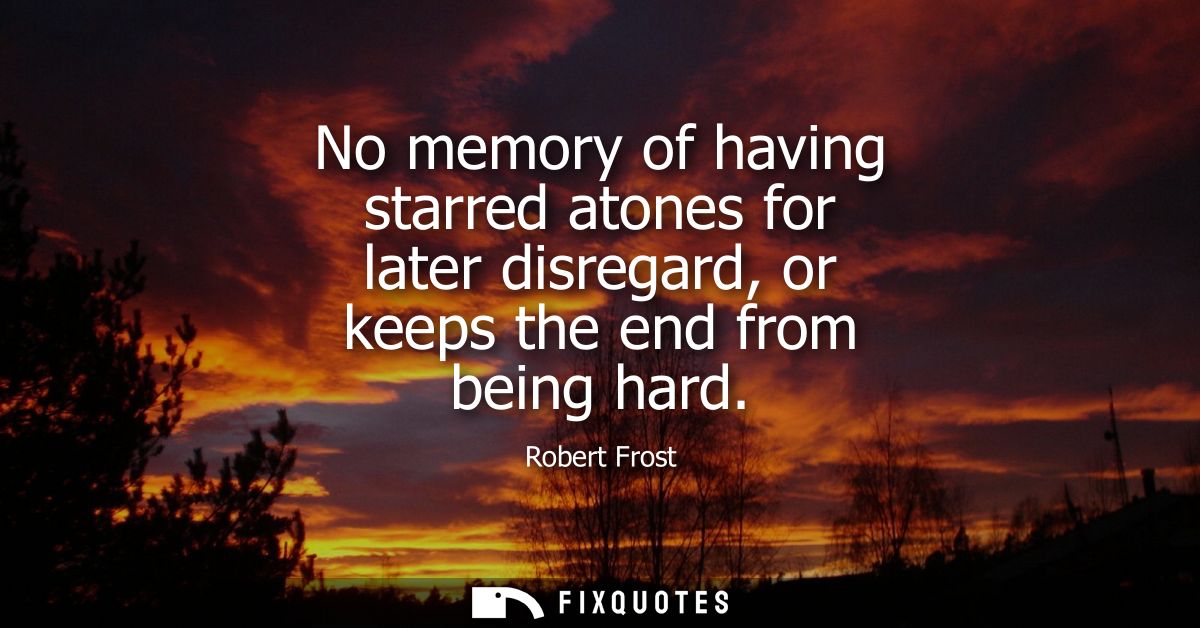
"No memory of having starred atones for later disregard, or keeps the end from being hard"
About this Quote
The verb choices do the real work. “Starred” is theatrical and temporary, a role granted by others, not an identity you can hold. “Atones” borrows from moral accounting, suggesting we want past affection to function like credit: I was good to you; you were good to me; therefore you owe me tenderness at the finish. Frost calls that fantasy. “Later disregard” lands with particular cruelty because it’s not a dramatic betrayal; it’s the slow downgrade from attention to indifference. The line understands how most endings actually go: not with a bang, but with someone looking past you.
Contextually, Frost’s poetry is full of moments where sentimentality tries to rush in and gets checked by reality - rural scenes that don’t redeem loneliness, nature that doesn’t provide a clean lesson. Here he’s also writing against the American habit of turning experience into uplift. Memory, he implies, is not a shield. It’s evidence you once mattered, which can make the disregard sharper, and the hard end harder.
Quote Details
| Topic | Legacy & Remembrance |
|---|---|
| Source | Help us find the source |
| Cite |
Citation Formats
APA Style (7th ed.)
Frost, Robert. (2026, January 15). No memory of having starred atones for later disregard, or keeps the end from being hard. FixQuotes. https://fixquotes.com/quotes/no-memory-of-having-starred-atones-for-later-36044/
Chicago Style
Frost, Robert. "No memory of having starred atones for later disregard, or keeps the end from being hard." FixQuotes. January 15, 2026. https://fixquotes.com/quotes/no-memory-of-having-starred-atones-for-later-36044/.
MLA Style (9th ed.)
"No memory of having starred atones for later disregard, or keeps the end from being hard." FixQuotes, 15 Jan. 2026, https://fixquotes.com/quotes/no-memory-of-having-starred-atones-for-later-36044/. Accessed 27 Mar. 2026.