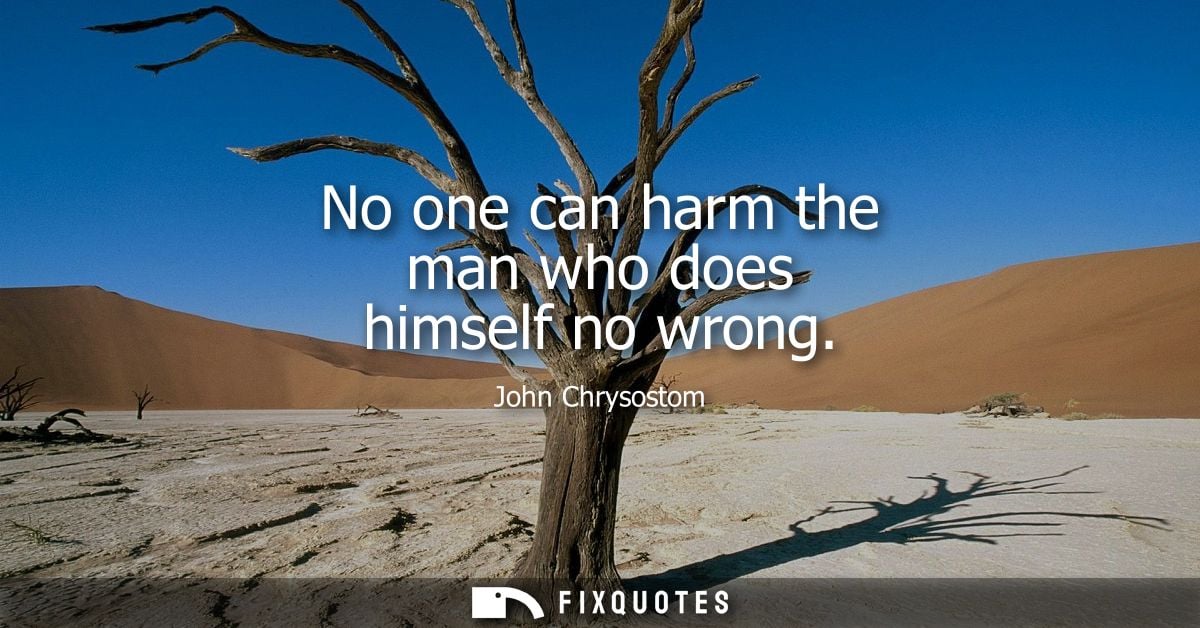
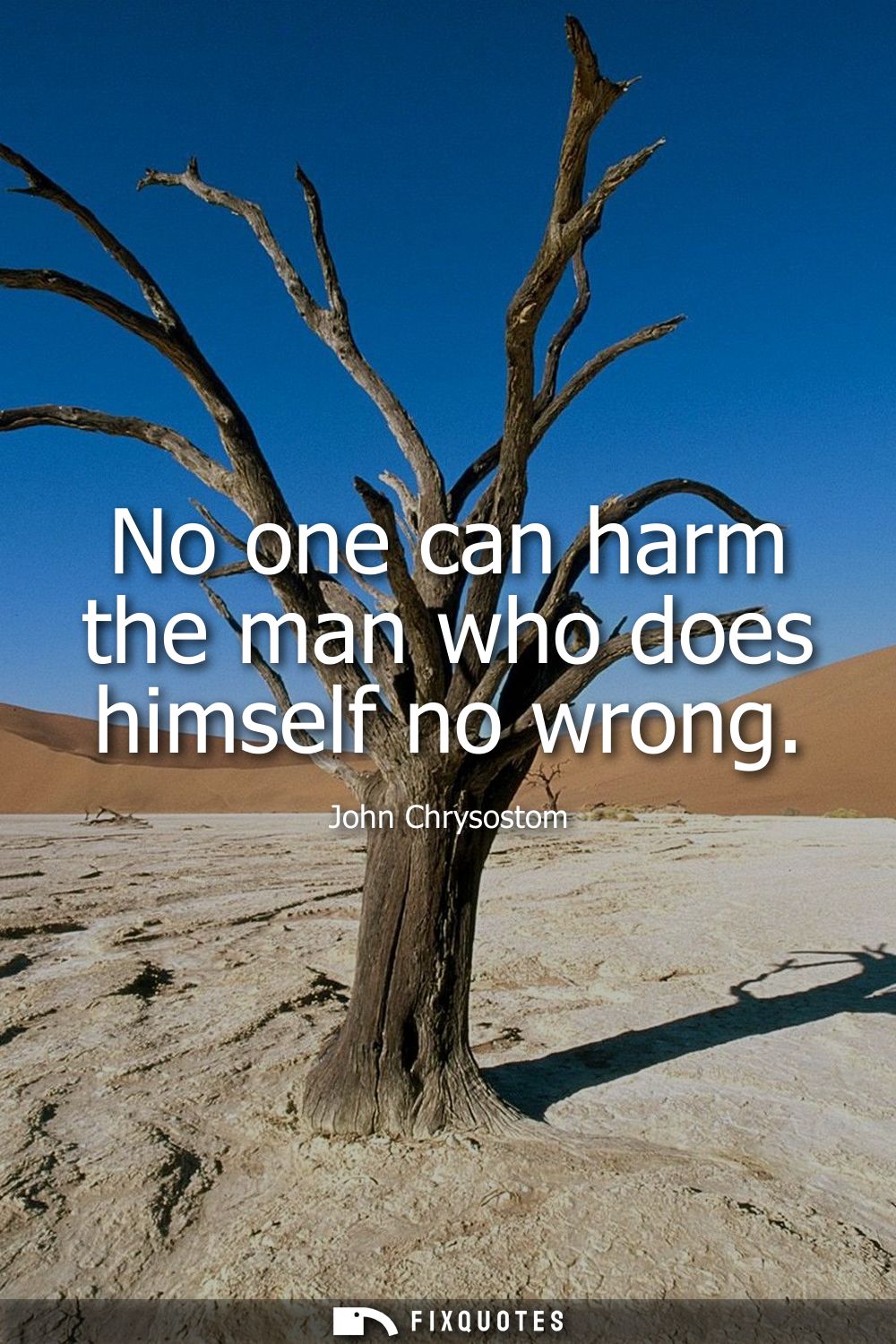
"No one can harm the man who does himself no wrong"
About this Quote
A line like this is spiritual self-defense disguised as moral bravado. Chrysostom isn’t claiming the world is gentle; he’s arguing that the most devastating injuries are the ones that recruit our own consent. The “harm” he’s talking about is not a broken body or a stolen purse, but a damaged soul - the inner corrosion that comes when you compromise yourself, rationalize cruelty, or let fear talk you into betrayal. If you refuse that bargain, external force can still hurt, but it can’t ultimately deform who you are.
The subtext is pastoral and tactical. Early Christianity lived under pressure: social marginalization, political volatility, and the constant temptation to meet violence with violence or to purchase safety with moral surrender. Chrysostom, a famed preacher in a fractious imperial church, knew how quickly “harm” becomes a story you tell yourself: I had to lie. I had to flatter power. I had to strike back. His sentence offers a different script - one that relocates agency to the only territory you can reliably govern.
It also works rhetorically because it’s absolute, almost taunting: “No one can.” That confidence is the point. He’s selling courage to ordinary people by redefining victory. The world can wound your circumstances; it can’t touch your integrity unless you open the door. In an era when bodies were vulnerable and institutions fickle, that was a radical kind of stability.
The subtext is pastoral and tactical. Early Christianity lived under pressure: social marginalization, political volatility, and the constant temptation to meet violence with violence or to purchase safety with moral surrender. Chrysostom, a famed preacher in a fractious imperial church, knew how quickly “harm” becomes a story you tell yourself: I had to lie. I had to flatter power. I had to strike back. His sentence offers a different script - one that relocates agency to the only territory you can reliably govern.
It also works rhetorically because it’s absolute, almost taunting: “No one can.” That confidence is the point. He’s selling courage to ordinary people by redefining victory. The world can wound your circumstances; it can’t touch your integrity unless you open the door. In an era when bodies were vulnerable and institutions fickle, that was a radical kind of stability.
Quote Details
| Topic | Ethics & Morality |
|---|---|
| Source | Help us find the source |
| Cite |
Citation Formats
APA Style (7th ed.)
Chrysostom, John. (2026, January 15). No one can harm the man who does himself no wrong. FixQuotes. https://fixquotes.com/quotes/no-one-can-harm-the-man-who-does-himself-no-wrong-51299/
Chicago Style
Chrysostom, John. "No one can harm the man who does himself no wrong." FixQuotes. January 15, 2026. https://fixquotes.com/quotes/no-one-can-harm-the-man-who-does-himself-no-wrong-51299/.
MLA Style (9th ed.)
"No one can harm the man who does himself no wrong." FixQuotes, 15 Jan. 2026, https://fixquotes.com/quotes/no-one-can-harm-the-man-who-does-himself-no-wrong-51299/. Accessed 27 Mar. 2026.
More Quotes by John
Add to List