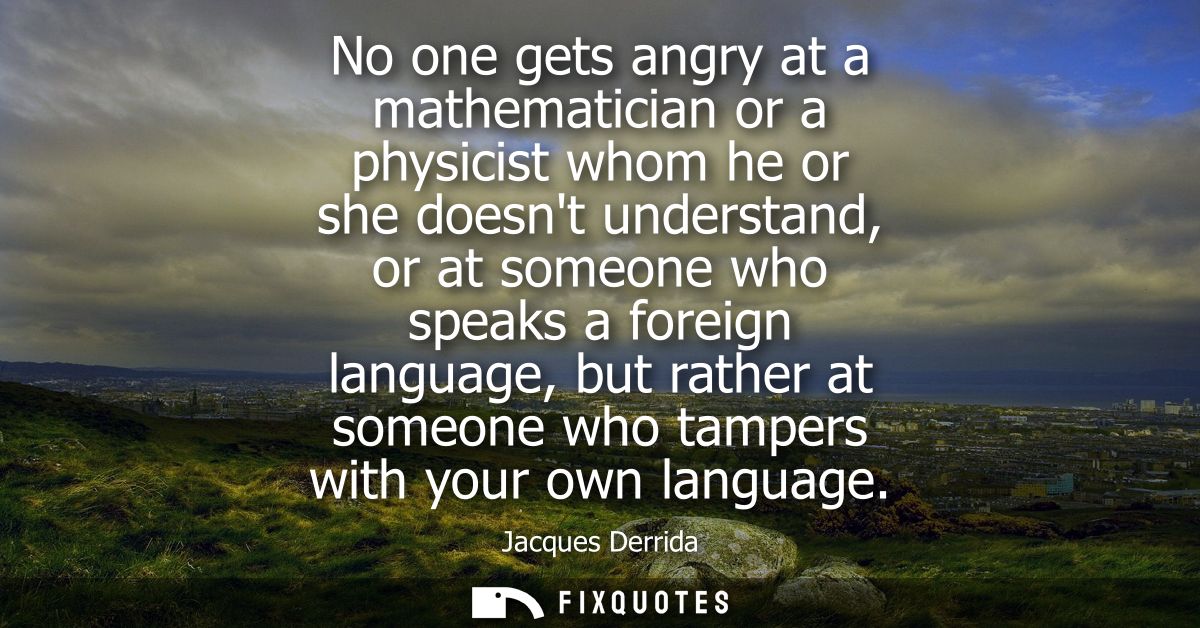
"No one gets angry at a mathematician or a physicist whom he or she doesn't understand, or at someone who speaks a foreign language, but rather at someone who tampers with your own language"
About this Quote
The bite in “tampers” matters. It frames linguistic innovation not as discovery but as meddling, like someone rewriting the rules of your household while you’re still living there. That’s the subtext of Derrida’s larger project: meaning isn’t a fixed deposit guarded by experts; it’s unstable, negotiated, and therefore threatening. His own famously difficult prose often triggered the exact reaction he describes, which gives the line a sly, self-aware edge. He’s diagnosing the backlash against theory while also explaining why it was inevitable.
Contextually, this sits in late-20th-century battles over structuralism, post-structuralism, and the authority of interpretation. Derrida suggests that language feels like property: “your own language” is tied to identity, class, nation, and common sense. When a philosopher “tamper[s]” with it, they aren’t merely making an argument; they’re disturbing the cultural software that makes the world feel stable. The quote works because it recasts intellectual hostility as something more intimate than disagreement: a fear of losing the very medium through which you recognize yourself and others.
Quote Details
| Topic | Wisdom |
|---|---|
| Source | Help us find the source |
| Cite |
Citation Formats
APA Style (7th ed.)
Derrida, Jacques. (2026, January 18). No one gets angry at a mathematician or a physicist whom he or she doesn't understand, or at someone who speaks a foreign language, but rather at someone who tampers with your own language. FixQuotes. https://fixquotes.com/quotes/no-one-gets-angry-at-a-mathematician-or-a-2718/
Chicago Style
Derrida, Jacques. "No one gets angry at a mathematician or a physicist whom he or she doesn't understand, or at someone who speaks a foreign language, but rather at someone who tampers with your own language." FixQuotes. January 18, 2026. https://fixquotes.com/quotes/no-one-gets-angry-at-a-mathematician-or-a-2718/.
MLA Style (9th ed.)
"No one gets angry at a mathematician or a physicist whom he or she doesn't understand, or at someone who speaks a foreign language, but rather at someone who tampers with your own language." FixQuotes, 18 Jan. 2026, https://fixquotes.com/quotes/no-one-gets-angry-at-a-mathematician-or-a-2718/. Accessed 5 Apr. 2026.