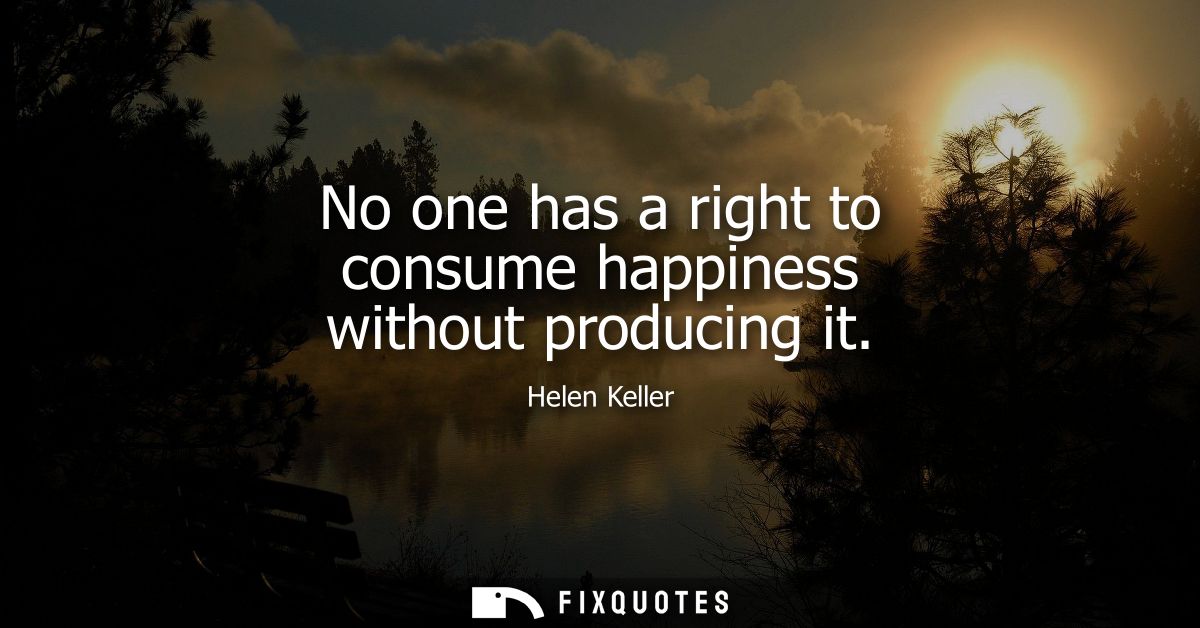
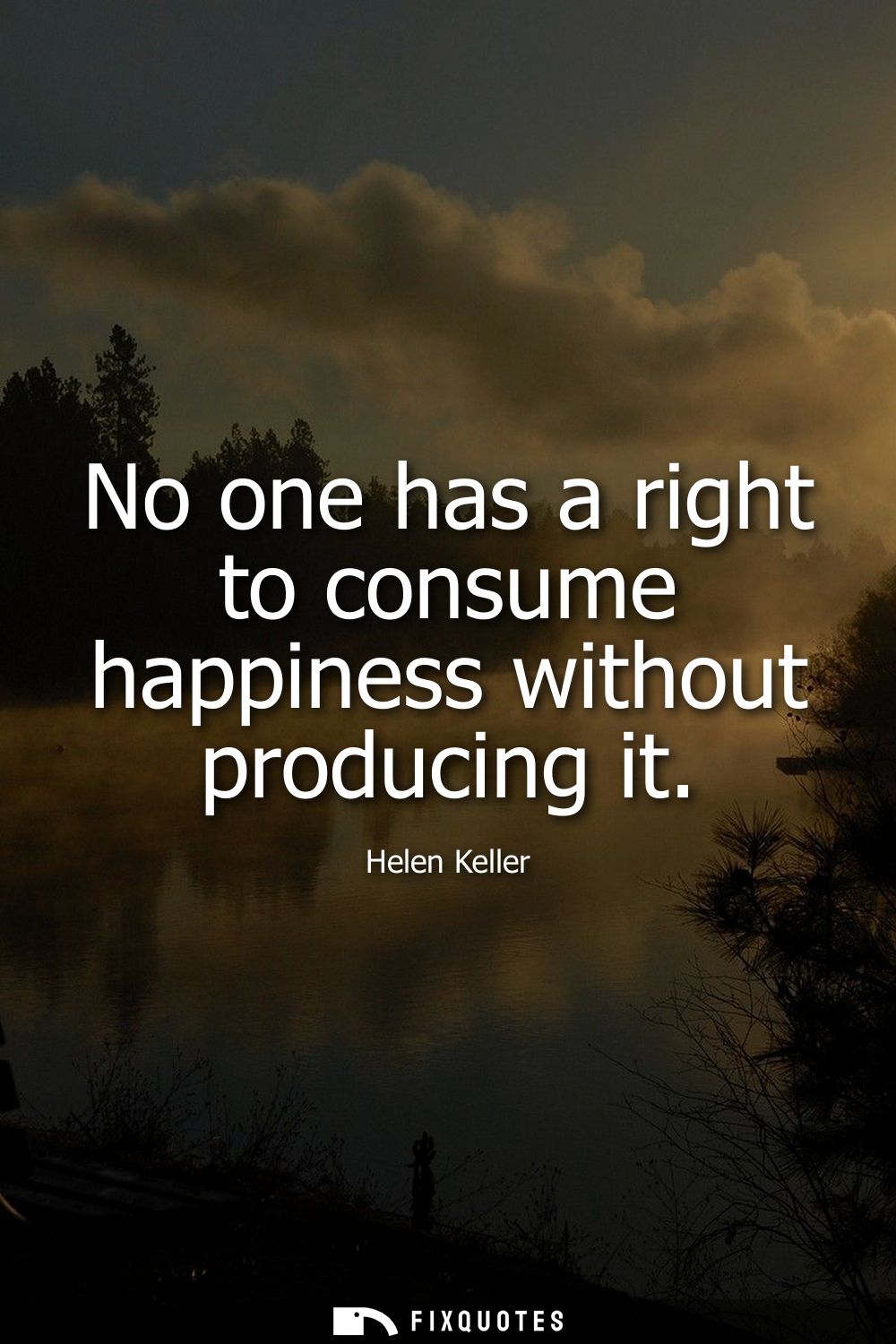
"No one has a right to consume happiness without producing it"
About this Quote
Keller’s line lands like a moral invoice: happiness isn’t a private luxury item you’re entitled to cash in, it’s a social good you’re expected to help manufacture. The phrasing is deliberately rights-talky and transactional. “No one has a right” borrows the language of law and citizenship, then swivels it toward the everyday ethics of taking and giving. “Consume” is the sharpest verb here: it makes joy sound like a resource you can deplete, a product you can binge, a comfort you can hoard. Against that, “producing” reframes happiness as labor - not only personal self-care, but contribution, repair, generosity, the unglamorous work of making other lives more livable.
The subtext is a rebuke to spectatorship. Keller, who lived at the crossroads of disability, public fame, and political radicalism, didn’t write from a place of abstract uplift. She spent decades insisting that suffering is not just an individual misfortune but a civic problem - shaped by poverty, war, labor exploitation, and neglect. In that context, the quote reads less like a scold aimed at individual gratitude and more like a critique of a society that permits comfort without responsibility.
It also quietly rejects the idea that happiness is a zero-sum reward for the deserving. Keller isn’t saying you must be cheerful only after earning it; she’s saying the cleanest way to justify your own joy is to enlarge the conditions that make joy possible for others. It’s a line built to embarrass complacency and dignify service, without ever letting “happiness” off the hook as something purely personal.
The subtext is a rebuke to spectatorship. Keller, who lived at the crossroads of disability, public fame, and political radicalism, didn’t write from a place of abstract uplift. She spent decades insisting that suffering is not just an individual misfortune but a civic problem - shaped by poverty, war, labor exploitation, and neglect. In that context, the quote reads less like a scold aimed at individual gratitude and more like a critique of a society that permits comfort without responsibility.
It also quietly rejects the idea that happiness is a zero-sum reward for the deserving. Keller isn’t saying you must be cheerful only after earning it; she’s saying the cleanest way to justify your own joy is to enlarge the conditions that make joy possible for others. It’s a line built to embarrass complacency and dignify service, without ever letting “happiness” off the hook as something purely personal.
Quote Details
| Topic | Ethics & Morality |
|---|---|
| Source | Help us find the source |
| Cite |
Citation Formats
APA Style (7th ed.)
Keller, Helen. (2026, January 17). No one has a right to consume happiness without producing it. FixQuotes. https://fixquotes.com/quotes/no-one-has-a-right-to-consume-happiness-without-35758/
Chicago Style
Keller, Helen. "No one has a right to consume happiness without producing it." FixQuotes. January 17, 2026. https://fixquotes.com/quotes/no-one-has-a-right-to-consume-happiness-without-35758/.
MLA Style (9th ed.)
"No one has a right to consume happiness without producing it." FixQuotes, 17 Jan. 2026, https://fixquotes.com/quotes/no-one-has-a-right-to-consume-happiness-without-35758/. Accessed 28 Mar. 2026.
More Quotes by Helen
Add to List