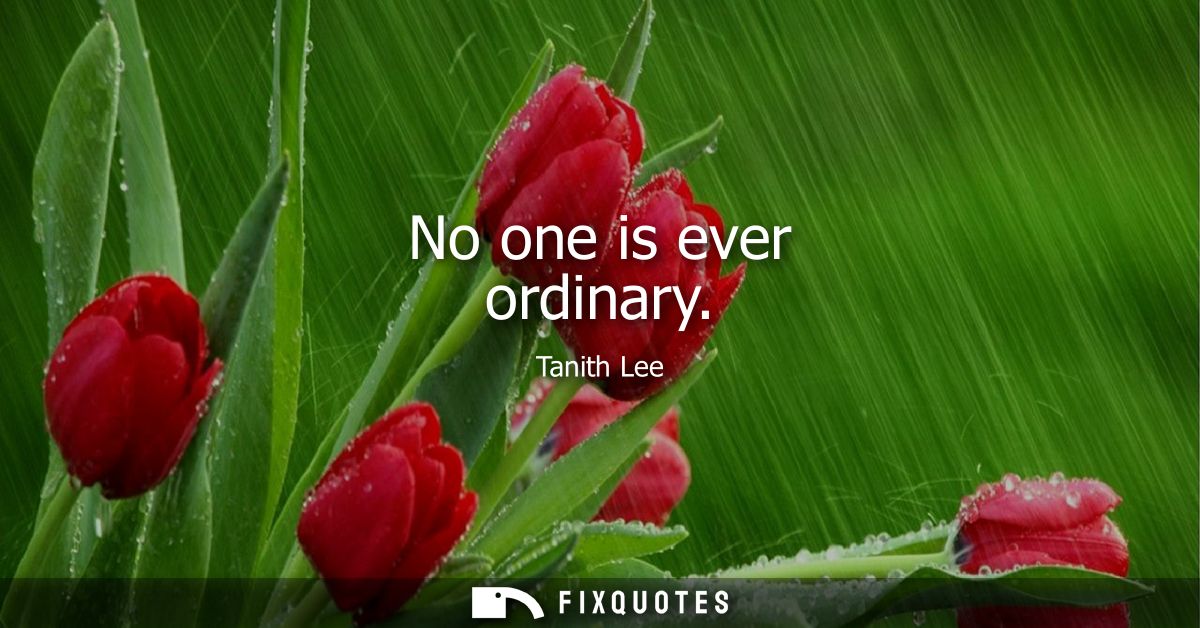
"No one is ever ordinary"
About this Quote
Tanith Lee’s “No one is ever ordinary” is the kind of line that looks like a greeting-card platitude until you remember who’s saying it: a writer whose work treated the so-called “normal” as a flimsy costume, always one sharp tug away from revealing claws, wings, hunger, divinity. Lee isn’t offering reassurance so much as issuing a corrective to the lazy categories we use to sort people for our own convenience. “Ordinary” isn’t a neutral description here; it’s a social verdict, a way to erase the messy particulars that don’t fit a neat template.
The sentence works because of its absolutism. “No one” slams the door on exceptions, and “ever” makes the claim feel cosmic, not situational. It’s an incantation against the default setting of realism, where characters and lives are reduced to types: the reliable coworker, the difficult woman, the background extra. Lee’s fiction famously expands the frame, granting interiority and mythic charge to figures that polite society would prefer to keep “average” and therefore ignorable.
The subtext is slightly dangerous in the best way: if no one is ordinary, then the systems built on “normal” are revealed as fragile and coercive. Gender, class, respectability, even sanity become narratives imposed from the outside. Coming from a late-20th-century fantasy and horror voice often sidelined by literary gatekeeping, the line also reads as a quiet rebuke to canons that decide whose strangeness counts as art. Lee’s point isn’t that everyone is special; it’s that “ordinary” is a story we tell to stop looking closely.
The sentence works because of its absolutism. “No one” slams the door on exceptions, and “ever” makes the claim feel cosmic, not situational. It’s an incantation against the default setting of realism, where characters and lives are reduced to types: the reliable coworker, the difficult woman, the background extra. Lee’s fiction famously expands the frame, granting interiority and mythic charge to figures that polite society would prefer to keep “average” and therefore ignorable.
The subtext is slightly dangerous in the best way: if no one is ordinary, then the systems built on “normal” are revealed as fragile and coercive. Gender, class, respectability, even sanity become narratives imposed from the outside. Coming from a late-20th-century fantasy and horror voice often sidelined by literary gatekeeping, the line also reads as a quiet rebuke to canons that decide whose strangeness counts as art. Lee’s point isn’t that everyone is special; it’s that “ordinary” is a story we tell to stop looking closely.
Quote Details
| Topic | Wisdom |
|---|---|
| Source | Help us find the source |
| Cite |
Citation Formats
APA Style (7th ed.)
Lee, Tanith. (2026, January 15). No one is ever ordinary. FixQuotes. https://fixquotes.com/quotes/no-one-is-ever-ordinary-145280/
Chicago Style
Lee, Tanith. "No one is ever ordinary." FixQuotes. January 15, 2026. https://fixquotes.com/quotes/no-one-is-ever-ordinary-145280/.
MLA Style (9th ed.)
"No one is ever ordinary." FixQuotes, 15 Jan. 2026, https://fixquotes.com/quotes/no-one-is-ever-ordinary-145280/. Accessed 30 Mar. 2026.
More Quotes by Tanith
Add to List