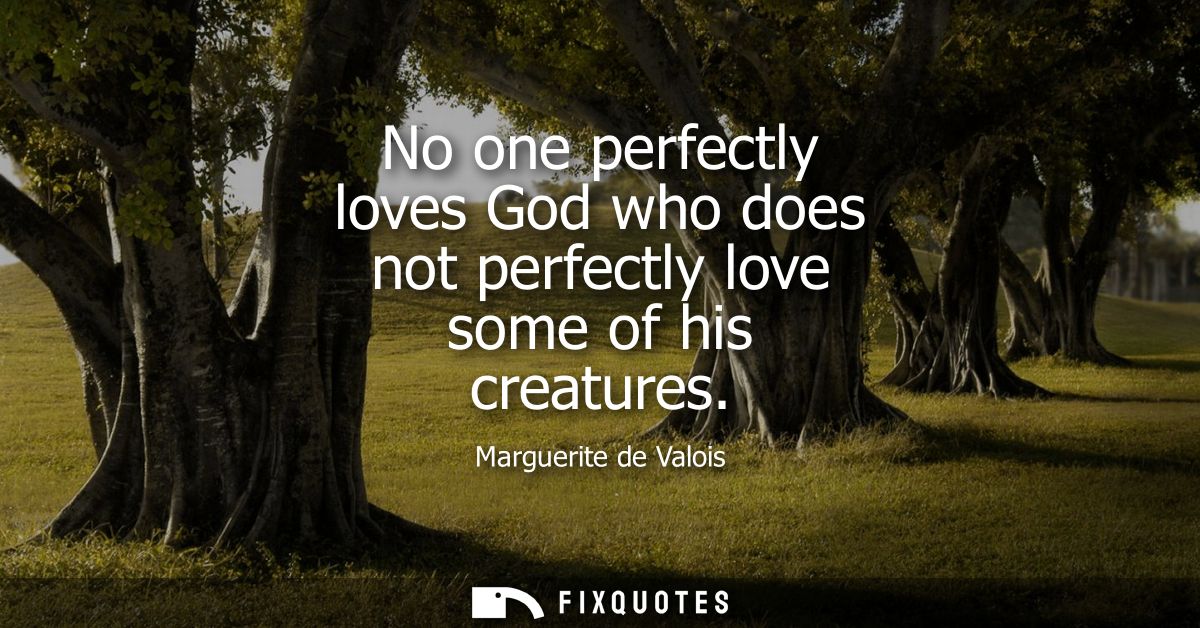
"No one perfectly loves God who does not perfectly love some of his creatures"
About this Quote
The subtext is political as much as spiritual. Marguerite lived through the French Wars of Religion, a period when “love of God” was routinely weaponized into factional cruelty. In that climate, insisting that divine love is inseparable from love of “his creatures” functions like a moral tripwire: it exposes the hypocrisy of sanctified violence and the self-congratulating austerity of courtly religion. You can’t claim heaven while treating humans as expendable.
Her phrasing also smuggles in a strategic humility. She doesn’t demand perfect love for all creatures, an impossible standard that would collapse into guilt or performance. She says “some.” It’s a realist’s theology: start where you are, with concrete attachments, and let that be the evidence of the invisible. Coming from royalty - a role built on hierarchy, spectacle, and distance - the claim lands as both confession and critique: the only credible holiness is the kind that gets close enough to be tested.
Quote Details
| Topic | God |
|---|---|
| Source | Help us find the source |
| Cite |
Citation Formats
APA Style (7th ed.)
Valois, Marguerite de. (2026, January 16). No one perfectly loves God who does not perfectly love some of his creatures. FixQuotes. https://fixquotes.com/quotes/no-one-perfectly-loves-god-who-does-not-perfectly-131289/
Chicago Style
Valois, Marguerite de. "No one perfectly loves God who does not perfectly love some of his creatures." FixQuotes. January 16, 2026. https://fixquotes.com/quotes/no-one-perfectly-loves-god-who-does-not-perfectly-131289/.
MLA Style (9th ed.)
"No one perfectly loves God who does not perfectly love some of his creatures." FixQuotes, 16 Jan. 2026, https://fixquotes.com/quotes/no-one-perfectly-loves-god-who-does-not-perfectly-131289/. Accessed 12 Feb. 2026.