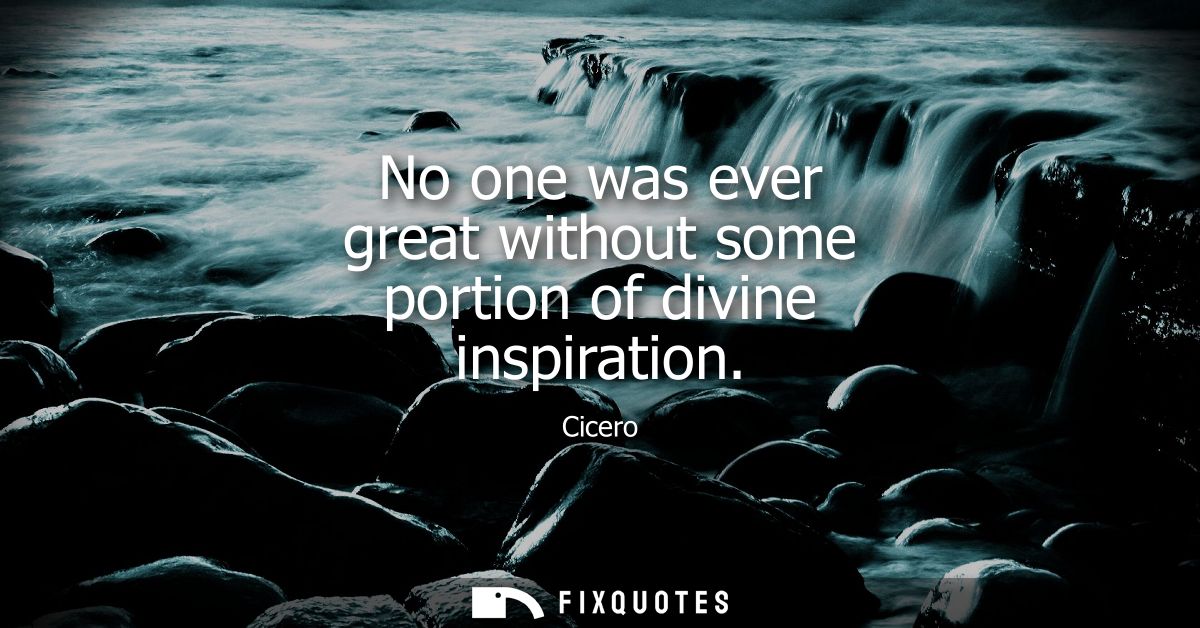
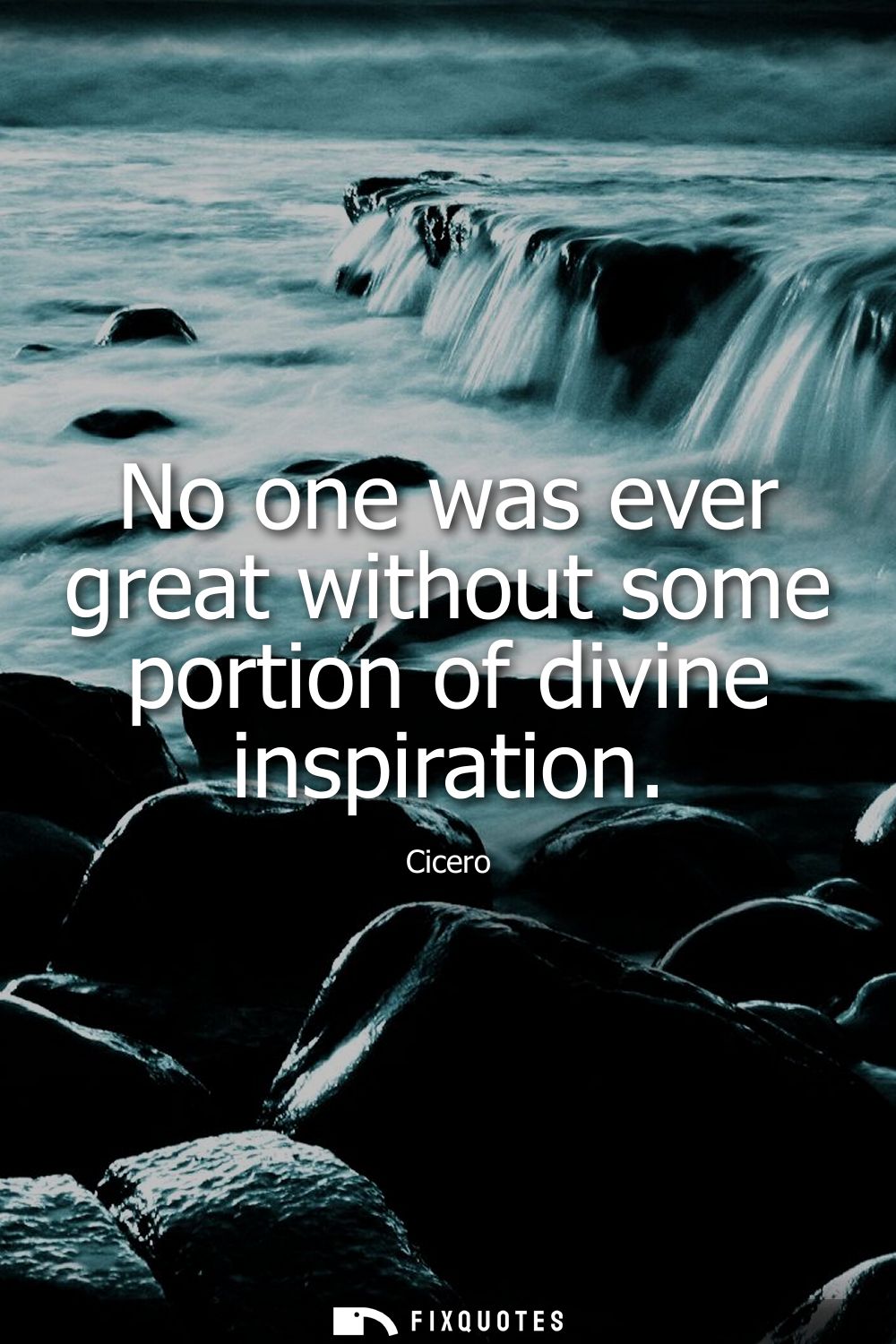
"No one was ever great without some portion of divine inspiration"
About this Quote
Greatness, Cicero suggests, is never just a matter of polish. It requires a spark that feels borrowed from somewhere higher than training, lineage, or brute will. In a Roman culture that prized virtus, discipline, and public achievement, that’s a provocative move: he grants the Republic its beloved meritocracy, then quietly argues that merit alone can’t explain the figures who bend history.
The phrase "some portion" matters. Cicero isn’t preaching mystical possession so much as staking out a credible middle ground between cold rationalism and superstition. A statesman and lawyer who made his living on argument, he treats divine inspiration as a practical category: the sudden clarity, the intuitive leap, the charisma that turns competence into authority. It’s a compliment to the extraordinary, but also a hedge against envy. If greatness has a divine ingredient, the rest of us aren’t merely outclassed; we’re operating in a different economy altogether.
Context sharpens the intent. Cicero lived through the Republic’s unraveling, watching ambitious men claim exceptional status as justification for exceptional power. Invoking the divine lets him dignify moral and civic excellence while implicitly warning that not every loud claim to destiny deserves belief. "Inspiration" here isn’t a license for tyranny; it’s a standard that raises the bar. Greatness, in his frame, should look like providence married to responsibility, not mere ambition dressed up as fate.
The phrase "some portion" matters. Cicero isn’t preaching mystical possession so much as staking out a credible middle ground between cold rationalism and superstition. A statesman and lawyer who made his living on argument, he treats divine inspiration as a practical category: the sudden clarity, the intuitive leap, the charisma that turns competence into authority. It’s a compliment to the extraordinary, but also a hedge against envy. If greatness has a divine ingredient, the rest of us aren’t merely outclassed; we’re operating in a different economy altogether.
Context sharpens the intent. Cicero lived through the Republic’s unraveling, watching ambitious men claim exceptional status as justification for exceptional power. Invoking the divine lets him dignify moral and civic excellence while implicitly warning that not every loud claim to destiny deserves belief. "Inspiration" here isn’t a license for tyranny; it’s a standard that raises the bar. Greatness, in his frame, should look like providence married to responsibility, not mere ambition dressed up as fate.
Quote Details
| Topic | Wisdom |
|---|---|
| Source | Help us find the source |
| Cite |
Citation Formats
APA Style (7th ed.)
Cicero. (2026, January 18). No one was ever great without some portion of divine inspiration. FixQuotes. https://fixquotes.com/quotes/no-one-was-ever-great-without-some-portion-of-9031/
Chicago Style
Cicero. "No one was ever great without some portion of divine inspiration." FixQuotes. January 18, 2026. https://fixquotes.com/quotes/no-one-was-ever-great-without-some-portion-of-9031/.
MLA Style (9th ed.)
"No one was ever great without some portion of divine inspiration." FixQuotes, 18 Jan. 2026, https://fixquotes.com/quotes/no-one-was-ever-great-without-some-portion-of-9031/. Accessed 24 Mar. 2026.
More Quotes by Cicero
Add to List