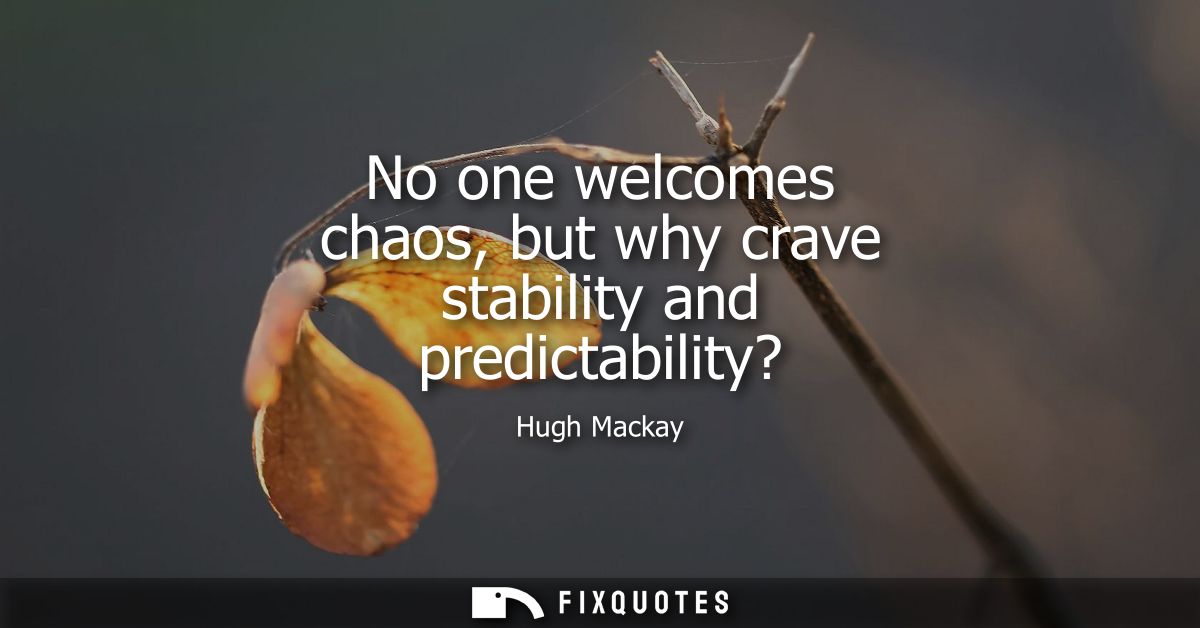
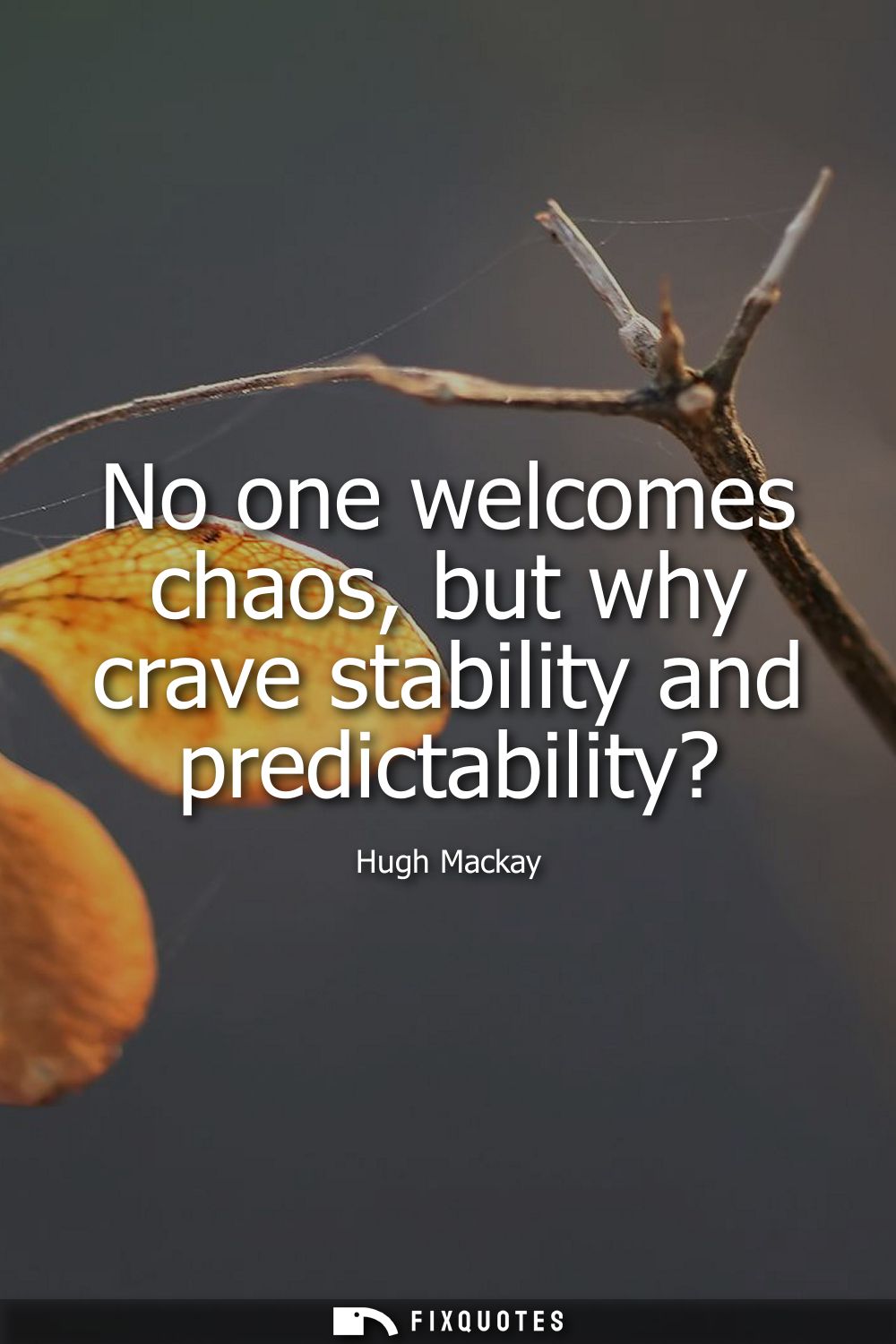
"No one welcomes chaos, but why crave stability and predictability?"
About this Quote
Chaos is the villain nobody invites to dinner, yet Mackay needles at our reflex to bolt the doors anyway. The line works because it’s built like a trap: it begins with a concession almost everyone will nod along to, then pivots into a question that quietly implicates the reader. Stability and predictability aren’t dismissed as virtues; they’re framed as cravings, closer to appetite than principle. That word choice matters. A craving suggests dependency, even self-medication: the comfort we reach for when uncertainty feels like a threat rather than a condition of being alive.
Mackay’s intent isn’t to romanticize disorder. It’s to puncture the moral status of “stable” as automatically good. In modern life, stability is often sold as adulthood itself: the fixed career path, the five-year plan, the optimized routine. Predictability becomes a consumer product and a personal brand. Mackay’s question hints that this pursuit can shrink a life, turning it into a managed environment where surprise is treated as a design flaw.
The subtext is psychological and cultural: fear of chaos often masks fear of agency. If everything is predictable, we’re spared the anxiety of choice, the risk of failure, the messy negotiations that growth requires. The quote nudges us toward a more adult relationship with uncertainty: not welcoming chaos, but recognizing that too much stability can be its own kind of stagnation, a quiet bargain where safety is purchased with possibility.
Mackay’s intent isn’t to romanticize disorder. It’s to puncture the moral status of “stable” as automatically good. In modern life, stability is often sold as adulthood itself: the fixed career path, the five-year plan, the optimized routine. Predictability becomes a consumer product and a personal brand. Mackay’s question hints that this pursuit can shrink a life, turning it into a managed environment where surprise is treated as a design flaw.
The subtext is psychological and cultural: fear of chaos often masks fear of agency. If everything is predictable, we’re spared the anxiety of choice, the risk of failure, the messy negotiations that growth requires. The quote nudges us toward a more adult relationship with uncertainty: not welcoming chaos, but recognizing that too much stability can be its own kind of stagnation, a quiet bargain where safety is purchased with possibility.
Quote Details
| Topic | Deep |
|---|---|
| Source | Help us find the source |
| Cite |
Citation Formats
APA Style (7th ed.)
Mackay, Hugh. (2026, January 17). No one welcomes chaos, but why crave stability and predictability? FixQuotes. https://fixquotes.com/quotes/no-one-welcomes-chaos-but-why-crave-stability-and-55129/
Chicago Style
Mackay, Hugh. "No one welcomes chaos, but why crave stability and predictability?" FixQuotes. January 17, 2026. https://fixquotes.com/quotes/no-one-welcomes-chaos-but-why-crave-stability-and-55129/.
MLA Style (9th ed.)
"No one welcomes chaos, but why crave stability and predictability?" FixQuotes, 17 Jan. 2026, https://fixquotes.com/quotes/no-one-welcomes-chaos-but-why-crave-stability-and-55129/. Accessed 14 Mar. 2026.
More Quotes by Hugh
Add to List