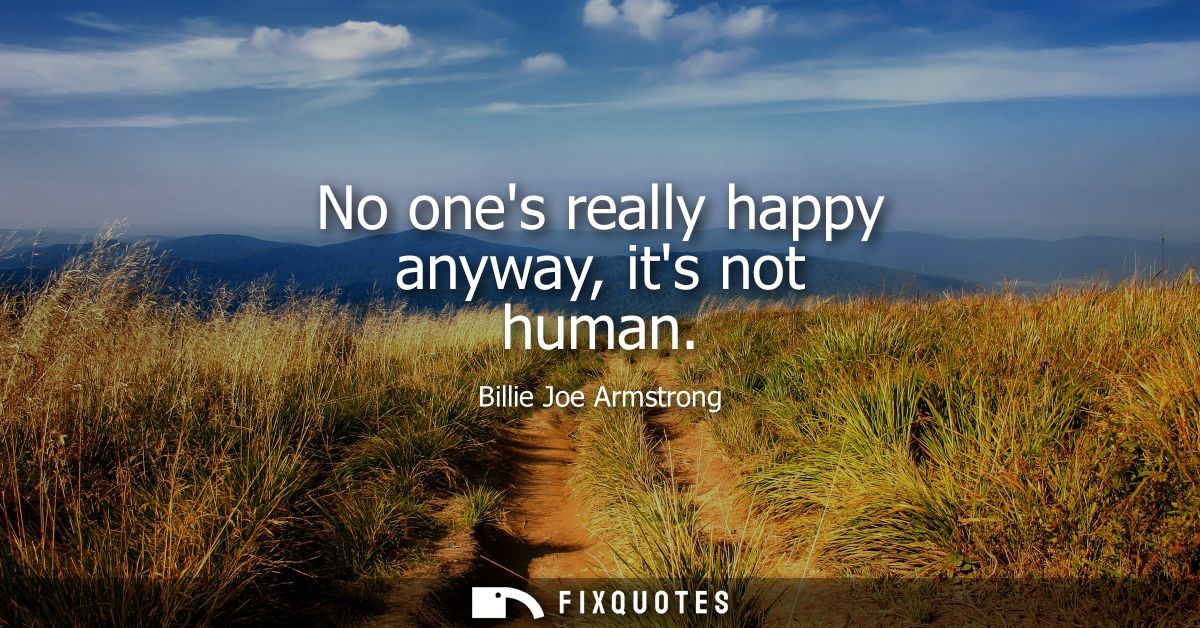
"No one's really happy anyway, it's not human"
About this Quote
Armstrong’s line lands like a shrug with a switchblade tucked inside it: bleak, funny, and strangely comforting. Coming from a punk frontman whose brand is equal parts sneer and sincerity, “No one’s really happy anyway” isn’t just teenage nihilism preserved in amber. It’s a defensive move against a culture that sells happiness as both a moral duty and a consumer product. If you’re not “thriving,” the algorithm implies, you’re failing. Armstrong flips that script by making unhappiness ordinary, even biological: “it’s not human.”
The phrasing matters. “Really happy” is doing heavy lifting, quietly mocking the plastic, high-gloss version of joy we’re trained to perform. He’s not denying pleasure or meaning; he’s rejecting the expectation of permanent, fully resolved contentment. The second clause sharpens the point: not only is constant happiness unrealistic, it’s suspect, like a symptom of denial, privilege, sedation, or branding.
In Green Day’s wider emotional universe, this tracks with the band’s long-standing fascination with alienation as a communal experience. Punk has always trafficked in the relief of saying the unsayable: that boredom, anxiety, and dissatisfaction are not personal defects but predictable responses to modern life. The subtext is an invitation to stop auditioning for joy and start admitting what’s actually there. If no one’s “really happy,” you’re not broken; you’re just awake.
The phrasing matters. “Really happy” is doing heavy lifting, quietly mocking the plastic, high-gloss version of joy we’re trained to perform. He’s not denying pleasure or meaning; he’s rejecting the expectation of permanent, fully resolved contentment. The second clause sharpens the point: not only is constant happiness unrealistic, it’s suspect, like a symptom of denial, privilege, sedation, or branding.
In Green Day’s wider emotional universe, this tracks with the band’s long-standing fascination with alienation as a communal experience. Punk has always trafficked in the relief of saying the unsayable: that boredom, anxiety, and dissatisfaction are not personal defects but predictable responses to modern life. The subtext is an invitation to stop auditioning for joy and start admitting what’s actually there. If no one’s “really happy,” you’re not broken; you’re just awake.
Quote Details
| Topic | Happiness |
|---|---|
| Source | Help us find the source |
| Cite |
Citation Formats
APA Style (7th ed.)
Armstrong, Billie Joe. (2026, January 17). No one's really happy anyway, it's not human. FixQuotes. https://fixquotes.com/quotes/no-ones-really-happy-anyway-its-not-human-39070/
Chicago Style
Armstrong, Billie Joe. "No one's really happy anyway, it's not human." FixQuotes. January 17, 2026. https://fixquotes.com/quotes/no-ones-really-happy-anyway-its-not-human-39070/.
MLA Style (9th ed.)
"No one's really happy anyway, it's not human." FixQuotes, 17 Jan. 2026, https://fixquotes.com/quotes/no-ones-really-happy-anyway-its-not-human-39070/. Accessed 26 Mar. 2026.
More Quotes by Billie
Add to List