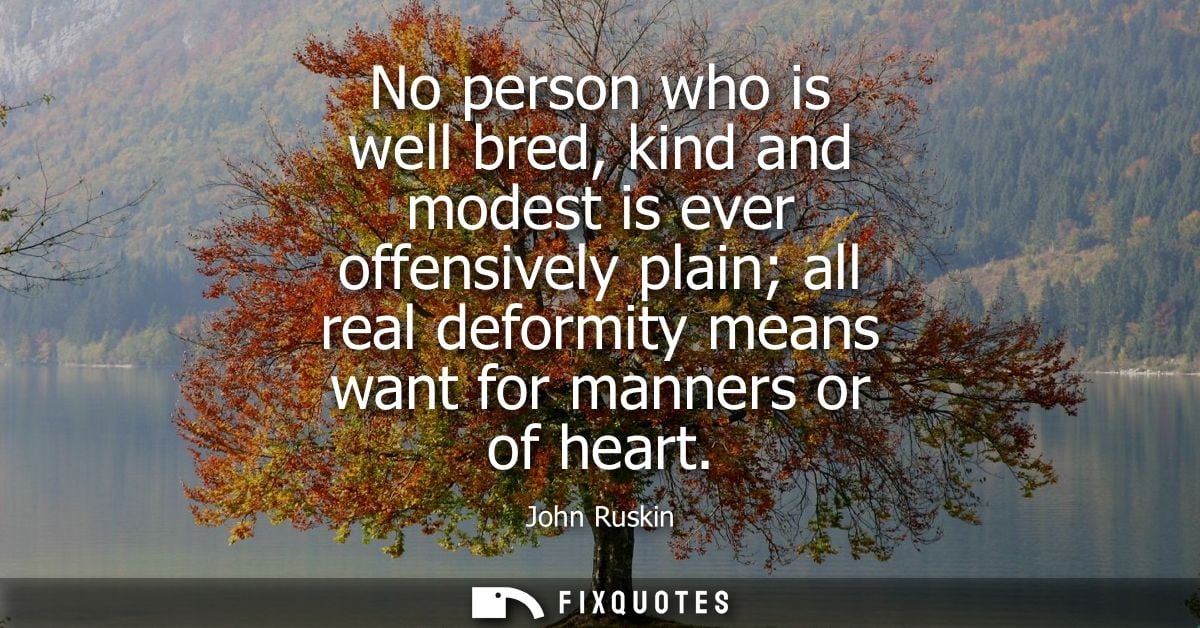
"No person who is well bred, kind and modest is ever offensively plain; all real deformity means want for manners or of heart"
About this Quote
That move does a lot of cultural work. It flatters the polite classes (“well bred” is doing heavy lifting) by casting their codes of restraint as spiritual beauty. It also reroutes discomfort about physical difference into an ethical verdict: if someone reads as repellent, the problem must be inner rot. The insult is disguised as uplift. Ruskin claims to rescue people from superficial judgment, then reintroduces judgment on a deeper, more inescapable level.
Context matters. Ruskin wrote in a 19th-century Britain obsessed with physiognomy, “character” as visible destiny, and strict manners as a technology of class control. His art criticism often treats beauty as a moral language; here he makes the body a moral billboard. The intent is disciplinary as much as compassionate: cultivate gentility and you will be safe from aesthetic contempt. The subtext is harsher: if society recoils from you, you probably deserve it.
Quote Details
| Topic | Kindness |
|---|---|
| Source | Help us find the source |
| Cite |
Citation Formats
APA Style (7th ed.)
Ruskin, John. (2026, January 18). No person who is well bred, kind and modest is ever offensively plain; all real deformity means want for manners or of heart. FixQuotes. https://fixquotes.com/quotes/no-person-who-is-well-bred-kind-and-modest-is-8283/
Chicago Style
Ruskin, John. "No person who is well bred, kind and modest is ever offensively plain; all real deformity means want for manners or of heart." FixQuotes. January 18, 2026. https://fixquotes.com/quotes/no-person-who-is-well-bred-kind-and-modest-is-8283/.
MLA Style (9th ed.)
"No person who is well bred, kind and modest is ever offensively plain; all real deformity means want for manners or of heart." FixQuotes, 18 Jan. 2026, https://fixquotes.com/quotes/no-person-who-is-well-bred-kind-and-modest-is-8283/. Accessed 4 Apr. 2026.