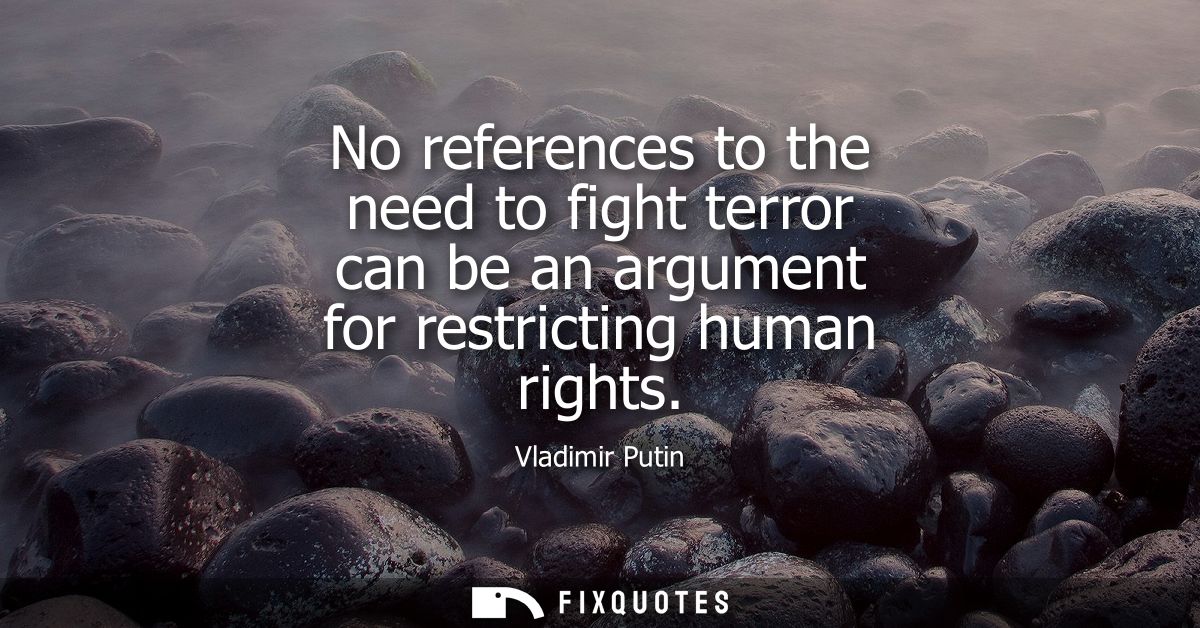
"No references to the need to fight terror can be an argument for restricting human rights"
About this Quote
The subtext is geopolitical as much as moral. This isn’t primarily a plea for universal rights; it’s a bid to seize rhetorical high ground and complicate Western criticism. By treating “fight terror” as a rhetorical crutch, Putin positions human rights language as a weapon that can be turned outward: if Washington or Brussels condemns Moscow, Moscow can point to Guantanamo, extraordinary rendition, or mass surveillance and say, you did it first. It’s symmetry politics, dressed as principle.
Context matters because Russia has long labeled a broad range of opponents as extremists or terrorists, especially around Chechnya and later domestic protest movements. So the line also functions as a preemptive reframing: the problem isn’t harsh security policy itself, it’s the hypocrisy of invoking terror selectively. The brilliance is its portability: it can be quoted by rights advocates against any state, even the one whose president uttered it.
Quote Details
| Topic | Human Rights |
|---|---|
| Source | Help us find the source |
| Cite |
Citation Formats
APA Style (7th ed.)
Putin, Vladimir. (2026, January 16). No references to the need to fight terror can be an argument for restricting human rights. FixQuotes. https://fixquotes.com/quotes/no-references-to-the-need-to-fight-terror-can-be-84952/
Chicago Style
Putin, Vladimir. "No references to the need to fight terror can be an argument for restricting human rights." FixQuotes. January 16, 2026. https://fixquotes.com/quotes/no-references-to-the-need-to-fight-terror-can-be-84952/.
MLA Style (9th ed.)
"No references to the need to fight terror can be an argument for restricting human rights." FixQuotes, 16 Jan. 2026, https://fixquotes.com/quotes/no-references-to-the-need-to-fight-terror-can-be-84952/. Accessed 4 Apr. 2026.