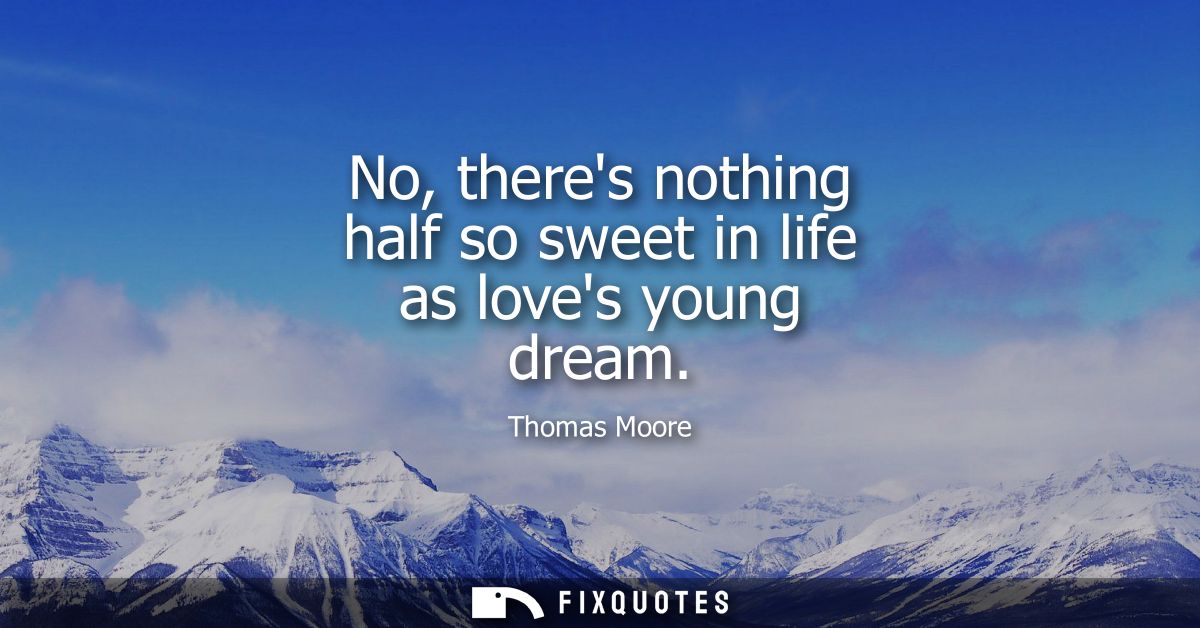
"No, there's nothing half so sweet in life as love's young dream"
About this Quote
Moore’s line is a sugar rush with an agenda: it doesn’t just praise youthful love, it tries to freeze it in amber. The phrasing is stage-ready, almost sung rather than spoken, and that’s the point. As a poet best known for lyric polish, Moore crafts “No” as a little dramatic flourish, a rebuttal to any adult, rational voice that might want to qualify the claim. He isn’t arguing; he’s insisting, charming you into agreement before you can object.
“Love’s young dream” is doing double duty. It’s not simply young love; it’s love as imagined by the young, a state where projection and feeling blur into one luminous story. The sweetness here isn’t rooted in knowledge or endurance but in unreality: the beloved as ideal, the future as guaranteed, the self as newly heroic. Moore’s superlative (“nothing half so sweet”) is intentionally excessive, a romantic overclaim that captures how first love feels precisely because it refuses moderation.
Context matters: early 19th-century Romantic culture prized intensity, innocence, and the private drama of emotion, often as a counterweight to a rapidly modernizing world. Moore’s Ireland, his politics, his salon world in London - all of it sits behind this velvet line. It offers readers a sanctioned escape: nostalgia before the loss has even happened. The subtext is faintly melancholy. A “dream” is sweet because it ends, and because waking up is inevitable. Moore gives you the high, while quietly acknowledging the crash.
“Love’s young dream” is doing double duty. It’s not simply young love; it’s love as imagined by the young, a state where projection and feeling blur into one luminous story. The sweetness here isn’t rooted in knowledge or endurance but in unreality: the beloved as ideal, the future as guaranteed, the self as newly heroic. Moore’s superlative (“nothing half so sweet”) is intentionally excessive, a romantic overclaim that captures how first love feels precisely because it refuses moderation.
Context matters: early 19th-century Romantic culture prized intensity, innocence, and the private drama of emotion, often as a counterweight to a rapidly modernizing world. Moore’s Ireland, his politics, his salon world in London - all of it sits behind this velvet line. It offers readers a sanctioned escape: nostalgia before the loss has even happened. The subtext is faintly melancholy. A “dream” is sweet because it ends, and because waking up is inevitable. Moore gives you the high, while quietly acknowledging the crash.
Quote Details
| Topic | Romantic |
|---|---|
| Source | Help us find the source |
| Cite |
Citation Formats
APA Style (7th ed.)
Moore, Thomas. (2026, January 18). No, there's nothing half so sweet in life as love's young dream. FixQuotes. https://fixquotes.com/quotes/no-theres-nothing-half-so-sweet-in-life-as-loves-11122/
Chicago Style
Moore, Thomas. "No, there's nothing half so sweet in life as love's young dream." FixQuotes. January 18, 2026. https://fixquotes.com/quotes/no-theres-nothing-half-so-sweet-in-life-as-loves-11122/.
MLA Style (9th ed.)
"No, there's nothing half so sweet in life as love's young dream." FixQuotes, 18 Jan. 2026, https://fixquotes.com/quotes/no-theres-nothing-half-so-sweet-in-life-as-loves-11122/. Accessed 5 Apr. 2026.
More Quotes by Thomas
Add to List