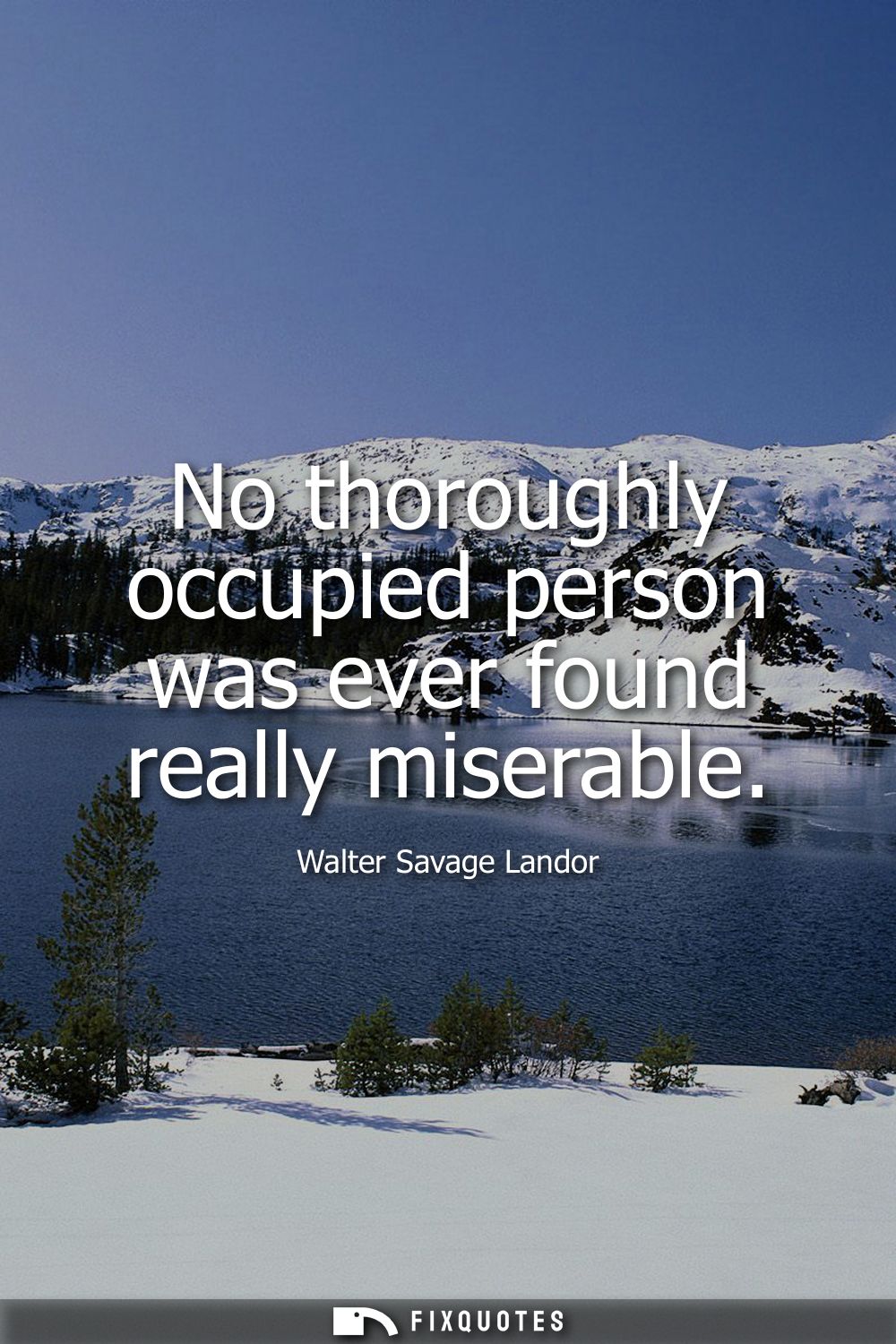
"No thoroughly occupied person was ever found really miserable"
About this Quote
Busyness isn’t offered here as a productivity hack; it’s Landor’s antidote to the special 19th-century sickness of self-scrutiny. “Thoroughly occupied” is a pointed phrase: not merely scheduled, not merely distracted, but taken up by something with friction and demand. Landor isn’t praising hustle. He’s arguing that misery thrives in the unclaimed hours where the mind turns into its own echo chamber, feeding on grievance, regret, and the romantic glamor of despair.
The line also carries a quiet moral edge. Occupation implies purpose, craft, responsibility - a life tethered to tasks that pull you outward, toward work and other people, away from the indulgence of feeling as identity. For a poet often associated with classical restraint and a certain patrician severity, this is less comfort than correction. Misery, he suggests, is not always a profound insight; it can be a symptom of too much unused attention.
Context matters: Landor lived through revolutions, exile, and relentless literary feuds. He knew temperament could be theatrical. The quote reads like a rebuke to the fashionable melancholy of his era - the Byronic pose where suffering becomes a badge of depth. Occupation, in Landor’s formulation, doesn’t erase pain or grief, but it reduces the room they have to metastasize into a worldview. It’s a stark claim, maybe even willfully overstated, yet rhetorically effective because it turns happiness into a practice: not something you discover inside yourself, but something you build by committing your attention.
The line also carries a quiet moral edge. Occupation implies purpose, craft, responsibility - a life tethered to tasks that pull you outward, toward work and other people, away from the indulgence of feeling as identity. For a poet often associated with classical restraint and a certain patrician severity, this is less comfort than correction. Misery, he suggests, is not always a profound insight; it can be a symptom of too much unused attention.
Context matters: Landor lived through revolutions, exile, and relentless literary feuds. He knew temperament could be theatrical. The quote reads like a rebuke to the fashionable melancholy of his era - the Byronic pose where suffering becomes a badge of depth. Occupation, in Landor’s formulation, doesn’t erase pain or grief, but it reduces the room they have to metastasize into a worldview. It’s a stark claim, maybe even willfully overstated, yet rhetorically effective because it turns happiness into a practice: not something you discover inside yourself, but something you build by committing your attention.
Quote Details
| Topic | Happiness |
|---|---|
| Source | Help us find the source |
| Cite | Cite this Quote |
Citation Formats
APA Style (7th ed.)
Landor, Walter Savage. (n.d.). No thoroughly occupied person was ever found really miserable. FixQuotes. https://fixquotes.com/quotes/no-thoroughly-occupied-person-was-ever-found-73380/
Chicago Style
Landor, Walter Savage. "No thoroughly occupied person was ever found really miserable." FixQuotes. Accessed February 2, 2026. https://fixquotes.com/quotes/no-thoroughly-occupied-person-was-ever-found-73380/.
MLA Style (9th ed.)
"No thoroughly occupied person was ever found really miserable." FixQuotes, https://fixquotes.com/quotes/no-thoroughly-occupied-person-was-ever-found-73380/. Accessed 2 Feb. 2026.
More Quotes by Walter
Add to List