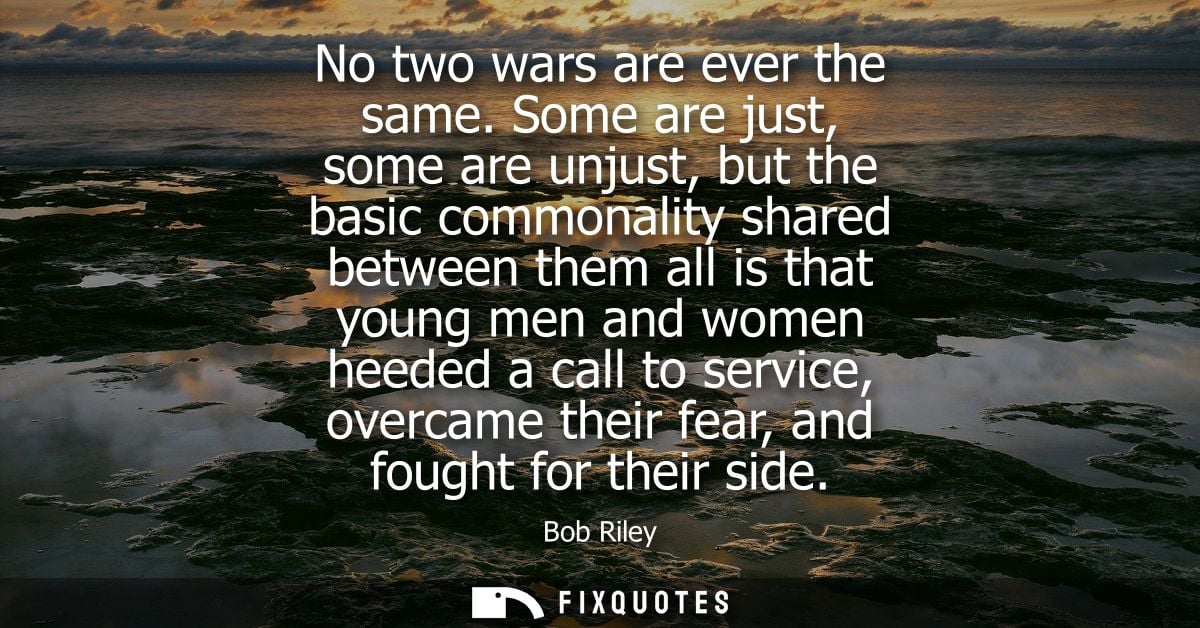
"No two wars are ever the same. Some are just, some are unjust, but the basic commonality shared between them all is that young men and women heeded a call to service, overcame their fear, and fought for their side"
About this Quote
The pivot is “some are just, some are unjust,” a concession that performs humility without naming a single unjust war, a single policy failure, or a single decision-maker. Accountability evaporates into grammar. What remains is the “basic commonality”: service, fear, courage. That’s the emotional payload. Riley is building a bipartisan, cross-ideological sanctuary where critique of war cannot easily contaminate admiration for the warrior.
The phrasing “fought for their side” is telling. It avoids “our country” and replaces it with a cooler, almost sports-like “side,” which subtly normalizes war as competition rather than moral catastrophe. It also universalizes the soldier’s experience, positioning valor as morally independent from the cause. That separation is the subtext: even an unjust war can still produce admirable sacrifice, so public gratitude should be unconditional.
Contextually, it reads like civic liturgy - the kind of language that plays well at memorials, Veterans Day podiums, or moments when leaders need unity without reopening the argument about why the war happened. The intent isn’t to settle history; it’s to manage memory.
Quote Details
| Topic | Military & Soldier |
|---|---|
| Source | Help us find the source |
| Cite |
Citation Formats
APA Style (7th ed.)
Riley, Bob. (2026, January 15). No two wars are ever the same. Some are just, some are unjust, but the basic commonality shared between them all is that young men and women heeded a call to service, overcame their fear, and fought for their side. FixQuotes. https://fixquotes.com/quotes/no-two-wars-are-ever-the-same-some-are-just-some-140569/
Chicago Style
Riley, Bob. "No two wars are ever the same. Some are just, some are unjust, but the basic commonality shared between them all is that young men and women heeded a call to service, overcame their fear, and fought for their side." FixQuotes. January 15, 2026. https://fixquotes.com/quotes/no-two-wars-are-ever-the-same-some-are-just-some-140569/.
MLA Style (9th ed.)
"No two wars are ever the same. Some are just, some are unjust, but the basic commonality shared between them all is that young men and women heeded a call to service, overcame their fear, and fought for their side." FixQuotes, 15 Jan. 2026, https://fixquotes.com/quotes/no-two-wars-are-ever-the-same-some-are-just-some-140569/. Accessed 12 Feb. 2026.