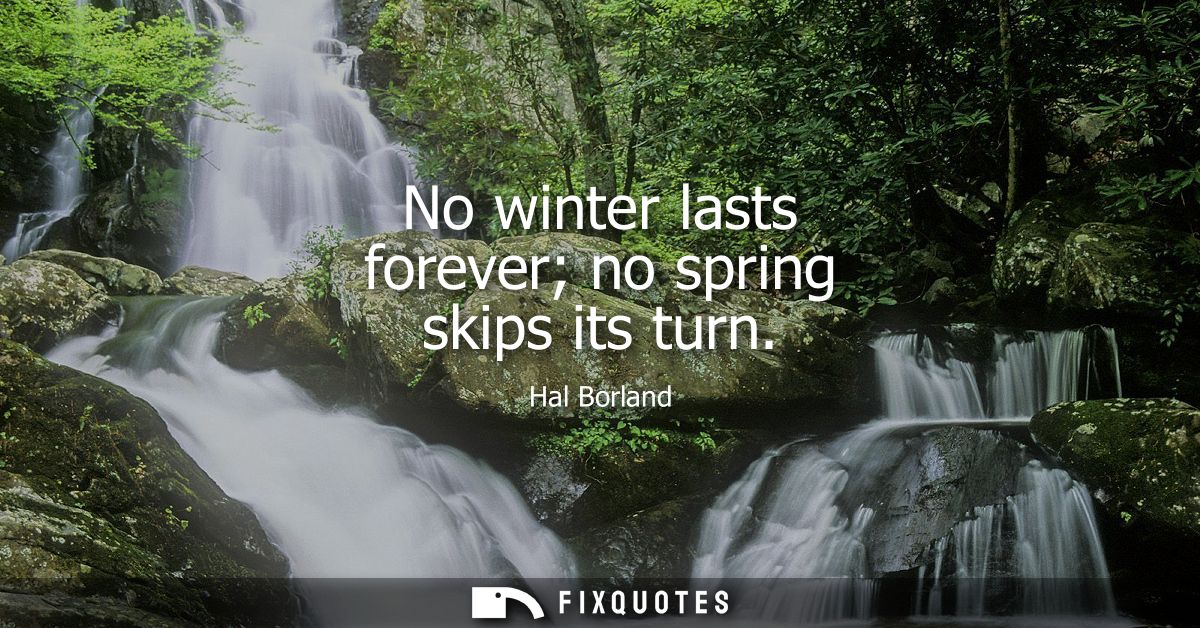
"No winter lasts forever; no spring skips its turn"
About this Quote
Borland’s line works because it refuses both despair and cheap optimism. “No winter lasts forever” is the obvious comfort, but it’s the second clause that gives the sentence its spine: “no spring skips its turn.” The phrasing treats renewal less like a miracle and more like a system. Spring doesn’t arrive because we earn it, or because the universe is finally being nice; it arrives because seasons rotate on schedule. That’s reassurance with teeth.
The intent is practical consolation, the kind you’d find in mid-century American nature writing where weather becomes a moral language without turning into a sermon. Borland, a journalist-turned-outdoors writer, is steeped in cycles: migrations, thaw lines, planting calendars, the slow negotiations between hardship and recovery. His authority comes from observation, not revelation.
Subtextually, the quote smuggles in a warning. If winter doesn’t last forever, neither does spring. The sentence invites patience, yes, but also a sober respect for time’s impartiality. The repetition of “no” functions like a gavel strike: you cannot bargain with the season you’re in, but you also cannot be trapped there. The person reading it in grief hears a promise; the person in comfort hears a reminder not to confuse a good stretch with permanence.
Culturally, it’s the sort of aphorism that survives because it travels well: from personal loss to political darkness to plain old burnout. Its durability comes from its refusal to name the crisis. Borland leaves a blank space, and the reader fills it with whatever winter they’re enduring.
The intent is practical consolation, the kind you’d find in mid-century American nature writing where weather becomes a moral language without turning into a sermon. Borland, a journalist-turned-outdoors writer, is steeped in cycles: migrations, thaw lines, planting calendars, the slow negotiations between hardship and recovery. His authority comes from observation, not revelation.
Subtextually, the quote smuggles in a warning. If winter doesn’t last forever, neither does spring. The sentence invites patience, yes, but also a sober respect for time’s impartiality. The repetition of “no” functions like a gavel strike: you cannot bargain with the season you’re in, but you also cannot be trapped there. The person reading it in grief hears a promise; the person in comfort hears a reminder not to confuse a good stretch with permanence.
Culturally, it’s the sort of aphorism that survives because it travels well: from personal loss to political darkness to plain old burnout. Its durability comes from its refusal to name the crisis. Borland leaves a blank space, and the reader fills it with whatever winter they’re enduring.
Quote Details
| Topic | New Beginnings |
|---|---|
| Source | Verified source: The New York Times: "April’s End" (editorial) (Hal Borland, 1956)
Evidence: So we come to the end of April, even a chilly April, with birdsong around us and some of spring’s color; and we feel the strengthening sun, we sense the opening buds, we know again that no winter lasts forever, no spring skips its turn. April is a promise that May is bound to keep, and we know it.. The best-supported primary-origin claim I can verify from accessible sources is that the line first appeared at the end of an editorial titled “April’s End” in The New York Times dated April 29, 1956, attributed to Hal Borland. The same passage is also reported as later reprinted in Borland’s book "Sundial of the Seasons: A Selection of Outdoor Editorials from The New York Times" (1964). Because nytimes.com is blocked to this tool (robots.txt), I cannot directly open/confirm the NYT archive scan/page or supply the original NYT page number here; the quote text above is transcribed in the secondary but research-oriented citation-tracing post linked in the URL field. Other candidates (1) The Book of Positive Quotations (Steve Deger, Leslie Ann Gibson, 2024) compilation95.0% ... No winter lasts forever ; no spring skips its turn . -Hal Borland You will suffer and you will hurt . You will ha... |
| Cite |
Citation Formats
APA Style (7th ed.)
Borland, Hal. (2026, February 8). No winter lasts forever; no spring skips its turn. FixQuotes. https://fixquotes.com/quotes/no-winter-lasts-forever-no-spring-skips-its-turn-54912/
Chicago Style
Borland, Hal. "No winter lasts forever; no spring skips its turn." FixQuotes. February 8, 2026. https://fixquotes.com/quotes/no-winter-lasts-forever-no-spring-skips-its-turn-54912/.
MLA Style (9th ed.)
"No winter lasts forever; no spring skips its turn." FixQuotes, 8 Feb. 2026, https://fixquotes.com/quotes/no-winter-lasts-forever-no-spring-skips-its-turn-54912/. Accessed 27 Mar. 2026.
More Quotes by Hal
Add to List