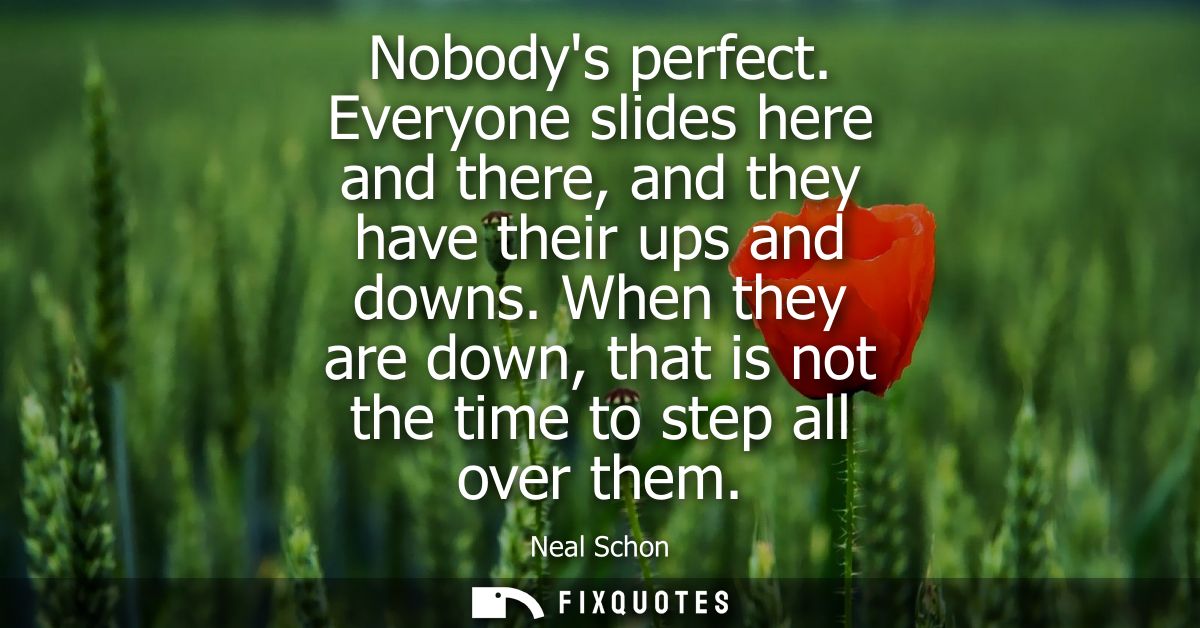
"Nobody's perfect. Everyone slides here and there, and they have their ups and downs. When they are down, that is not the time to step all over them"
About this Quote
Schon’s line reads like bandroom wisdom, but it lands because it’s really about power: who gets to define someone’s “worst moment,” and what the crowd is allowed to do with it. “Nobody’s perfect” is a familiar opener, yet he immediately makes it physical - people “slide,” they’re “up,” they’re “down.” That vocabulary comes straight from a working musician’s life, where momentum is everything: tours, breakups, relapses, bad shows, public feuds, career droughts. The point isn’t abstract forgiveness; it’s a practical ethic for a culture that loves a pile-on.
The intent is protective, almost disciplinary. Schon isn’t begging for kindness so much as drawing a boundary: when someone’s already down, piling on isn’t accountability, it’s opportunism. The subtext is that humiliation has become a spectator sport - in bands, in fandoms, in media cycles that turn personal collapse into content. He’s pushing back against the idea that being right entitles you to be cruel.
Context matters: rock culture has long romanticized self-destruction while punishing the people who actually fall apart. That contradiction creates a weird moral economy where audiences feel ownership over artists and their mistakes. Schon’s sentence rejects that ownership. It asks for basic human restraint, not because everyone deserves a pass, but because kicking someone when they’re down says more about the kicker than the fall.
The intent is protective, almost disciplinary. Schon isn’t begging for kindness so much as drawing a boundary: when someone’s already down, piling on isn’t accountability, it’s opportunism. The subtext is that humiliation has become a spectator sport - in bands, in fandoms, in media cycles that turn personal collapse into content. He’s pushing back against the idea that being right entitles you to be cruel.
Context matters: rock culture has long romanticized self-destruction while punishing the people who actually fall apart. That contradiction creates a weird moral economy where audiences feel ownership over artists and their mistakes. Schon’s sentence rejects that ownership. It asks for basic human restraint, not because everyone deserves a pass, but because kicking someone when they’re down says more about the kicker than the fall.
Quote Details
| Topic | Kindness |
|---|
More Quotes by Neal
Add to List