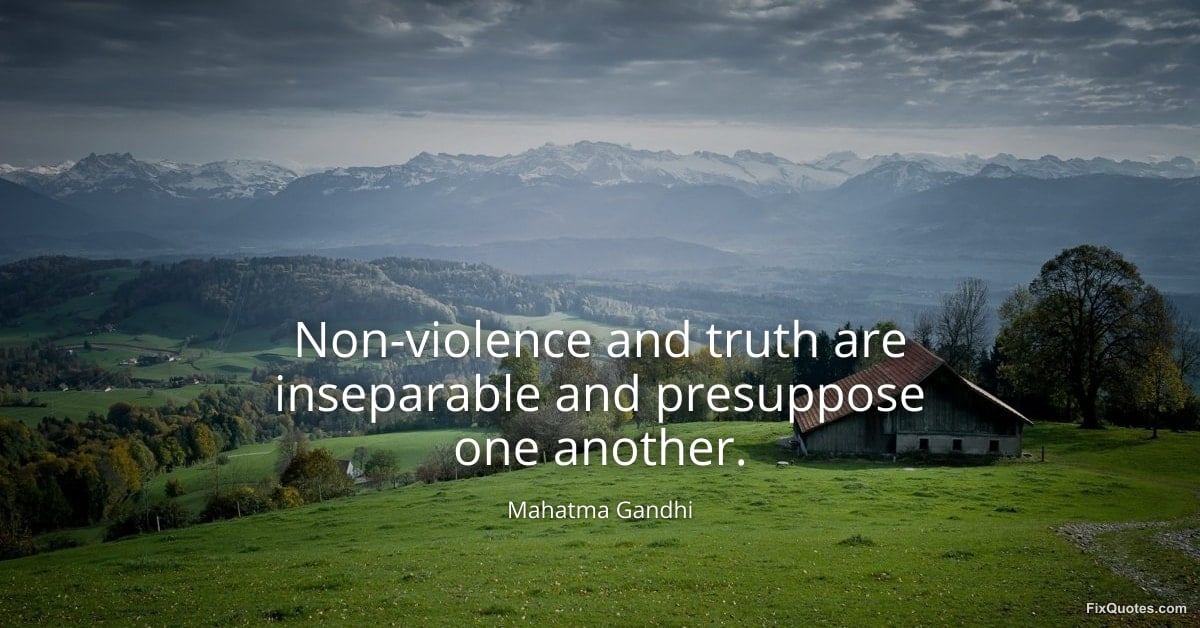
"Non-violence and truth are inseparable and presuppose one another"
About this Quote
Gandhi welds ethics to strategy with a sentence that leaves almost no room for the comforting loopholes of “good intentions.” “Non-violence and truth” aren’t presented as parallel virtues you can mix and match; they’re a locked pair. If you claim truth while practicing coercion, you’re not just being inconsistent, you’re manufacturing a result rather than discovering what’s right. And if you claim non-violence while tolerating self-deception, your restraint becomes performative, a moral costume that can hide cowardice, complacency, or quiet complicity.
The intent is disciplinary. Gandhi is policing the means-ends logic that political movements routinely violate: get justice now, clean up the ethics later. By insisting the two “presuppose one another,” he argues that method is not a mere vehicle for truth; it’s the test of truth. Truth that needs a fist or a gun to survive is, in his framework, already corrupted by fear and domination. Non-violence isn’t simply kindness; it’s an epistemology, a way of knowing that refuses to treat other human beings as obstacles to be moved.
In context, this is the philosophical engine of satyagraha - “truth-force” - forged under colonial rule where violence would have invited moral and logistical defeat against an empire built for it. The subtext is both spiritual and brutally practical: a movement can only claim legitimacy if its tactics embody the world it wants to build. Gandhi’s line is less a pious slogan than a warning: the moment you separate truth from non-violence, you stop resisting oppression and start rehearsing it.
The intent is disciplinary. Gandhi is policing the means-ends logic that political movements routinely violate: get justice now, clean up the ethics later. By insisting the two “presuppose one another,” he argues that method is not a mere vehicle for truth; it’s the test of truth. Truth that needs a fist or a gun to survive is, in his framework, already corrupted by fear and domination. Non-violence isn’t simply kindness; it’s an epistemology, a way of knowing that refuses to treat other human beings as obstacles to be moved.
In context, this is the philosophical engine of satyagraha - “truth-force” - forged under colonial rule where violence would have invited moral and logistical defeat against an empire built for it. The subtext is both spiritual and brutally practical: a movement can only claim legitimacy if its tactics embody the world it wants to build. Gandhi’s line is less a pious slogan than a warning: the moment you separate truth from non-violence, you stop resisting oppression and start rehearsing it.
Quote Details
| Topic | Truth |
|---|---|
| Source | Help us find the source |
| Cite |
Citation Formats
APA Style (7th ed.)
Gandhi, Mahatma. (2026, January 17). Non-violence and truth are inseparable and presuppose one another. FixQuotes. https://fixquotes.com/quotes/non-violence-and-truth-are-inseparable-and-34144/
Chicago Style
Gandhi, Mahatma. "Non-violence and truth are inseparable and presuppose one another." FixQuotes. January 17, 2026. https://fixquotes.com/quotes/non-violence-and-truth-are-inseparable-and-34144/.
MLA Style (9th ed.)
"Non-violence and truth are inseparable and presuppose one another." FixQuotes, 17 Jan. 2026, https://fixquotes.com/quotes/non-violence-and-truth-are-inseparable-and-34144/. Accessed 24 Mar. 2026.
More Quotes by Mahatma
Add to List