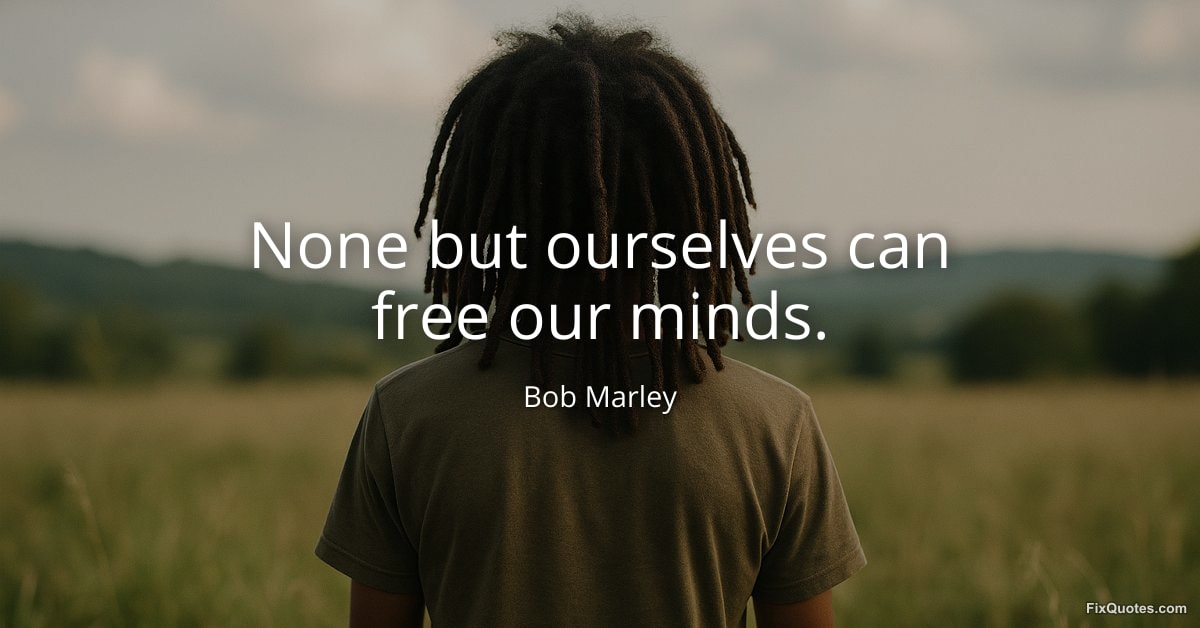
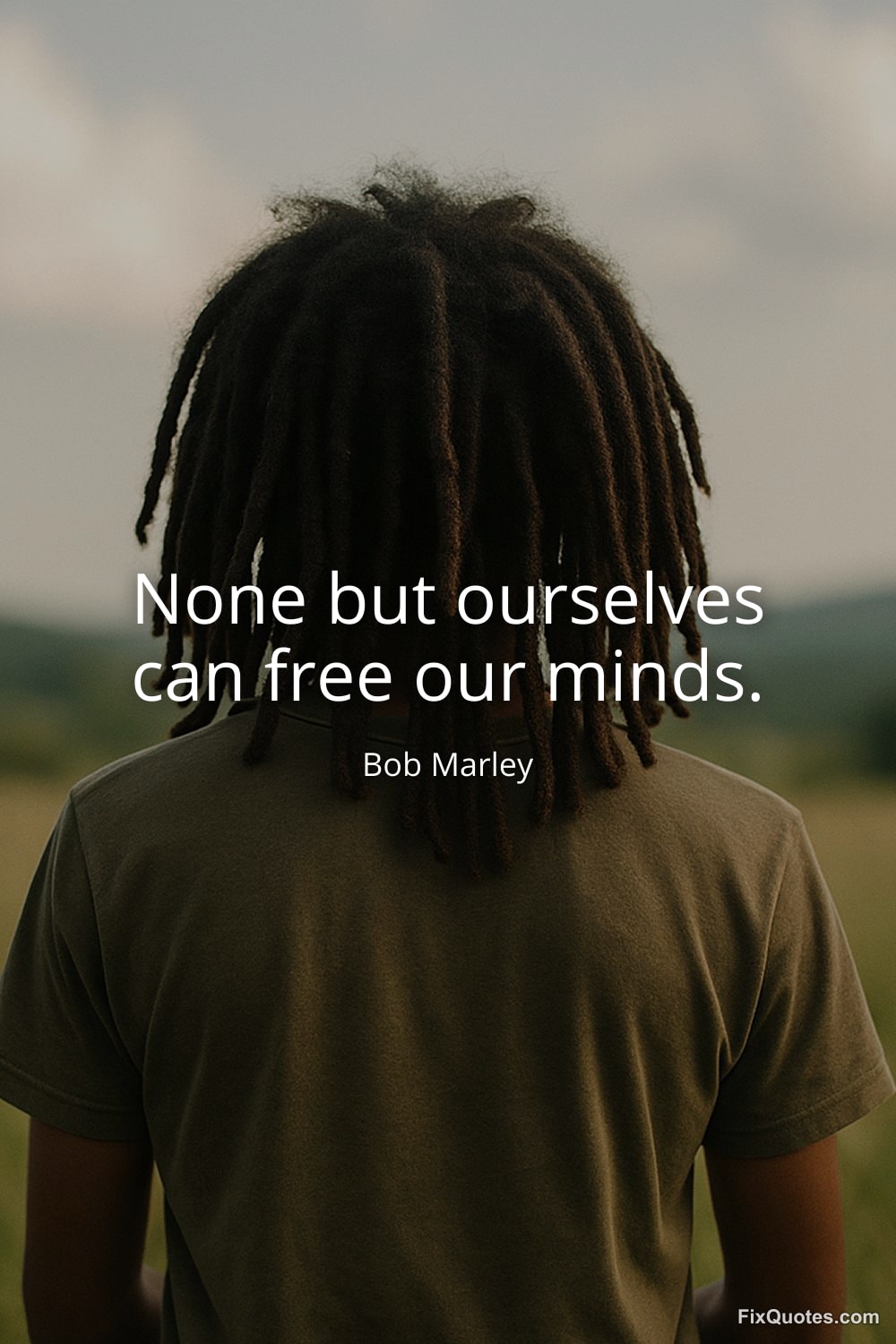
"None but ourselves can free our minds"
About this Quote
A revolution that starts in your skull is harder to police. "None but ourselves can free our minds" lands like a mantra, but it’s also a strategic diagnosis: the most durable form of control isn’t the baton or the border, it’s internalized permission. Marley isn’t offering self-help; he’s naming the quiet aftershock of oppression, where people carry the cage with them even after the door is open.
The line works because it’s blunt to the point of provocation. "None but ourselves" strips away savior fantasies, including the seductive idea that liberation arrives as a gift from leaders, lovers, or institutions. It puts agency back on the listener, but it also smuggles in accountability: if mental bondage is partly self-maintained, then freedom demands work, not vibes. Marley’s phrasing is communal and singular at once - "ourselves" implies a shared condition, yet the responsibility is intimate, internal.
Context matters. The lyric echoes Marcus Garvey’s call to "emancipate yourselves from mental slavery", threading reggae’s global rise into a longer Black diasporic tradition of anti-colonial thought. In the late 1970s, Marley was performing amid Jamaica’s political violence and Cold War proxy pressures, when slogans were everywhere and trust was scarce. Against that noise, he offers a different battlefield. The subtext is both spiritual and political: change the mind, or the system will simply rent space inside you and call it normal.
The line works because it’s blunt to the point of provocation. "None but ourselves" strips away savior fantasies, including the seductive idea that liberation arrives as a gift from leaders, lovers, or institutions. It puts agency back on the listener, but it also smuggles in accountability: if mental bondage is partly self-maintained, then freedom demands work, not vibes. Marley’s phrasing is communal and singular at once - "ourselves" implies a shared condition, yet the responsibility is intimate, internal.
Context matters. The lyric echoes Marcus Garvey’s call to "emancipate yourselves from mental slavery", threading reggae’s global rise into a longer Black diasporic tradition of anti-colonial thought. In the late 1970s, Marley was performing amid Jamaica’s political violence and Cold War proxy pressures, when slogans were everywhere and trust was scarce. Against that noise, he offers a different battlefield. The subtext is both spiritual and political: change the mind, or the system will simply rent space inside you and call it normal.
Quote Details
| Topic | Freedom |
|---|---|
| Source | "None but ourselves can free our minds" — lyric from "Redemption Song" (Bob Marley, 1980, album Uprising). |
| Cite |
Citation Formats
APA Style (7th ed.)
Marley, Bob. (2026, January 17). None but ourselves can free our minds. FixQuotes. https://fixquotes.com/quotes/none-but-ourselves-can-free-our-minds-30283/
Chicago Style
Marley, Bob. "None but ourselves can free our minds." FixQuotes. January 17, 2026. https://fixquotes.com/quotes/none-but-ourselves-can-free-our-minds-30283/.
MLA Style (9th ed.)
"None but ourselves can free our minds." FixQuotes, 17 Jan. 2026, https://fixquotes.com/quotes/none-but-ourselves-can-free-our-minds-30283/. Accessed 1 Apr. 2026.
More Quotes by Bob
Add to List