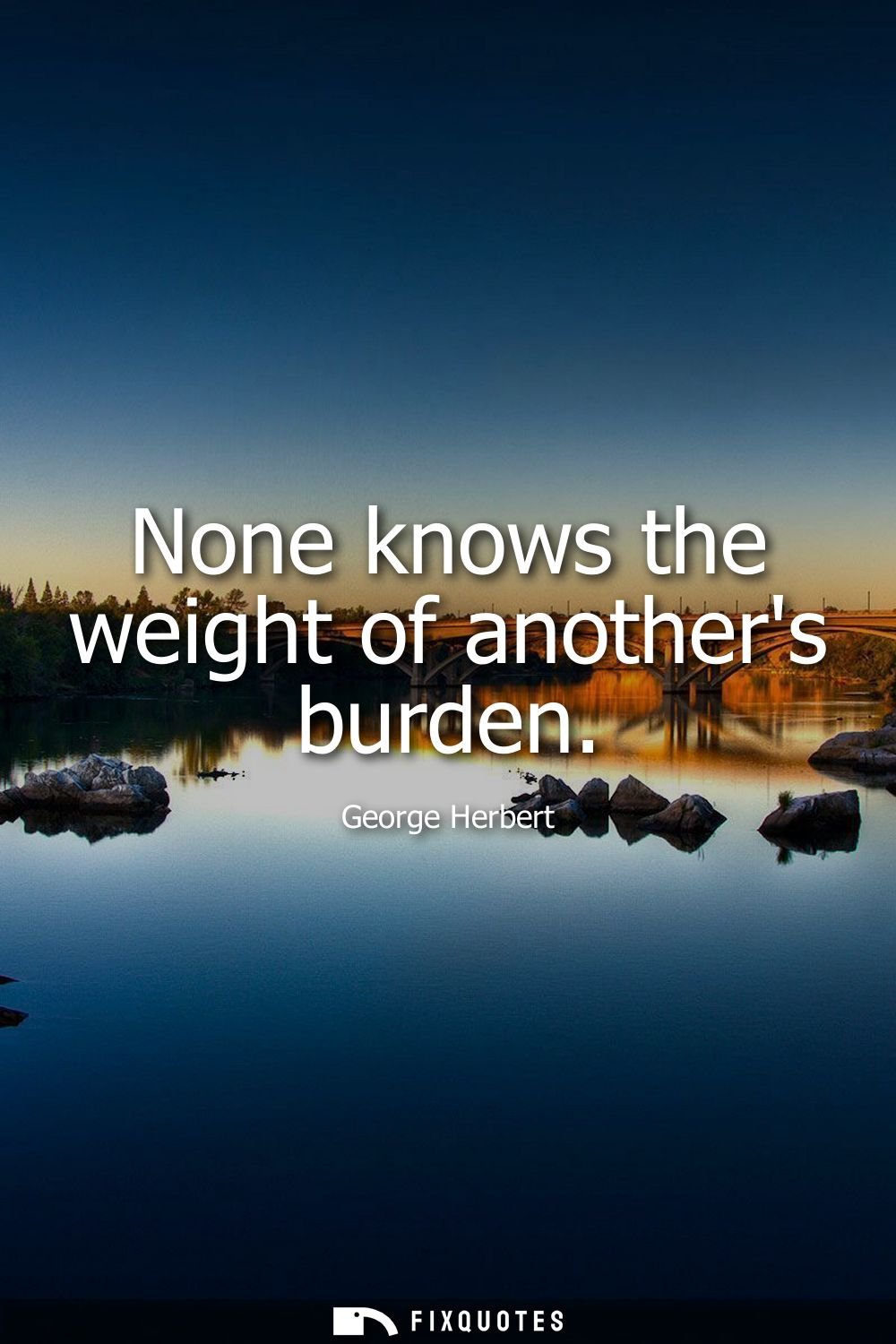
"None knows the weight of another's burden"
About this Quote
A line like this lands softly, then refuses to move. Herbert doesn’t argue; he cautions. “None knows” is a blunt ceiling on human certainty, a reminder that empathy has limits no matter how confident our judgments feel. The phrase “weight” does the heavy lifting: burdens aren’t just visible troubles but felt pressure, the private physics of shame, grief, debt, illness, doubt. You can see someone carrying a load; you can’t measure how it compresses their ribs.
Herbert’s context matters. As a metaphysical poet and Anglican priest writing in a culture steeped in public piety and social rank, he understood how quickly people turn moral assessment into sport. The subtext reads like a rebuke to the era’s easy certainties: the prosperous assume the poor are lazy; the healthy assume the sick lack discipline; the righteous assume the struggling lack faith. Herbert’s theology tends to locate truth in interior struggle rather than outward performance, and this aphorism protects that interiority. It implies that God may know the full weight, but neighbors and even family usually don’t.
The line also flatters no one. It doesn’t romanticize suffering or promise that pain is meaningful. It simply blocks the cheap transaction where we trade other people’s stories for our verdicts. In a modern register, it’s a warning against hot takes about lives we only witness in fragments. The sentence is short because the lesson is: be careful. You’re not holding the strap.
Herbert’s context matters. As a metaphysical poet and Anglican priest writing in a culture steeped in public piety and social rank, he understood how quickly people turn moral assessment into sport. The subtext reads like a rebuke to the era’s easy certainties: the prosperous assume the poor are lazy; the healthy assume the sick lack discipline; the righteous assume the struggling lack faith. Herbert’s theology tends to locate truth in interior struggle rather than outward performance, and this aphorism protects that interiority. It implies that God may know the full weight, but neighbors and even family usually don’t.
The line also flatters no one. It doesn’t romanticize suffering or promise that pain is meaningful. It simply blocks the cheap transaction where we trade other people’s stories for our verdicts. In a modern register, it’s a warning against hot takes about lives we only witness in fragments. The sentence is short because the lesson is: be careful. You’re not holding the strap.
Quote Details
| Topic | Loneliness |
|---|---|
| Source | George Herbert , "Jacula Prudentum" (proverb in The Temple, published 1633): "None knoweth the weight of another's burden". |
More Quotes by George
Add to List