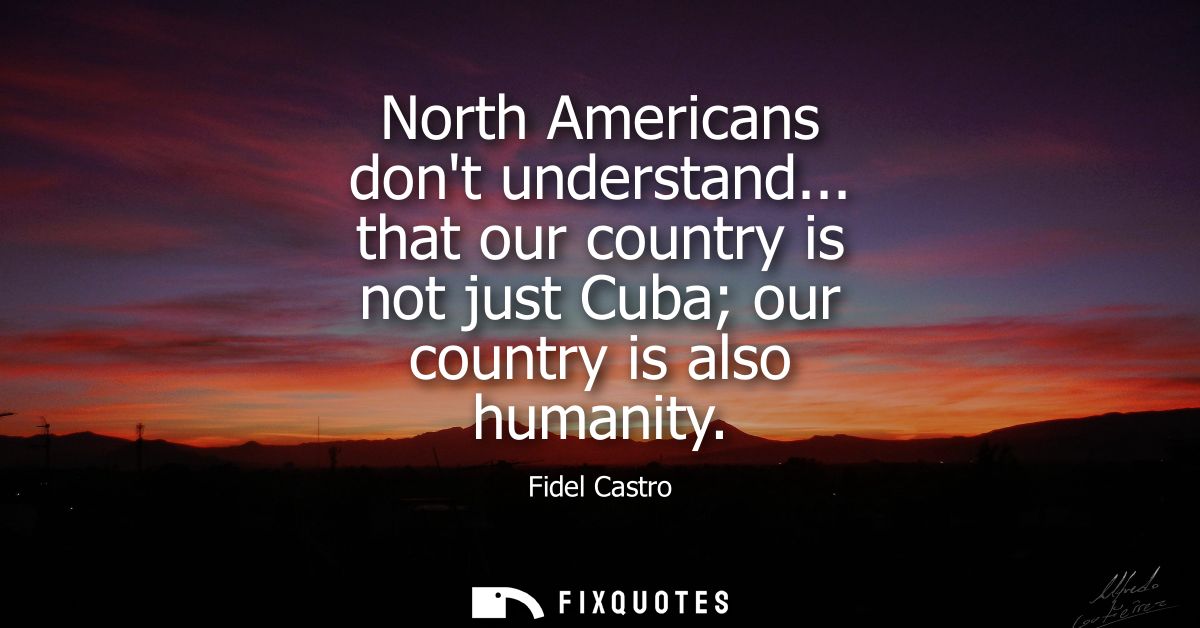
"North Americans don't understand... that our country is not just Cuba; our country is also humanity"
About this Quote
Castro isn’t pleading to be understood; he’s demanding to be misread on his terms. In one breath, he flips the map: Cuba stops being a small island under Washington’s thumb and becomes a moral project with global jurisdiction. That leap is the point. For a revolutionary statesman boxed in by embargo, isolation, and constant U.S. narration, “our country is also humanity” is a rhetorical jailbreak.
The specific intent is diplomatic and domestic at once. To North Americans, it frames U.S. policy as parochial, even provincial: you think in borders and punishments, we think in people. To Cubans and fellow anti-imperialist audiences, it offers an ennobling identity that can justify sacrifice. Shortages, militarization, curtailed dissent: these are easier to swallow if the nation is cast as an ethical vanguard rather than a beleaguered state.
The subtext is audacious: Cuba claims the right to act beyond its size - exporting doctors, soldiers, teachers, ideology - because it serves “humanity.” That universalism is also a shield. If the revolution speaks for humanity, then opposition at home can be painted as betrayal not just of the state but of the species’ progress.
Context does the heavy lifting. This line sits inside the Cold War logic where small countries survived by becoming symbols. Castro understood media and myth: the island as David, the U.S. as Goliath. The quote works because it’s both an accusation and an invitation - it shames the listener for narrowness while offering a grander story in which Cuba is not merely a place, but a cause.
The specific intent is diplomatic and domestic at once. To North Americans, it frames U.S. policy as parochial, even provincial: you think in borders and punishments, we think in people. To Cubans and fellow anti-imperialist audiences, it offers an ennobling identity that can justify sacrifice. Shortages, militarization, curtailed dissent: these are easier to swallow if the nation is cast as an ethical vanguard rather than a beleaguered state.
The subtext is audacious: Cuba claims the right to act beyond its size - exporting doctors, soldiers, teachers, ideology - because it serves “humanity.” That universalism is also a shield. If the revolution speaks for humanity, then opposition at home can be painted as betrayal not just of the state but of the species’ progress.
Context does the heavy lifting. This line sits inside the Cold War logic where small countries survived by becoming symbols. Castro understood media and myth: the island as David, the U.S. as Goliath. The quote works because it’s both an accusation and an invitation - it shames the listener for narrowness while offering a grander story in which Cuba is not merely a place, but a cause.
Quote Details
| Topic | Human Rights |
|---|
More Quotes by Fidel
Add to List