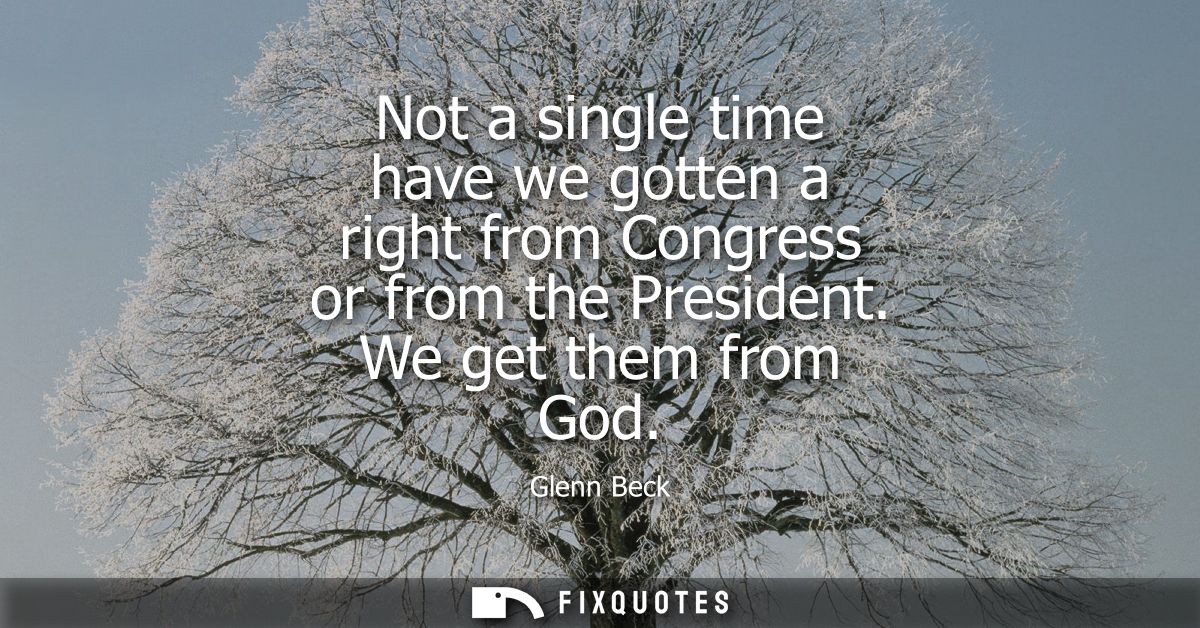
"Not a single time have we gotten a right from Congress or from the President. We get them from God"
About this Quote
The subtext is a populist suspicion of institutions paired with a craving for certainty. “Not a single time” is deliberately absolute, flattening history into a simple grievance narrative: elites never give; they only take. It also recasts government’s role from author of rights to mere gatekeeper - at best recognizing what already exists, at worst conspiring to deny it. That framing neatly immunizes the speaker’s preferred liberties from democratic bargaining. If the public votes for regulations you dislike, you can argue the ballot box doesn’t get a say.
Context matters because Beck is speaking from an American tradition that already flirts with this idea: the Declaration of Independence’s “endowed by their Creator,” the natural-rights language that underwrites everything from abolitionist sermons to modern gun-rights absolutism. But Beck’s formulation is more combative than philosophical. It’s built for an audience that feels politically cornered, offering a theology of ownership: your freedoms aren’t permissions, they’re property.
The irony is that even in the U.S., rights function as rights only when institutions enforce them. Beck’s sentence sells metaphysical certainty while dodging the earthly question: whose God, and whose interpretation, gets to cash the check?
Quote Details
| Topic | God |
|---|---|
| Source | Help us find the source |
| Cite |
Citation Formats
APA Style (7th ed.)
Beck, Glenn. (2026, January 17). Not a single time have we gotten a right from Congress or from the President. We get them from God. FixQuotes. https://fixquotes.com/quotes/not-a-single-time-have-we-gotten-a-right-from-71462/
Chicago Style
Beck, Glenn. "Not a single time have we gotten a right from Congress or from the President. We get them from God." FixQuotes. January 17, 2026. https://fixquotes.com/quotes/not-a-single-time-have-we-gotten-a-right-from-71462/.
MLA Style (9th ed.)
"Not a single time have we gotten a right from Congress or from the President. We get them from God." FixQuotes, 17 Jan. 2026, https://fixquotes.com/quotes/not-a-single-time-have-we-gotten-a-right-from-71462/. Accessed 27 Mar. 2026.