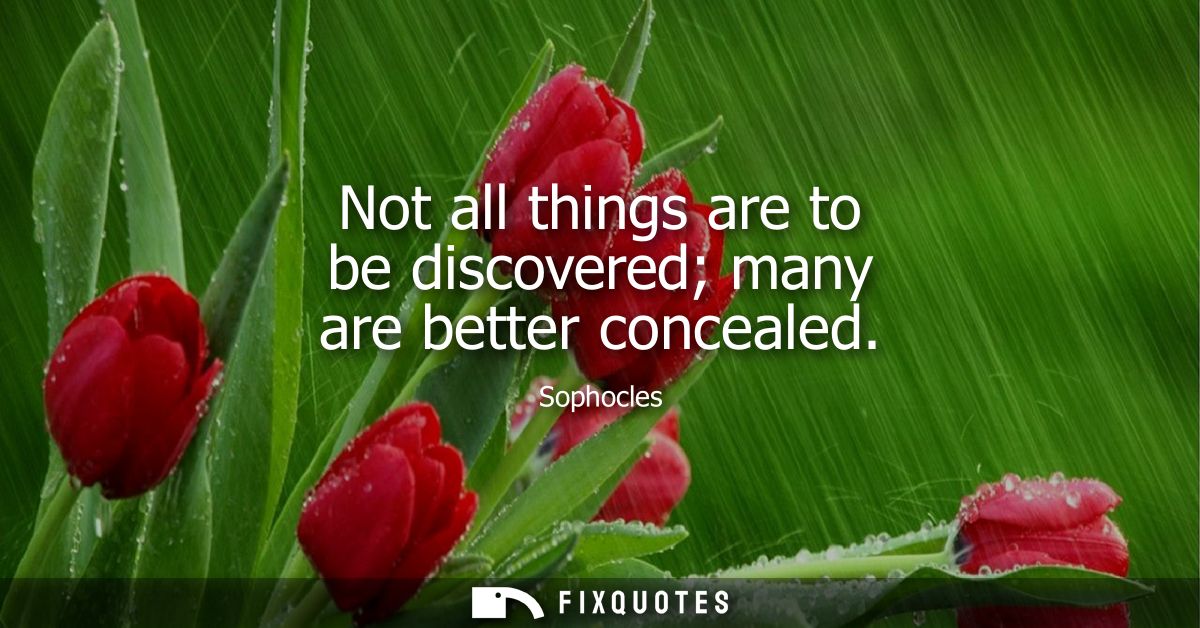
"Not all things are to be discovered; many are better concealed"
About this Quote
Athenian tragedy runs on the idea that knowledge is not an innocent upgrade. Sophocles, writing for a city intoxicated by inquiry and argument, keeps staging what happens when the human appetite to know outruns the human capacity to bear. "Not all things are to be discovered; many are better concealed" reads less like cozy prudence than a warning shot aimed at the era's rising confidence: some truths arrive with consequences that cannot be unlearned.
The line’s power sits in its double edge. On one level it endorses restraint, even secrecy, a cultural instinct in Greek life where certain matters belonged to gods, to ritual, to the household, not to public scrutiny. On another level it’s a critique of hubris: the belief that illumination is always moral, that exposure equals progress. Sophoclean heroes often treat the hidden as an insult to their agency. They interrogate, pry, insist on clarity, then discover that the world’s concealments are load-bearing. Pull one out and the structure collapses.
The subtext is tragic irony: concealment isn’t just a cover-up; it can be mercy, social stability, self-preservation. Yet Sophocles never lets concealment off the hook either. What’s buried tends to fester, and the cost of ignorance can be catastrophic. The quote lives in that tension, refusing modern binaries where transparency is automatically virtuous and secrecy automatically corrupt. It suggests a harsher ethic: wisdom isn’t the maximum amount of information, it’s knowing which doors not to open, and why.
The line’s power sits in its double edge. On one level it endorses restraint, even secrecy, a cultural instinct in Greek life where certain matters belonged to gods, to ritual, to the household, not to public scrutiny. On another level it’s a critique of hubris: the belief that illumination is always moral, that exposure equals progress. Sophoclean heroes often treat the hidden as an insult to their agency. They interrogate, pry, insist on clarity, then discover that the world’s concealments are load-bearing. Pull one out and the structure collapses.
The subtext is tragic irony: concealment isn’t just a cover-up; it can be mercy, social stability, self-preservation. Yet Sophocles never lets concealment off the hook either. What’s buried tends to fester, and the cost of ignorance can be catastrophic. The quote lives in that tension, refusing modern binaries where transparency is automatically virtuous and secrecy automatically corrupt. It suggests a harsher ethic: wisdom isn’t the maximum amount of information, it’s knowing which doors not to open, and why.
Quote Details
| Topic | Wisdom |
|---|
More Quotes by Sophocles
Add to List