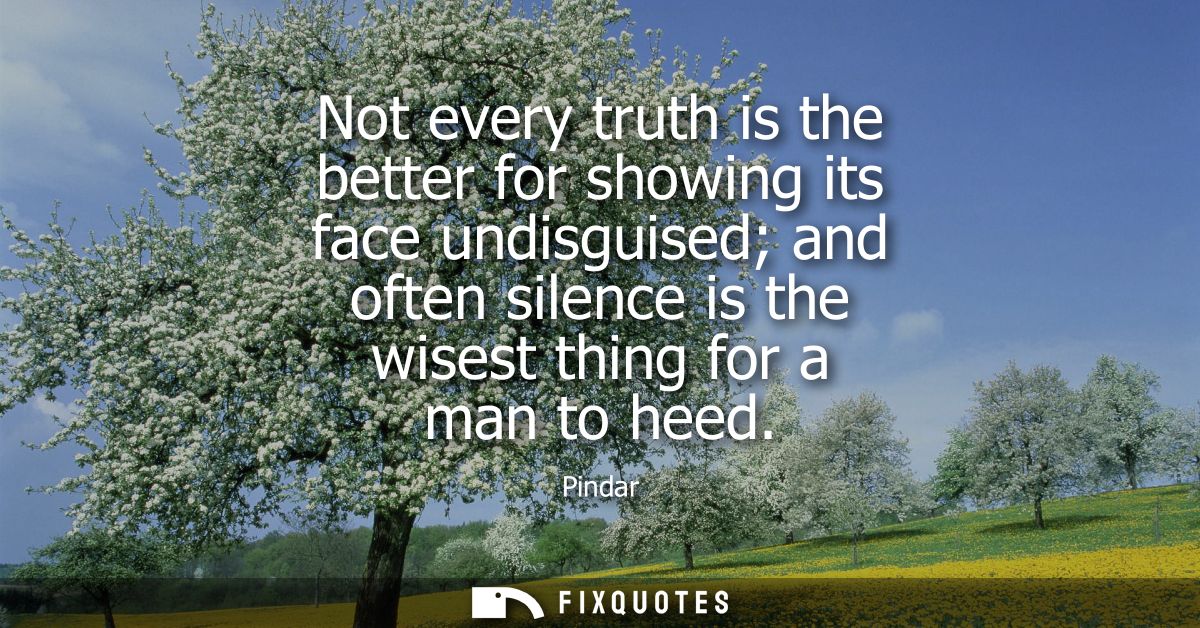
"Not every truth is the better for showing its face undisguised; and often silence is the wisest thing for a man to heed"
About this Quote
Pindar isn’t praising cowardice here; he’s defending discretion as a civic art. In a culture where reputation was public property and speech could ricochet through a tight-knit polis, “truth” wasn’t a neutral commodity you simply dropped on the table. It was a force, and forces need handling. The line works because it refuses our modern romance with “radical honesty.” Pindar treats candor not as virtue-by-default but as a tool that can bruise, inflame, or cheapen what it touches.
“Showing its face undisguised” is the key phrase. Truth, in this framing, isn’t denied; it’s masked, timed, staged. That’s not hypocrisy so much as rhetoric: the recognition that how something is said determines what it becomes once it lands. Pindar, a poet of victory odes paid for by elites, understood the political economy of speech. Praise had to be calibrated, envy anticipated, rivals managed. A public statement could elevate an athlete and still destabilize a community by provoking resentment. Silence, then, isn’t emptiness; it’s strategy.
The subtext is an ethics of restraint: the wise person protects relationships, institutions, even the truth itself from the damage of unfiltered exposure. Pindar’s world prized sophrosyne - self-control - and distrusted the kind of bluntness that reads like courage but functions like self-indulgence. He’s not asking you to lie. He’s asking you to respect consequences, and to admit that moral purity in speech is often just another form of vanity.
“Showing its face undisguised” is the key phrase. Truth, in this framing, isn’t denied; it’s masked, timed, staged. That’s not hypocrisy so much as rhetoric: the recognition that how something is said determines what it becomes once it lands. Pindar, a poet of victory odes paid for by elites, understood the political economy of speech. Praise had to be calibrated, envy anticipated, rivals managed. A public statement could elevate an athlete and still destabilize a community by provoking resentment. Silence, then, isn’t emptiness; it’s strategy.
The subtext is an ethics of restraint: the wise person protects relationships, institutions, even the truth itself from the damage of unfiltered exposure. Pindar’s world prized sophrosyne - self-control - and distrusted the kind of bluntness that reads like courage but functions like self-indulgence. He’s not asking you to lie. He’s asking you to respect consequences, and to admit that moral purity in speech is often just another form of vanity.
Quote Details
| Topic | Wisdom |
|---|---|
| Source | Help us find the source |
More Quotes by Pindar
Add to List