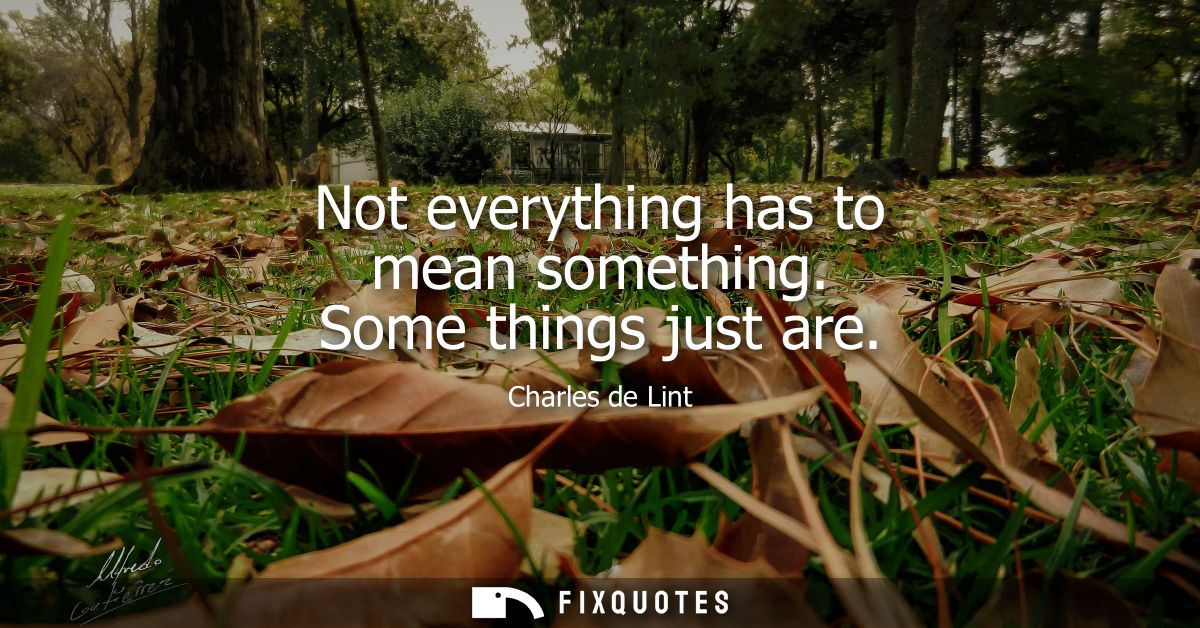
"Not everything has to mean something. Some things just are"
About this Quote
De Lint’s line is a quiet rebellion against our era’s compulsive interpretive hunger. We live inside recommendation engines and discourse cycles that insist every object is content, every gesture a signal, every story a “statement.” “Not everything has to mean something” isn’t anti-intellectual so much as anti-extraction: a refusal to treat experience like a mine that owes us a moral, a thesis, a hot take.
The sentence works because it’s structured like a release valve. First clause: permission to stop forcing coherence. Second clause: a grounding move, almost tactile in its bluntness. “Some things just are” lands with the calm finality of weather. It rehabilitates the ordinary and the inexplicable, reclaiming the right to encounter something without turning it into a performance of insight.
De Lint’s broader fictional world helps explain the intent. As a writer associated with urban fantasy, he’s spent a career elevating the numinous in everyday life: alleyway myths, street-corner magic, the sense that reality has seams you can feel but not always name. In that context, the quote doubles as an artistic manifesto. Not every symbol needs decoding; sometimes the point is the mood, the atmosphere, the lived texture. Meaning can be a byproduct rather than a demand.
There’s also a gentle ethical subtext: insisting everything “means” can become a form of control, a way to domesticate grief, chance, or other people’s complexity. De Lint offers an alternative posture: attention without possession.
The sentence works because it’s structured like a release valve. First clause: permission to stop forcing coherence. Second clause: a grounding move, almost tactile in its bluntness. “Some things just are” lands with the calm finality of weather. It rehabilitates the ordinary and the inexplicable, reclaiming the right to encounter something without turning it into a performance of insight.
De Lint’s broader fictional world helps explain the intent. As a writer associated with urban fantasy, he’s spent a career elevating the numinous in everyday life: alleyway myths, street-corner magic, the sense that reality has seams you can feel but not always name. In that context, the quote doubles as an artistic manifesto. Not every symbol needs decoding; sometimes the point is the mood, the atmosphere, the lived texture. Meaning can be a byproduct rather than a demand.
There’s also a gentle ethical subtext: insisting everything “means” can become a form of control, a way to domesticate grief, chance, or other people’s complexity. De Lint offers an alternative posture: attention without possession.
Quote Details
| Topic | Live in the Moment |
|---|---|
| Source | Help us find the source |
| Cite |
Citation Formats
APA Style (7th ed.)
Lint, Charles de. (2026, January 15). Not everything has to mean something. Some things just are. FixQuotes. https://fixquotes.com/quotes/not-everything-has-to-mean-something-some-things-139935/
Chicago Style
Lint, Charles de. "Not everything has to mean something. Some things just are." FixQuotes. January 15, 2026. https://fixquotes.com/quotes/not-everything-has-to-mean-something-some-things-139935/.
MLA Style (9th ed.)
"Not everything has to mean something. Some things just are." FixQuotes, 15 Jan. 2026, https://fixquotes.com/quotes/not-everything-has-to-mean-something-some-things-139935/. Accessed 13 Feb. 2026.
More Quotes by Charles
Add to List