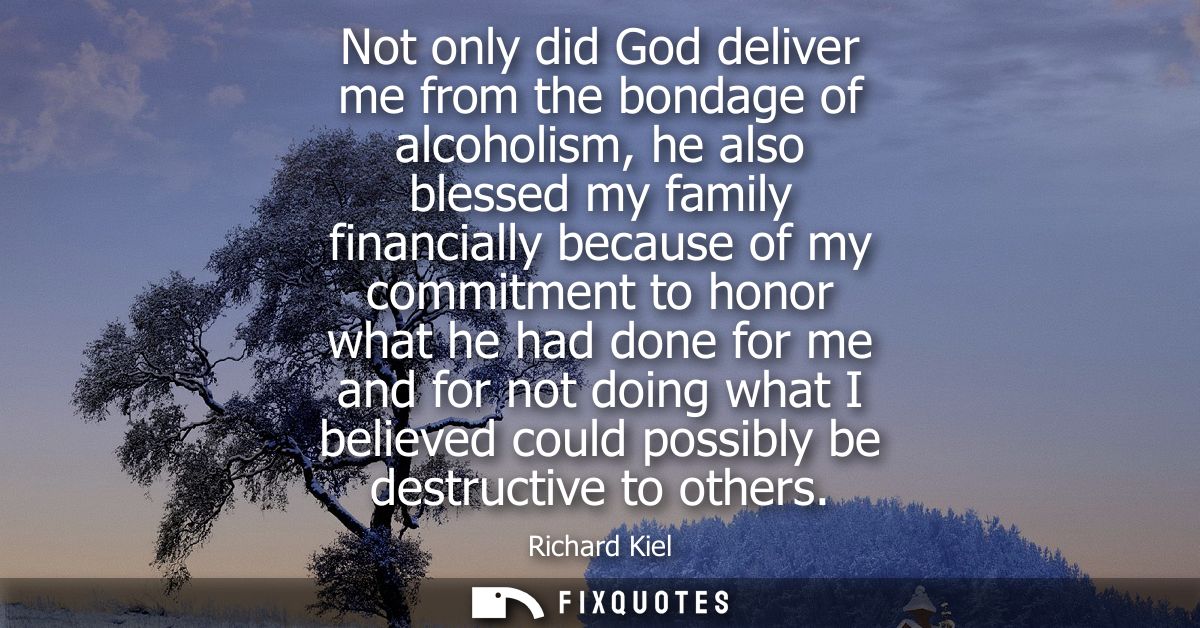
"Not only did God deliver me from the bondage of alcoholism, he also blessed my family financially because of my commitment to honor what he had done for me, and for not doing what I believed could possibly be destructive to others"
About this Quote
The language quietly negotiates a familiar anxiety around public redemption narratives: suspicion. By emphasizing “commitment” and “honor,” he’s preempting the idea that faith is a performance. He casts his choices as restraint, not self-branding: “for not doing what I believed could possibly be destructive to others.” The careful hedging (“believed,” “possibly”) suggests someone shaped by consequences who’s learned that certainty can be dangerous; he’s describing an ethic of risk management as much as an ethic of holiness.
As an actor, Kiel would have lived in a world that rewards excess and offers easy access to it. The quote reads like a counter-myth to the entertainment industry’s standard script of crash, rehab, relapse, repeat. Here, the real conversion isn’t only quitting alcohol; it’s redefining success. Prosperity becomes less a trophy than a responsibility, tied to protecting others from collateral damage. That’s the subtext: redemption isn’t private if your life touches other people.
Quote Details
| Topic | God |
|---|---|
| Source | Help us find the source |
| Cite |
Citation Formats
APA Style (7th ed.)
Kiel, Richard. (2026, February 16). Not only did God deliver me from the bondage of alcoholism, he also blessed my family financially because of my commitment to honor what he had done for me, and for not doing what I believed could possibly be destructive to others. FixQuotes. https://fixquotes.com/quotes/not-only-did-god-deliver-me-from-the-bondage-of-123931/
Chicago Style
Kiel, Richard. "Not only did God deliver me from the bondage of alcoholism, he also blessed my family financially because of my commitment to honor what he had done for me, and for not doing what I believed could possibly be destructive to others." FixQuotes. February 16, 2026. https://fixquotes.com/quotes/not-only-did-god-deliver-me-from-the-bondage-of-123931/.
MLA Style (9th ed.)
"Not only did God deliver me from the bondage of alcoholism, he also blessed my family financially because of my commitment to honor what he had done for me, and for not doing what I believed could possibly be destructive to others." FixQuotes, 16 Feb. 2026, https://fixquotes.com/quotes/not-only-did-god-deliver-me-from-the-bondage-of-123931/. Accessed 14 Mar. 2026.