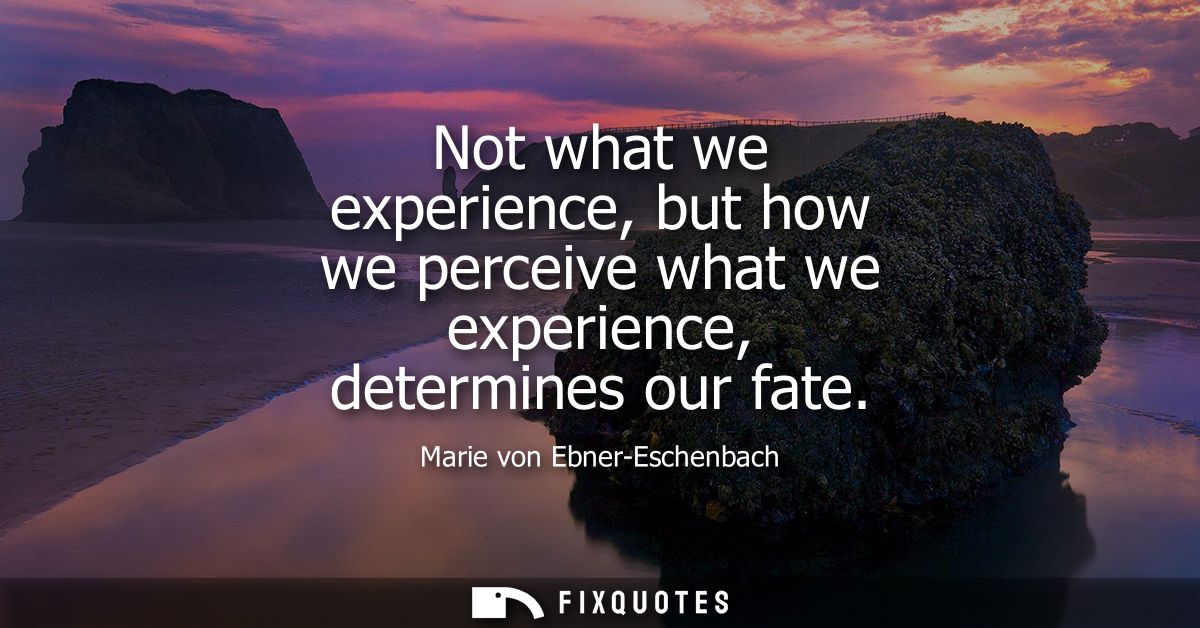
"Not what we experience, but how we perceive what we experience, determines our fate"
About this Quote
Fate, in Ebner-Eschenbach's hands, isn’t a thunderbolt from the gods; it’s a story problem. The line smuggles a radical claim under the calm grammar of a maxim: events don’t rule us nearly as much as the interpretive machinery we aim at them. That’s novelist logic applied to life. Plot is never just what happens; plot is what a consciousness decides what happened means.
The quote’s specific intent is to relocate power. By demoting “experience” to raw material and elevating “perception” to destiny-maker, she argues that agency survives even when circumstances don’t cooperate. It’s not a naïve pep talk about positive thinking; it’s a warning about the tyranny of your own framing. If perception is fate, then pessimism, resentment, and self-deception aren’t moods, they’re architects.
The subtext is moral and social. Writing in the late Habsburg world, Ebner-Eschenbach watched rigid class structures and gender expectations pretend to be natural law. Her sentence quietly undermines that alibi: what feels inevitable is often just the interpretation you’ve inherited. At the same time, she doesn’t let the individual off easy. If your fate is perception-shaped, then you’re implicated in your own confinement; you can’t outsource your life entirely to “what happened.”
It works because it’s a reversal with teeth. The phrasing sets up experience as the obvious candidate, then swaps it out for the less visible culprit: the lens. You finish the sentence looking not at the world, but at the way you look.
The quote’s specific intent is to relocate power. By demoting “experience” to raw material and elevating “perception” to destiny-maker, she argues that agency survives even when circumstances don’t cooperate. It’s not a naïve pep talk about positive thinking; it’s a warning about the tyranny of your own framing. If perception is fate, then pessimism, resentment, and self-deception aren’t moods, they’re architects.
The subtext is moral and social. Writing in the late Habsburg world, Ebner-Eschenbach watched rigid class structures and gender expectations pretend to be natural law. Her sentence quietly undermines that alibi: what feels inevitable is often just the interpretation you’ve inherited. At the same time, she doesn’t let the individual off easy. If your fate is perception-shaped, then you’re implicated in your own confinement; you can’t outsource your life entirely to “what happened.”
It works because it’s a reversal with teeth. The phrasing sets up experience as the obvious candidate, then swaps it out for the less visible culprit: the lens. You finish the sentence looking not at the world, but at the way you look.
Quote Details
| Topic | Free Will & Fate |
|---|
More Quotes by Marie
Add to List