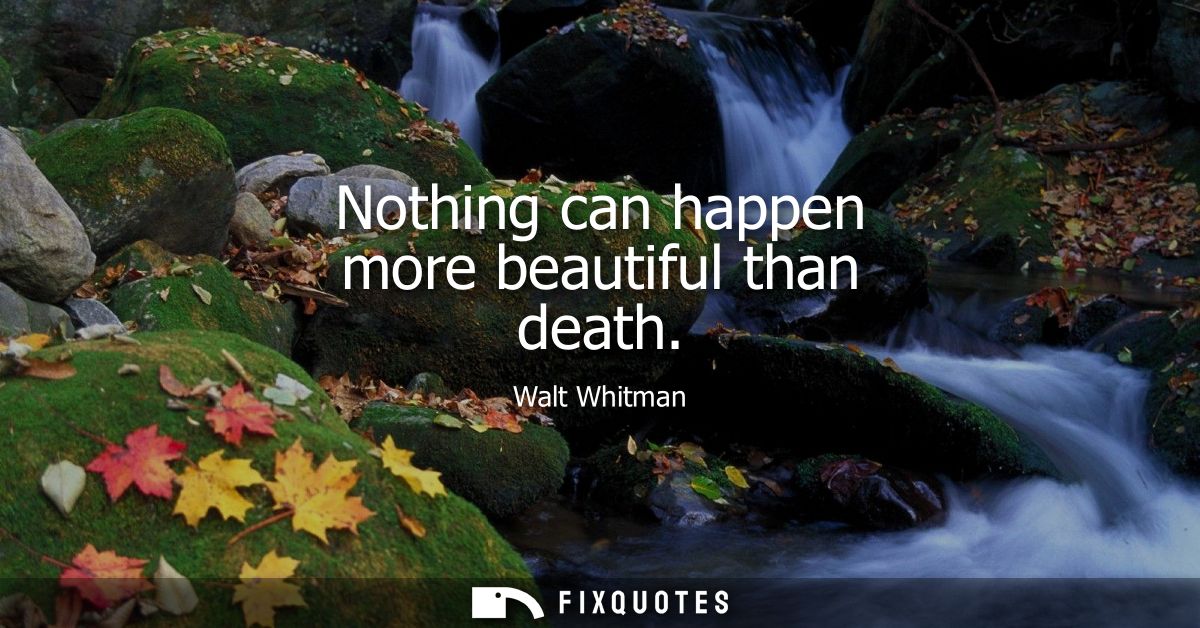
"Nothing can happen more beautiful than death"
About this Quote
Whitman calling death “beautiful” isn’t a goth flourish; it’s a deliberate provocation from a poet trying to rewire what Americans are allowed to feel in public. In a culture where death was often framed as moral accounting (sin, judgment, salvation), Whitman pitches it as aesthetic and natural: the body’s final participation in a larger, ongoing physics of life. The line’s blunt certainty - “Nothing can happen more beautiful” - refuses the polite consolations that keep grief tidy. He’s not minimizing loss; he’s stripping death of its theological melodrama and social embarrassment.
The intent is rhetorical pressure. By crowning death as the peak of beauty, Whitman forces the reader to reconsider beauty itself: not prettiness, not comfort, but a kind of cosmic rightness. It’s also a democratic gesture. Death is the one experience that flattens hierarchy, the ultimate shared fate; Whitman, the great celebrant of the common body, turns that final commonality into a strange compliment.
Subtextually, it’s a bid for intimacy with the feared. Whitman’s poetics thrive on dissolving boundaries - between self and others, body and soul, sex and spirit. Death becomes another border to eroticize, not in a cheap shock sense, but in the sense of merging, dispersal, return. Context matters: writing in a 19th-century America marked by mass death (especially the Civil War), Whitman witnessed bodies broken at scale. Naming death “beautiful” reads as an act of spiritual triage: a way to keep faith with the physical world when the physical world is unbearable.
The intent is rhetorical pressure. By crowning death as the peak of beauty, Whitman forces the reader to reconsider beauty itself: not prettiness, not comfort, but a kind of cosmic rightness. It’s also a democratic gesture. Death is the one experience that flattens hierarchy, the ultimate shared fate; Whitman, the great celebrant of the common body, turns that final commonality into a strange compliment.
Subtextually, it’s a bid for intimacy with the feared. Whitman’s poetics thrive on dissolving boundaries - between self and others, body and soul, sex and spirit. Death becomes another border to eroticize, not in a cheap shock sense, but in the sense of merging, dispersal, return. Context matters: writing in a 19th-century America marked by mass death (especially the Civil War), Whitman witnessed bodies broken at scale. Naming death “beautiful” reads as an act of spiritual triage: a way to keep faith with the physical world when the physical world is unbearable.
Quote Details
| Topic | Mortality |
|---|---|
| Source | Help us find the source |
| Cite |
Citation Formats
APA Style (7th ed.)
Whitman, Walt. (2026, January 17). Nothing can happen more beautiful than death. FixQuotes. https://fixquotes.com/quotes/nothing-can-happen-more-beautiful-than-death-28990/
Chicago Style
Whitman, Walt. "Nothing can happen more beautiful than death." FixQuotes. January 17, 2026. https://fixquotes.com/quotes/nothing-can-happen-more-beautiful-than-death-28990/.
MLA Style (9th ed.)
"Nothing can happen more beautiful than death." FixQuotes, 17 Jan. 2026, https://fixquotes.com/quotes/nothing-can-happen-more-beautiful-than-death-28990/. Accessed 23 Mar. 2026.
More Quotes by Walt
Add to List