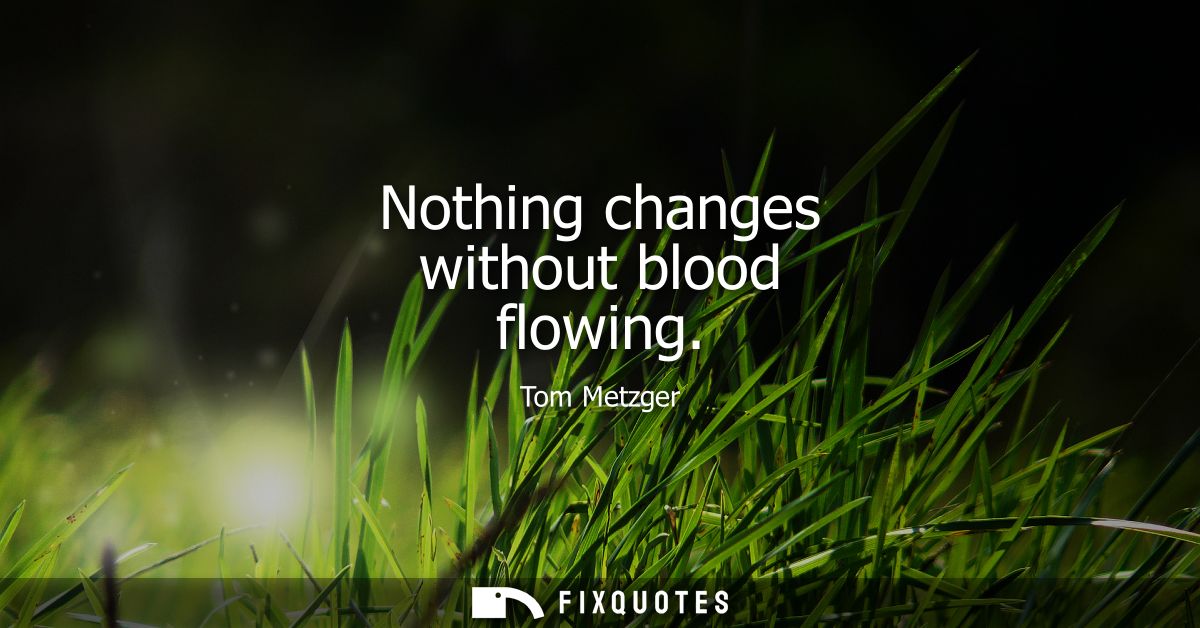
"Nothing changes without blood flowing"
About this Quote
"Nothing changes without blood flowing" is the kind of line that pretends to be a hard-nosed truth about history while quietly trying to make violence feel inevitable, even righteous. Its power comes from how it compresses a whole political program into a faux observation: not an argument for bloodshed, just a shrugging description of how the world supposedly works. That rhetorical dodge matters. If violence is framed as natural law, then anyone urging restraint looks naive, and anyone urging escalation can pose as a realist.
The phrasing is absolutist and antiseptic. "Nothing" and "without" slam the door on alternatives like organizing, voting, persuasion, labor action, or coalition-building. "Blood flowing" is passive and almost hygienic: no subject, no perpetrator, no accountability. Blood just happens to flow. That grammatical choice launders responsibility and makes the listener focus on outcomes rather than victims.
Context sharpens the intent. Tom Metzger is associated with extremist politics, and in that ecosystem, this line functions less as a historical insight than as recruitment copy. It romanticizes conflict, signals toughness, and offers a simple emotional bargain: your frustration is justified, and the brutal solution is not only permissible but necessary. It also works as a pressure tactic inside a movement, nudging wavering sympathizers toward radicalization by implying that change without violence is cowardice or delusion.
The subtext is an ultimatum dressed up as wisdom: accept blood, or accept stagnation. That’s not realism. It’s persuasion by fatalism.
The phrasing is absolutist and antiseptic. "Nothing" and "without" slam the door on alternatives like organizing, voting, persuasion, labor action, or coalition-building. "Blood flowing" is passive and almost hygienic: no subject, no perpetrator, no accountability. Blood just happens to flow. That grammatical choice launders responsibility and makes the listener focus on outcomes rather than victims.
Context sharpens the intent. Tom Metzger is associated with extremist politics, and in that ecosystem, this line functions less as a historical insight than as recruitment copy. It romanticizes conflict, signals toughness, and offers a simple emotional bargain: your frustration is justified, and the brutal solution is not only permissible but necessary. It also works as a pressure tactic inside a movement, nudging wavering sympathizers toward radicalization by implying that change without violence is cowardice or delusion.
The subtext is an ultimatum dressed up as wisdom: accept blood, or accept stagnation. That’s not realism. It’s persuasion by fatalism.
Quote Details
| Topic | War |
|---|---|
| Source | Help us find the source |
| Cite |
Citation Formats
APA Style (7th ed.)
Metzger, Tom. (2026, January 16). Nothing changes without blood flowing. FixQuotes. https://fixquotes.com/quotes/nothing-changes-without-blood-flowing-117145/
Chicago Style
Metzger, Tom. "Nothing changes without blood flowing." FixQuotes. January 16, 2026. https://fixquotes.com/quotes/nothing-changes-without-blood-flowing-117145/.
MLA Style (9th ed.)
"Nothing changes without blood flowing." FixQuotes, 16 Jan. 2026, https://fixquotes.com/quotes/nothing-changes-without-blood-flowing-117145/. Accessed 28 Mar. 2026.
More Quotes by Tom
Add to List