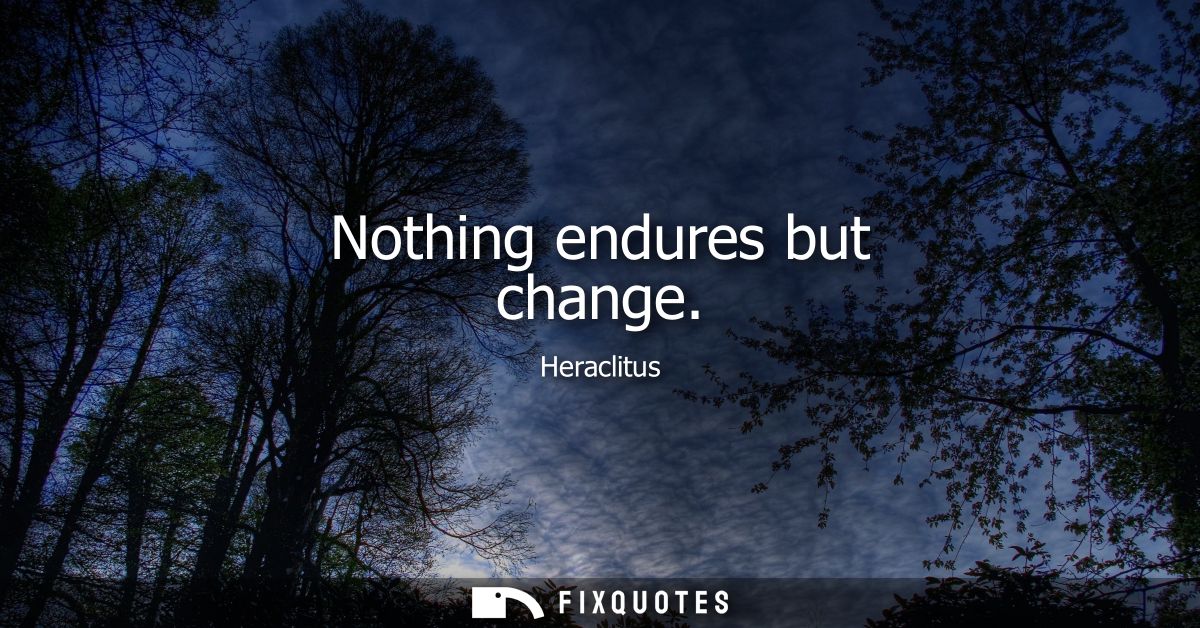
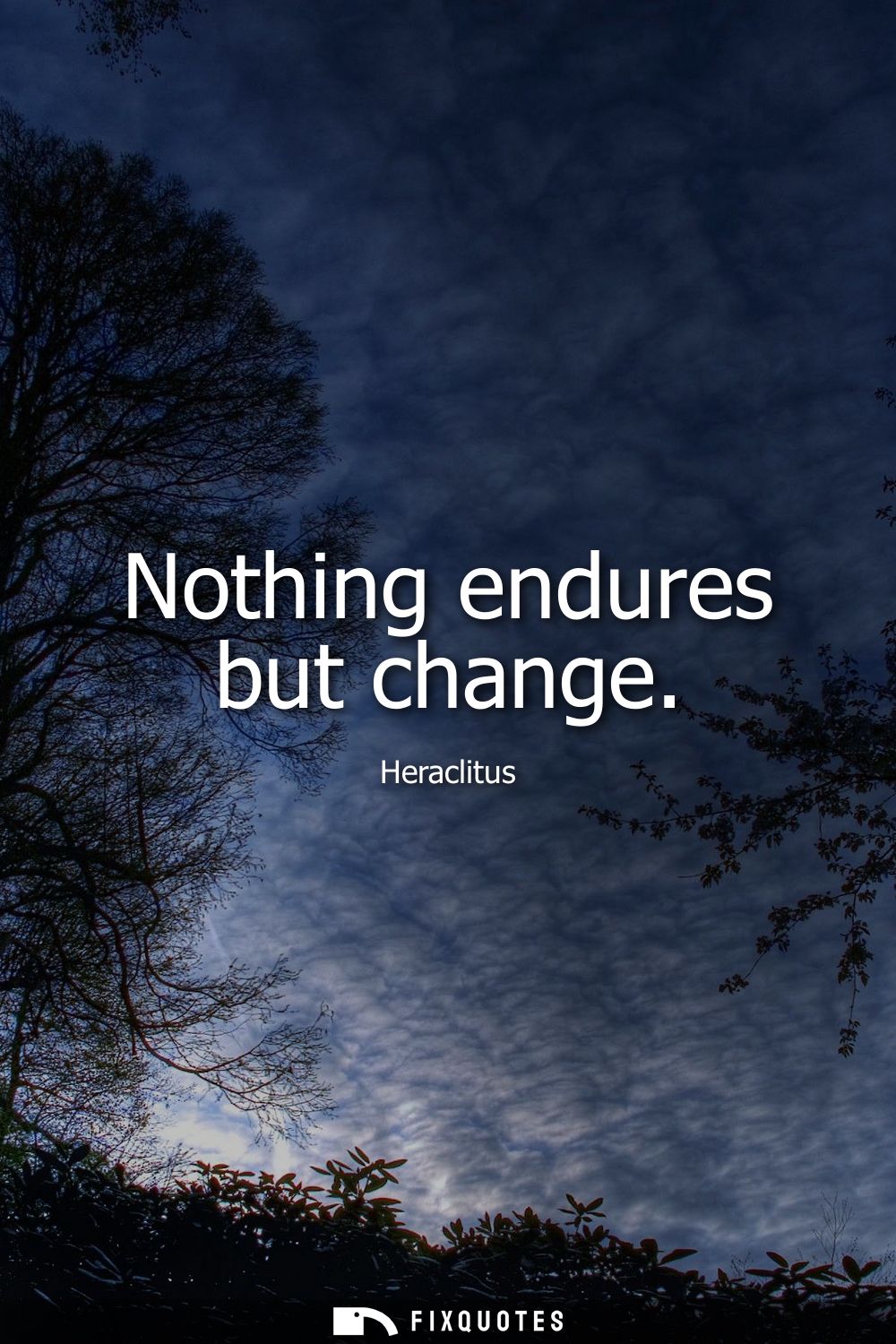
"Nothing endures but change"
About this Quote
A pre-Socratic grenade in six words, "Nothing endures but change" refuses the comfort most philosophies quietly offer: that beneath the mess there is a stable floor. Heraclitus is writing at a moment when Greek thinkers are trying to name what reality is made of and, just as crucially, what makes it intelligible. Plenty of rivals went looking for permanence (an unchanging substance, an ultimate principle you can hang your certainty on). Heraclitus pivots hard the other way: the world is not a thing but a process.
The line works because it sounds like reassurance while behaving like a threat. "Endures" usually points to what can be trusted; Heraclitus attaches it to the very force that dissolves trust. The subtext is almost moral: stop bargaining with time. If you build your identity, politics, or metaphysics around what must stay the same, you're not being traditional, you're being unrealistic.
Context matters: the Greek city-states are dynamic, competitive, and volatile; trade expands; law and custom are visibly human-made rather than divinely fixed. Heraclitus turns that lived instability into ontology. Change isn't merely what happens in the world; it is what the world is. That claim also smuggles in his deeper idea of logos, an order you don't find by freezing reality but by tracking its patterns of transformation.
As a piece of rhetoric, the aphorism is designed to haunt. It doesn't offer a program, it offers a posture: wisdom as the ability to live inside flux without begging it to stop.
The line works because it sounds like reassurance while behaving like a threat. "Endures" usually points to what can be trusted; Heraclitus attaches it to the very force that dissolves trust. The subtext is almost moral: stop bargaining with time. If you build your identity, politics, or metaphysics around what must stay the same, you're not being traditional, you're being unrealistic.
Context matters: the Greek city-states are dynamic, competitive, and volatile; trade expands; law and custom are visibly human-made rather than divinely fixed. Heraclitus turns that lived instability into ontology. Change isn't merely what happens in the world; it is what the world is. That claim also smuggles in his deeper idea of logos, an order you don't find by freezing reality but by tracking its patterns of transformation.
As a piece of rhetoric, the aphorism is designed to haunt. It doesn't offer a program, it offers a posture: wisdom as the ability to live inside flux without begging it to stop.
Quote Details
| Topic | Change |
|---|
More Quotes by Heraclitus
Add to List