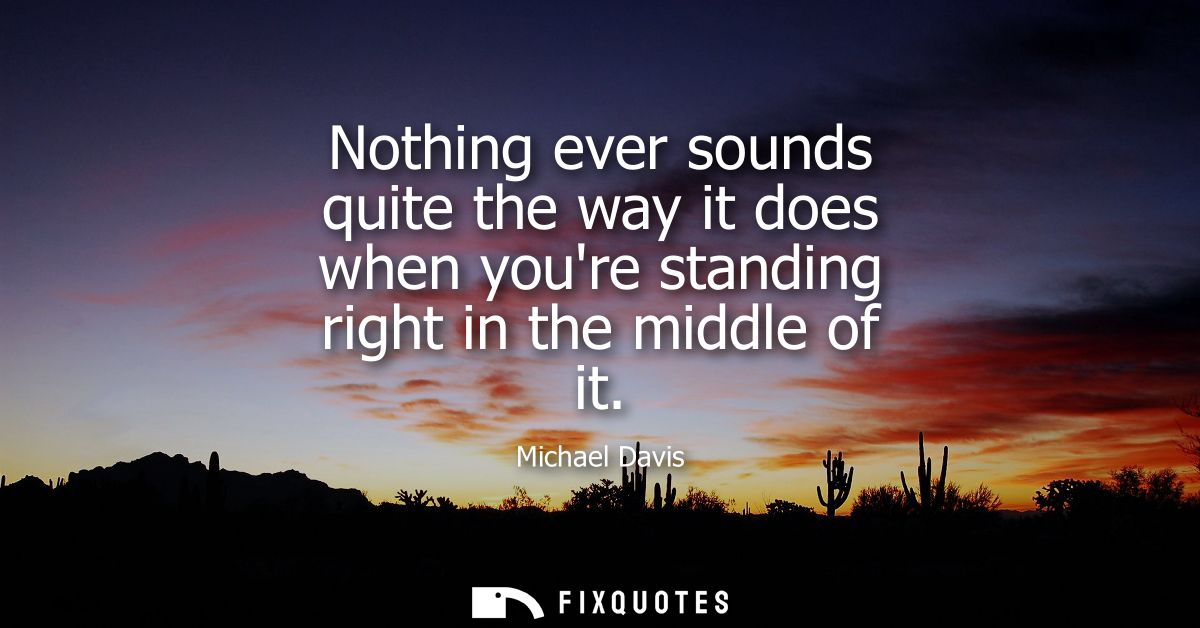
"Nothing ever sounds quite the way it does when you're standing right in the middle of it"
About this Quote
The intent reads as both caution and comfort. Caution, because people routinely confuse proximity with clarity: we assume the closest witness has the truest account, when closeness often produces the messiest one. Comfort, because it grants permission to be confused while living through something. If life doesn’t “sound right” mid-crisis, that may be the point; perspective is partly an exit strategy.
Subtextually, Davis is talking about mediation and memory. The “quite” does a lot of work, implying that the sound will later resolve into something more coherent - edited by distance, retold into something shareable. It’s also an argument about power: institutions, commentators, and even friends on the outside can make events “sound” simpler than they are for the people trapped inside them.
Context could be war reporting, family drama, grief, political upheaval, any scenario where reality is loudest and least legible up close. The line lands because it resists the moral of immediacy; it insists that understanding often arrives after the volume drops.
Quote Details
| Topic | Live in the Moment |
|---|---|
| Source | Help us find the source |
| Cite |
Citation Formats
APA Style (7th ed.)
Davis, Michael. (2026, January 16). Nothing ever sounds quite the way it does when you're standing right in the middle of it. FixQuotes. https://fixquotes.com/quotes/nothing-ever-sounds-quite-the-way-it-does-when-108401/
Chicago Style
Davis, Michael. "Nothing ever sounds quite the way it does when you're standing right in the middle of it." FixQuotes. January 16, 2026. https://fixquotes.com/quotes/nothing-ever-sounds-quite-the-way-it-does-when-108401/.
MLA Style (9th ed.)
"Nothing ever sounds quite the way it does when you're standing right in the middle of it." FixQuotes, 16 Jan. 2026, https://fixquotes.com/quotes/nothing-ever-sounds-quite-the-way-it-does-when-108401/. Accessed 29 Mar. 2026.