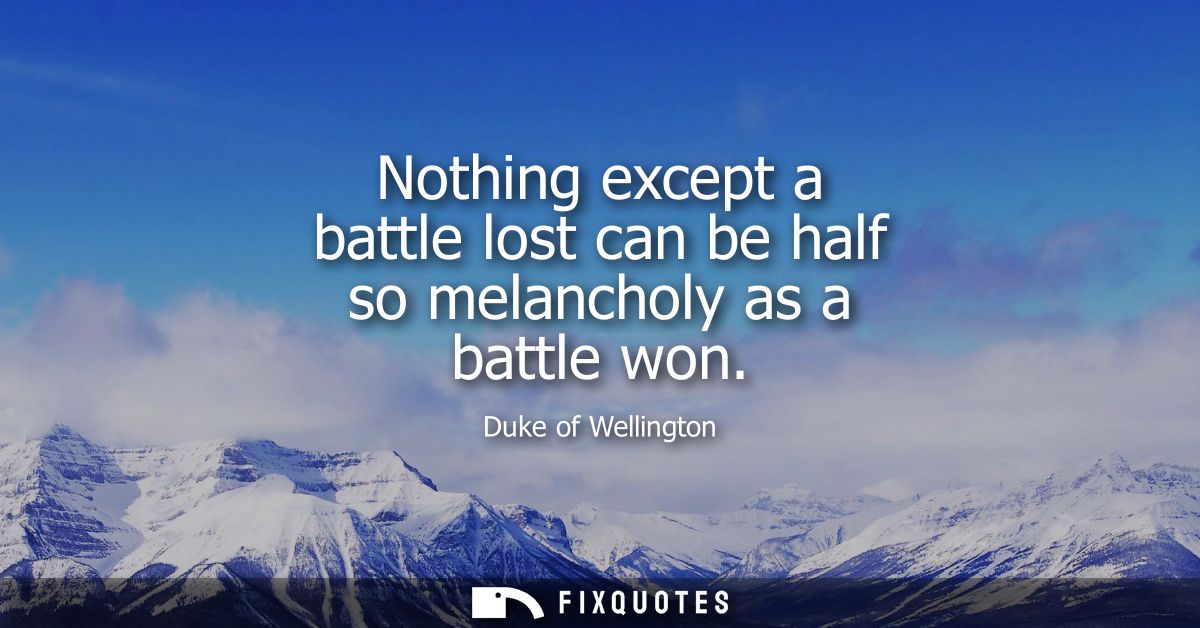
"Nothing except a battle lost can be half so melancholy as a battle won"
About this Quote
The intent is both personal and political. Personally, it reads like a commander admitting what official dispatches can’t: the post-battle quiet is not relief but reckoning. Politically, it’s a corrective to the era’s romantic militarism, the kind of public hunger that turns war into pageantry and commanders into icons. Wellington refuses the clean narrative arc. He offers a paradox that forces the listener to feel the moral hangover of success.
The subtext is leadership stripped of swagger. A lost battle is obviously tragic; a won battle is supposed to be redemptive. Wellington insists that competence doesn’t soften consequence. If anything, winning can sharpen responsibility: you ordered the advance, you got the result, and now you must live with the human invoice. In a Britain that would later remember Waterloo as national myth, his melancholy reads almost like preemptive resistance to propaganda.
Context matters: the Napoleonic Wars were industrializing violence while society still spoke the language of honor. Wellington’s line bridges that gap, warning that modern victory is rarely pure, and that the most serious leaders don’t confuse success with innocence.
Quote Details
| Topic | War |
|---|---|
| Source | Later attribution: Arthur Wellesley, 1st Duke of Wellington (Duke of Wellington) modern compilation
Evidence: lieve me nothing except a battle lost can be half so melancholy as a battle won the bra Other candidates (1) Familiar short sayings of great men, with notes by S.A. Bent (Familiar short sayings, 1887) compilation95.0% ... DUKE OF WELLINGTON . [ Arthur Wellesley ; born in Ireland , May 1 , 1769 ... Duke of Wellington and sent as ambas... |
| Cite |
Citation Formats
APA Style (7th ed.)
Wellington, Duke of. (2026, January 14). Nothing except a battle lost can be half so melancholy as a battle won. FixQuotes. https://fixquotes.com/quotes/nothing-except-a-battle-lost-can-be-half-so-17305/
Chicago Style
Wellington, Duke of. "Nothing except a battle lost can be half so melancholy as a battle won." FixQuotes. January 14, 2026. https://fixquotes.com/quotes/nothing-except-a-battle-lost-can-be-half-so-17305/.
MLA Style (9th ed.)
"Nothing except a battle lost can be half so melancholy as a battle won." FixQuotes, 14 Jan. 2026, https://fixquotes.com/quotes/nothing-except-a-battle-lost-can-be-half-so-17305/. Accessed 5 Mar. 2026.