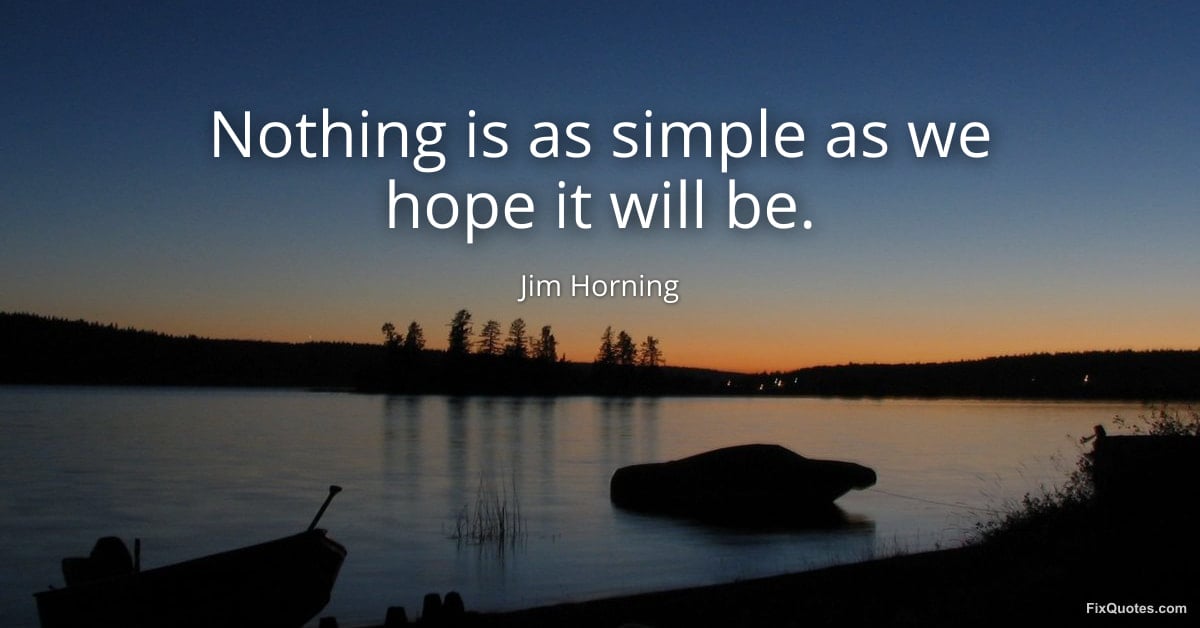
"Nothing is as simple as we hope it will be"
About this Quote
“Nothing is as simple as we hope it will be” lands with the dry sting of lab-bench realism. Horning, writing from a scientist’s posture, isn’t selling pessimism so much as puncturing a very human fantasy: that the world will eventually yield to clean explanations if we just think hard enough. The line works because it frames simplicity not as a property of reality, but as a desire we bring to reality. “Hope” is the tell. We don’t merely expect simplicity; we emotionally invest in it, and that investment quietly distorts how we plan, measure, and interpret.
The intent feels twofold: a warning and a coping mechanism. As warning, it nudges readers away from magical thinking in engineering, research, and policy: models have edge cases; systems have feedback loops; “just” is the most dangerous word in any proposal. As coping mechanism, it normalizes friction. When experiments fail, software breaks, or data refuses to behave, the quote offers a kind of permission slip: the difficulty isn’t proof you’re incompetent; it’s the baseline condition of complex systems.
Subtextually, Horning is also critiquing narratives of mastery. Modern culture loves the myth of the elegant solution and the lone genius; science, in practice, is mostly an extended negotiation with messiness, uncertainty, and unintended consequences. The context is the everyday grind of technical work, where each answer spawns new questions and every simplification comes with a price tag. The sentence is short because the lesson takes a career to learn.
The intent feels twofold: a warning and a coping mechanism. As warning, it nudges readers away from magical thinking in engineering, research, and policy: models have edge cases; systems have feedback loops; “just” is the most dangerous word in any proposal. As coping mechanism, it normalizes friction. When experiments fail, software breaks, or data refuses to behave, the quote offers a kind of permission slip: the difficulty isn’t proof you’re incompetent; it’s the baseline condition of complex systems.
Subtextually, Horning is also critiquing narratives of mastery. Modern culture loves the myth of the elegant solution and the lone genius; science, in practice, is mostly an extended negotiation with messiness, uncertainty, and unintended consequences. The context is the everyday grind of technical work, where each answer spawns new questions and every simplification comes with a price tag. The sentence is short because the lesson takes a career to learn.
Quote Details
| Topic | Wisdom |
|---|---|
| Source | Help us find the source |
| Cite |
Citation Formats
APA Style (7th ed.)
Horning, Jim. (2026, January 16). Nothing is as simple as we hope it will be. FixQuotes. https://fixquotes.com/quotes/nothing-is-as-simple-as-we-hope-it-will-be-125093/
Chicago Style
Horning, Jim. "Nothing is as simple as we hope it will be." FixQuotes. January 16, 2026. https://fixquotes.com/quotes/nothing-is-as-simple-as-we-hope-it-will-be-125093/.
MLA Style (9th ed.)
"Nothing is as simple as we hope it will be." FixQuotes, 16 Jan. 2026, https://fixquotes.com/quotes/nothing-is-as-simple-as-we-hope-it-will-be-125093/. Accessed 12 Feb. 2026.
More Quotes by Jim
Add to List