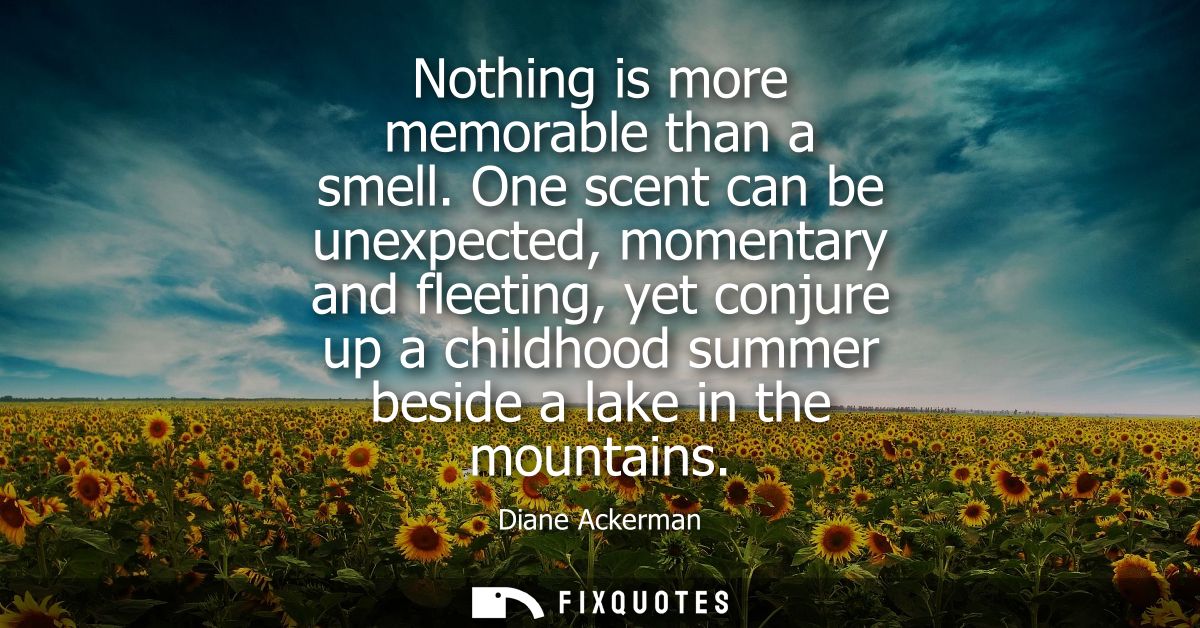
"Nothing is more memorable than a smell. One scent can be unexpected, momentary and fleeting, yet conjure up a childhood summer beside a lake in the mountains"
About this Quote
Her sentence structure mirrors the phenomenon. The triad “unexpected, momentary and fleeting” moves fast, almost evasive, then the line opens into a long, specific tableau: “a childhood summer beside a lake in the mountains.” That pivot is the trick. The sensory trigger is small and vanishing; the world it unlocks is expansive and immersive. Subtext: what we call the past isn’t primarily an archive of facts, it’s a stash of bodily impressions waiting to be reactivated.
There’s also a gentle rebuke to our image-dominated era. Photos flatten time into surfaces; scent restores volume. It can resurrect not only what happened but how it felt to be there, including the parts you didn’t know you were recording: sunscreen, pine resin, damp rocks, the cold metallic edge of lake water.
Context matters: Ackerman’s work often treats the senses as intellectual portals, not indulgences. Here, she frames smell as an almost involuntary form of truth-telling, a reminder that our most durable memories are less curated than ambushed.
Quote Details
| Topic | Nostalgia |
|---|---|
| Source | Diane Ackerman, A Natural History of the Senses (1990) — contains the line: "Nothing is more memorable than a smell. One scent can be unexpected, momentary and fleeting, yet conjure up a childhood summer beside a lake in the mountains." |
| Cite |
Citation Formats
APA Style (7th ed.)
Ackerman, Diane. (2026, January 15). Nothing is more memorable than a smell. One scent can be unexpected, momentary and fleeting, yet conjure up a childhood summer beside a lake in the mountains. FixQuotes. https://fixquotes.com/quotes/nothing-is-more-memorable-than-a-smell-one-scent-126151/
Chicago Style
Ackerman, Diane. "Nothing is more memorable than a smell. One scent can be unexpected, momentary and fleeting, yet conjure up a childhood summer beside a lake in the mountains." FixQuotes. January 15, 2026. https://fixquotes.com/quotes/nothing-is-more-memorable-than-a-smell-one-scent-126151/.
MLA Style (9th ed.)
"Nothing is more memorable than a smell. One scent can be unexpected, momentary and fleeting, yet conjure up a childhood summer beside a lake in the mountains." FixQuotes, 15 Jan. 2026, https://fixquotes.com/quotes/nothing-is-more-memorable-than-a-smell-one-scent-126151/. Accessed 14 Feb. 2026.