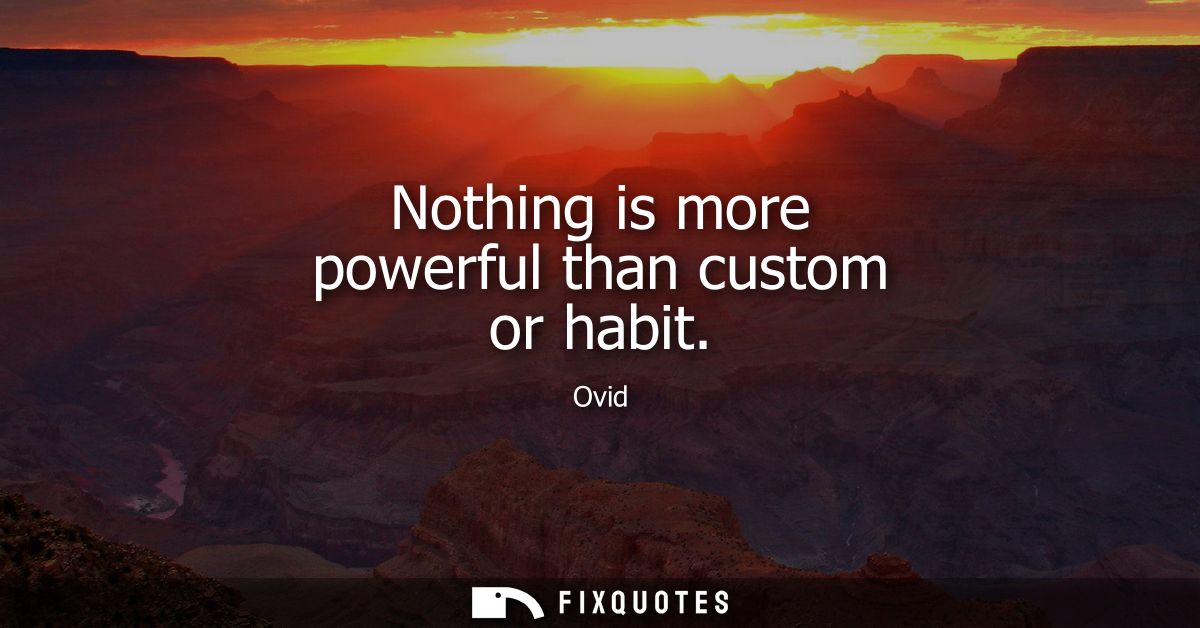
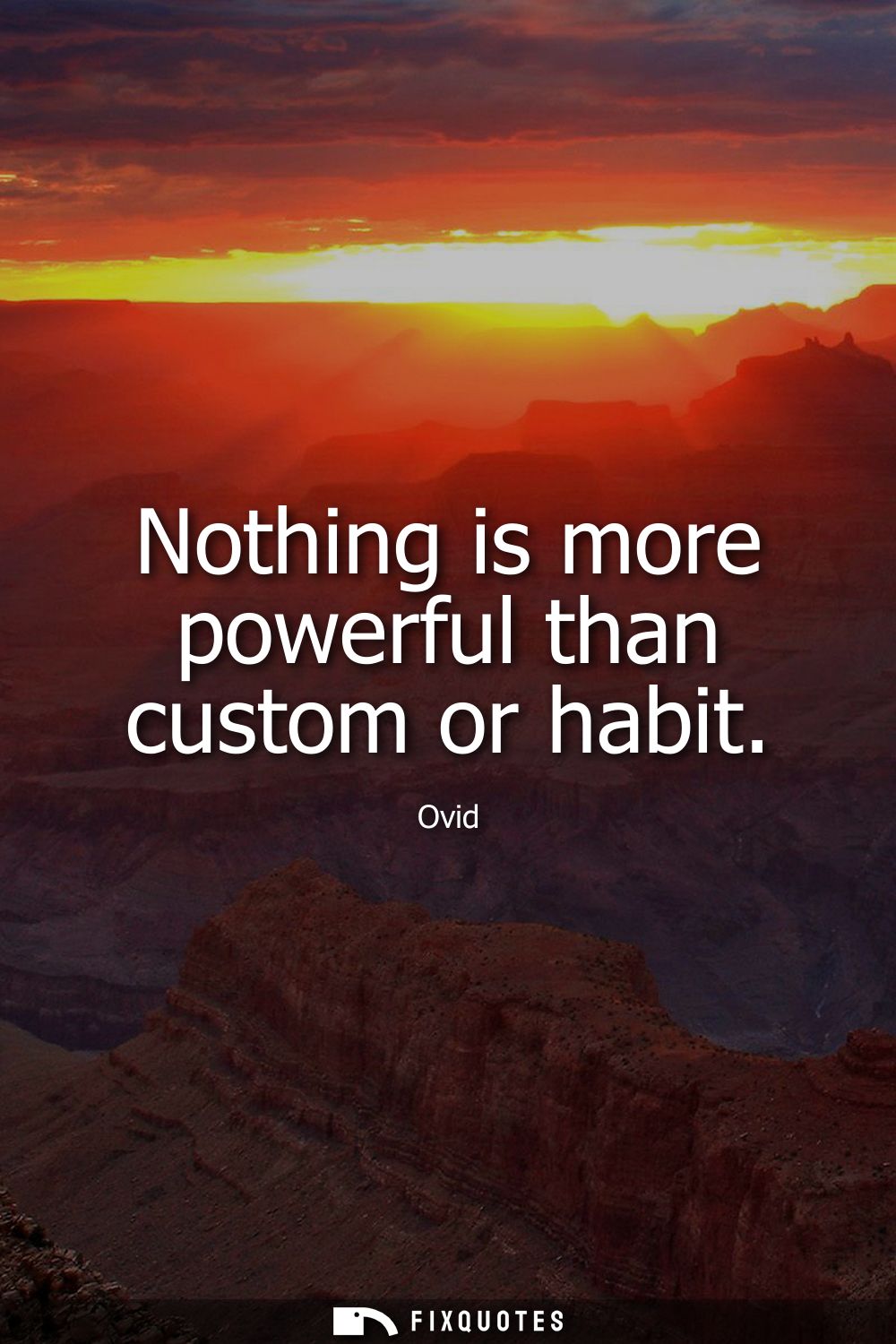
"Nothing is more powerful than custom or habit"
About this Quote
Custom is Ovid's quiet superpower: an invisible force that outmuscles laws, vows, even desire. Coming from a poet who made his career narrating transformations, it's telling that he points not to gods or fate but to repetition. Habit is the human engine of metamorphosis - not dramatic lightning strikes, but the slow, daily pressure that turns the shocking into the normal.
The intent lands as both warning and explanation. Ovid isn't praising discipline in a self-help way; he's diagnosing how people get domesticated by their own routines. "Nothing is more powerful" is an absolutist claim that dares you to test it. Try to stop doing the thing you do automatically - the social performance, the private vice, the politically convenient silence - and you feel the grip. Custom is power precisely because it doesn't announce itself as power. It arrives disguised as "common sense", "the way things are", the default setting of a culture.
Context matters. Ovid wrote at the hinge point of the Roman Republic becoming empire, when Augustus was attempting to legislate morality and stabilize society through public norms. In that environment, habit isn't just personal; it's civic infrastructure. The line carries a sly, almost subversive edge: if you want to reform a people, sermons won't do it. Change what they rehearse. Control the rituals, the incentives, the daily scripts, and you control what feels natural.
Ovid's poetry often delights in the gap between what we think we choose and what we can't help repeating. This line exposes that gap with ruthless simplicity.
The intent lands as both warning and explanation. Ovid isn't praising discipline in a self-help way; he's diagnosing how people get domesticated by their own routines. "Nothing is more powerful" is an absolutist claim that dares you to test it. Try to stop doing the thing you do automatically - the social performance, the private vice, the politically convenient silence - and you feel the grip. Custom is power precisely because it doesn't announce itself as power. It arrives disguised as "common sense", "the way things are", the default setting of a culture.
Context matters. Ovid wrote at the hinge point of the Roman Republic becoming empire, when Augustus was attempting to legislate morality and stabilize society through public norms. In that environment, habit isn't just personal; it's civic infrastructure. The line carries a sly, almost subversive edge: if you want to reform a people, sermons won't do it. Change what they rehearse. Control the rituals, the incentives, the daily scripts, and you control what feels natural.
Ovid's poetry often delights in the gap between what we think we choose and what we can't help repeating. This line exposes that gap with ruthless simplicity.
Quote Details
| Topic | Habits |
|---|---|
| Source | Help us find the source |
| Cite |
Citation Formats
APA Style (7th ed.)
Ovid. (2026, January 17). Nothing is more powerful than custom or habit. FixQuotes. https://fixquotes.com/quotes/nothing-is-more-powerful-than-custom-or-habit-34550/
Chicago Style
Ovid. "Nothing is more powerful than custom or habit." FixQuotes. January 17, 2026. https://fixquotes.com/quotes/nothing-is-more-powerful-than-custom-or-habit-34550/.
MLA Style (9th ed.)
"Nothing is more powerful than custom or habit." FixQuotes, 17 Jan. 2026, https://fixquotes.com/quotes/nothing-is-more-powerful-than-custom-or-habit-34550/. Accessed 9 Mar. 2026.
More Quotes by Ovid
Add to List